
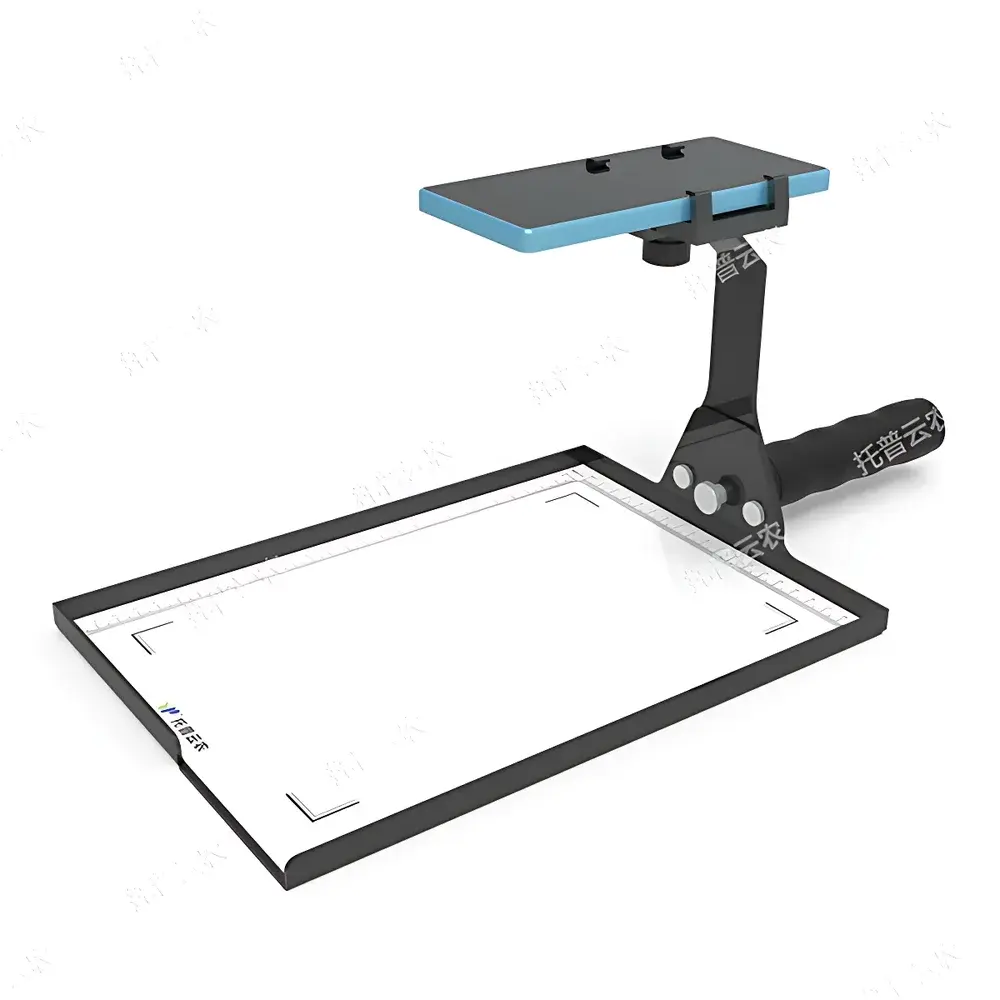
Top Cloud-agri TPTB-SC1.0 Portable Pest Capture and AI Identification System
| Brand | Top Cloud-agri |
|---|---|
| Origin | Zhejiang, China |
| Manufacturer Type | Direct Manufacturer |
| Product Origin | Domestic (China) |
| Model | TPTB-SC1.0 |
| Pricing | Available Upon Request |
Overview
The Top Cloud-agri TPTB-SC1.0 Portable Pest Capture and AI Identification System is a field-deployable integrated solution engineered for plant protection officers, agricultural extension technicians, and crop monitoring personnel conducting real-time entomological surveys in open-field, greenhouse, and orchard environments. Unlike conventional trapping devices—such as standard light traps or pheromone traps—the TPTB-SC1.0 adds on-device image acquisition, edge-based AI inference, and structured data output to transform passive insect capture into quantifiable, taxonomically annotated pest intelligence. The system operates on the principle of high-resolution digital imaging coupled with convolutional neural network (CNN)-based classification trained on geographically relevant agricultural pest datasets. It does not rely on morphological dissection or molecular analysis; instead, it leverages visual feature extraction from dorsal/ventral macro-images under controlled illumination to support rapid species-level discrimination among common phytophagous insects. Designed for interoperability, the unit functions independently or as an add-on module to existing non-intelligent monitoring infrastructure—including traditional blacklight traps, LED-based insecticidal lamps, or sticky-board systems—thereby extending the functional lifecycle of legacy equipment without hardware replacement.
Key Features
- Edge-AI Pest Classification: On-device inference engine processes captured images using a lightweight CNN architecture optimized for ARM-based embedded platforms; delivers species-level identification across >120 economically significant agricultural pests with ≥85% average precision under field lighting conditions.
- Integrated Imaging Module: Equipped with a 12-megapixel auto-focus camera, adjustable white-balance illumination, and anti-glare macro lens assembly to ensure consistent image quality across varying ambient light, humidity, and specimen size (0.5–25 mm body length).
- Field-Ready Ergonomics: Fully self-contained in a ruggedized, IP54-rated carry case with integrated battery (12 h operational runtime), USB-C power delivery, and quick-swap SD card storage—designed for single-operator deployment during multi-hour survey routes.
- Real-Time Data Visualization: Local touchscreen interface displays live image preview, confidence-scored identification results, temporal count trends, and spatial heatmaps synced via Bluetooth 5.0 to the companion mobile application.
- Extensible Taxonomic Framework: Preloaded entomological database includes morphological descriptors, host plant associations, phenological activity windows, regional distribution maps (aligned with China’s provincial agro-ecological zones), and IPM-aligned control recommendations compliant with GB/T 23726–2021 standards.
Sample Compatibility & Compliance
The TPTB-SC1.0 accepts specimens collected manually or via auxiliary trapping methods—including water pan traps, funnel traps, and adhesive cards—as long as specimens remain intact and unobscured by debris or excessive moisture. It supports identification of adult-stage Lepidoptera, Coleoptera, Hemiptera, Diptera, and Orthoptera commonly associated with rice, wheat, maize, cotton, tea, and fruit tree cultivation. While not certified for regulatory submission under ISO/IEC 17025 or FDA 21 CFR Part 11, the system logs all image captures, timestamps, GPS coordinates (via paired smartphone), and classification metadata in immutable .csv and .json formats suitable for internal QA/QC reporting, GLP-aligned field notebooks, and integration into national pest surveillance platforms such as China’s National Crop Pest Monitoring and Early Warning System (NCPEWS).
Software & Data Management
The proprietary TopCloud PestVision™ mobile application (iOS/Android) provides secure over-the-air firmware updates, cloud-synced database expansion, and export functionality for tabular reports (.xlsx), annotated image galleries (.zip), and time-series graphs (PNG/SVG). All image data remains locally stored unless explicitly uploaded; no raw biometric or location data is transmitted without explicit user consent. Audit trails record operator ID, session start/end time, device serial number, and model version—supporting traceability requirements in multi-team monitoring programs. Optional API access enables integration with farm management software (FMS) platforms and national agricultural data hubs adhering to AgGateway ADAPT or OGC SensorThings API specifications.
Applications
- Dynamic pest population mapping during seasonal scouting campaigns
- Validation and ground-truthing of remote-sensing or drone-based pest detection models
- Training and capacity building for county-level plant protection stations
- Longitudinal monitoring of invasive species establishment (e.g., Spodoptera frugiperda, Bemisia tabaci Q-biotype)
- Supporting evidence-based threshold-based intervention decisions in IPM protocols
- Generating standardized input for provincial pest forecasting bulletins issued by CAAS institutes
FAQ
Does the TPTB-SC1.0 require continuous internet connectivity to perform identification?
No. Core AI inference runs offline on the embedded processor; cloud connectivity is optional and only required for database updates or report synchronization.
Can the system identify larval or pupal stages?
Currently limited to morphologically distinct adult specimens; immature stages require manual verification or complementary lab-based diagnostics.
Is the insect database customizable for non-Chinese pest species?
Yes—custom model retraining services are available under NDA for regional adaptation, subject to minimum dataset requirements (≥500 verified images per target species).
What calibration or maintenance procedures are recommended?
Annual optical alignment verification and firmware validation are advised; no routine mechanical servicing is required due to solid-state imaging architecture.
How is data privacy handled for field-collected images?
All images are encrypted at rest using AES-256; metadata anonymization options are configurable prior to cloud upload in accordance with local data sovereignty regulations.
Related Products







