
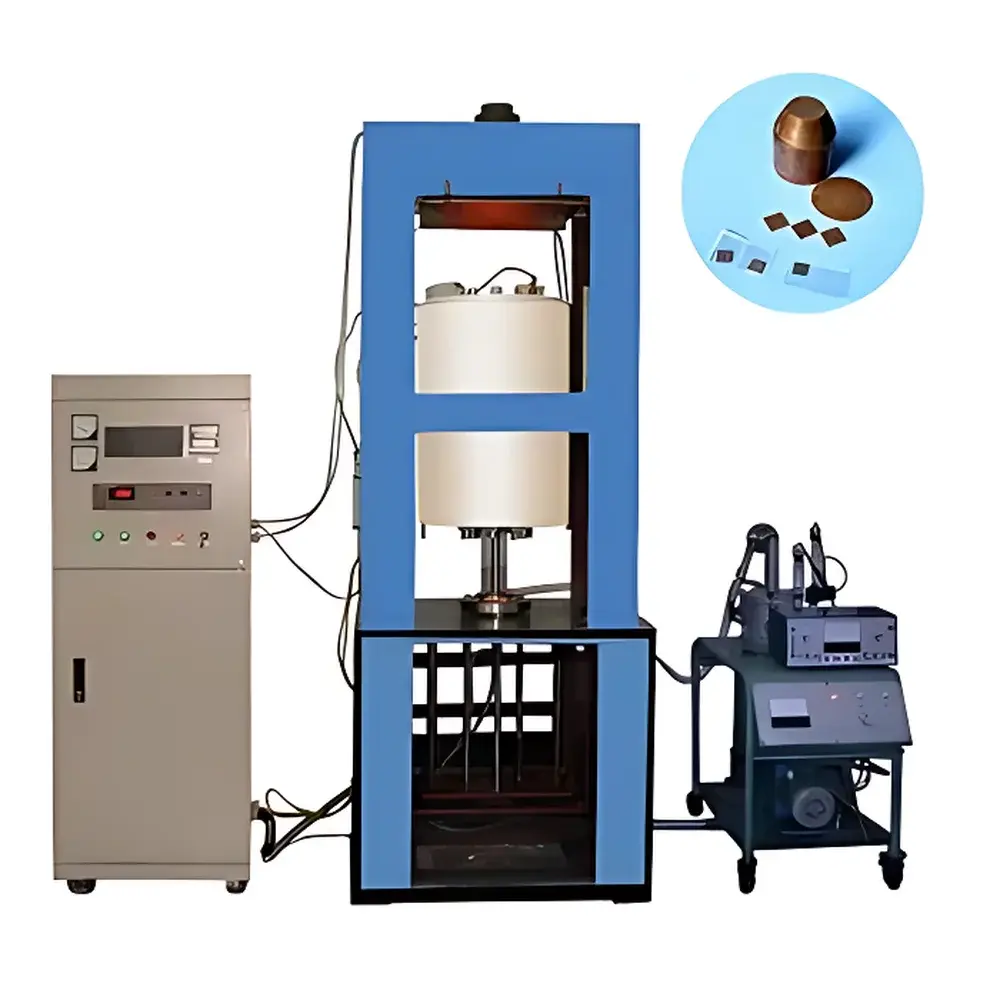
Metal Single Crystal Growth Furnace – Hefei Kejing Model BR-SCG
| Brand | Hefei Kejing |
|---|---|
| Origin | Anhui, China |
| Model | BR-SCG (Bridgman-type Single Crystal Growth Furnace) |
| Heating Method | Resistive Vertical Gradient Zone Melting |
| Max Operating Temperature | 1200 °C (standard configuration) |
| Temperature Uniformity | ±0.5 °C over 100 mm axial zone |
| Programmable Ramp Rate | 0.1–5 °C/min |
| Crucible Travel Speed | 0.01–2 mm/h (motorized precision vertical translation) |
| Chamber Atmosphere | High-purity inert gas (Ar/N₂) or vacuum (10⁻³ mbar base pressure) |
| Control System | PID + PLC with dual-loop thermal profiling |
| Compliance | CE-marked |
Overview
The Hefei Kejing BR-SCG is a vertically oriented, programmable Bridgman-type single crystal growth furnace engineered for reproducible synthesis of high-purity metallic and ionic single crystals via the vertical gradient freeze (VGF) and controlled crucible descent method. Based on the classical Bridgman–Stockbarger principle, the system establishes a stable axial temperature gradient across a sealed crucible—typically graphite, tungsten, or quartz—containing polycrystalline feedstock. The furnace maintains a narrow molten zone slightly above the material’s equilibrium melting point while precisely translating the crucible downward at sub-millimeter-per-hour rates. Solidification initiates at the cooled tip of the crucible and progresses unidirectionally upward, enabling low-defect, orientation-controlled crystal growth with minimized constitutional supercooling and segregation. This architecture is particularly suited for metals (e.g., Ni, Co, Fe-based alloys), intermetallics, and halide/fluoride compounds (e.g., NaCl, KF, CsI, BaF₂), where stoichiometric fidelity and lattice perfection are critical for X-ray optics, neutron scattering targets, and fundamental solid-state physics research.
Key Features
- Vertical double-zone resistive heating system with independent upper (melt zone) and lower (annealing/cooling zone) temperature control, enabling precise thermal profile shaping and steep axial gradients (up to 30 °C/cm)
- Motor-driven crucible translation stage with closed-loop position feedback, offering repeatable descent speeds from 0.01 to 2 mm/h and positional resolution of ±1 µm
- High-stability PID+PLC controller with 16-segment programmable ramp-soak profiles, real-time thermocouple logging (Type C or S, ±0.25 °C accuracy), and automatic fault detection
- Water-cooled stainless-steel chamber with integrated gas purge ports and optional turbomolecular pumping system for operation under high-purity argon (99.999%), nitrogen, or dynamic vacuum (10⁻³ mbar)
- Modular crucible support assembly compatible with diameters from 12 to 50 mm and lengths up to 300 mm; configurable with insulating felt, radiation shields, and seed rod holders
- CE-compliant electrical architecture with reinforced insulation, overtemperature cut-off, and emergency stop circuit meeting IEC 60204-1 safety requirements
Sample Compatibility & Compliance
The BR-SCG supports growth of metallic systems—including transition metal single crystals (Ni, Cu, Al, Ti alloys), rare-earth intermetallics (e.g., YCo₅, GdFe₂), and alkali/alkaline-earth halides (LiF, NaI, CaF₂) and fluorides (BaF₂, SrF₂). All crucible materials (graphite, W, Mo, Pt, fused silica) are selected per chemical compatibility and vapor pressure constraints at operational temperatures. The system conforms to ISO/IEC 17025-relevant environmental controls for metrology-grade crystal synthesis and supports GLP documentation workflows. Optional traceable calibration certificates (NIST-traceable thermocouples, furnace mapping reports) are available upon request.
Software & Data Management
The integrated control interface runs on Windows-based HMI software with local data logging (CSV export), real-time graphing of thermocouple channels and position feedback, and password-protected user profiles. Audit trails record all parameter changes, start/stop events, and alarm conditions—fully compliant with FDA 21 CFR Part 11 requirements when deployed with electronic signature modules. Remote monitoring via Ethernet (Modbus TCP) enables integration into centralized lab management platforms without proprietary drivers.
Applications
- Growth of orientation-defined single crystals for synchrotron X-ray monochromators and neutron diffraction substrates
- Preparation of high-purity reference materials for compositional analysis (EPMA, SIMS, LA-ICP-MS)
- Investigation of solidification kinetics, phase equilibria, and defect formation in binary and ternary metallic systems
- Production of scintillation-grade halide crystals for radiation detection applications
- Teaching and methodology development in advanced materials synthesis laboratories
FAQ
What crystal orientations can be achieved using the BR-SCG?
The system supports both seeded and unseeded growth; with proper seed alignment fixtures, [100], [110], and [111] orientations are routinely obtained for cubic metals and halides.
Is vacuum capability standard or optional?
Base configuration includes inert gas purging; high-vacuum operation (10⁻³ mbar) requires optional turbomolecular pump package and all-metal seals.
Can the furnace accommodate custom crucible geometries?
Yes—modular support rails and adjustable clamping allow integration of user-supplied crucibles up to 50 mm OD and 300 mm length, subject to thermal and mechanical validation.
Does Hefei Kejing provide application support beyond equipment supply?
Yes—comprehensive on-site or remote technical training on Bridgman process optimization, thermal profiling, and post-growth annealing protocols is included at no additional cost.
Are calibration and qualification documents provided?
Factory-assembled temperature uniformity maps, thermocouple calibration certificates (ISO/IEC 17025 accredited labs), and IQ/OQ documentation templates are supplied with each unit.



