
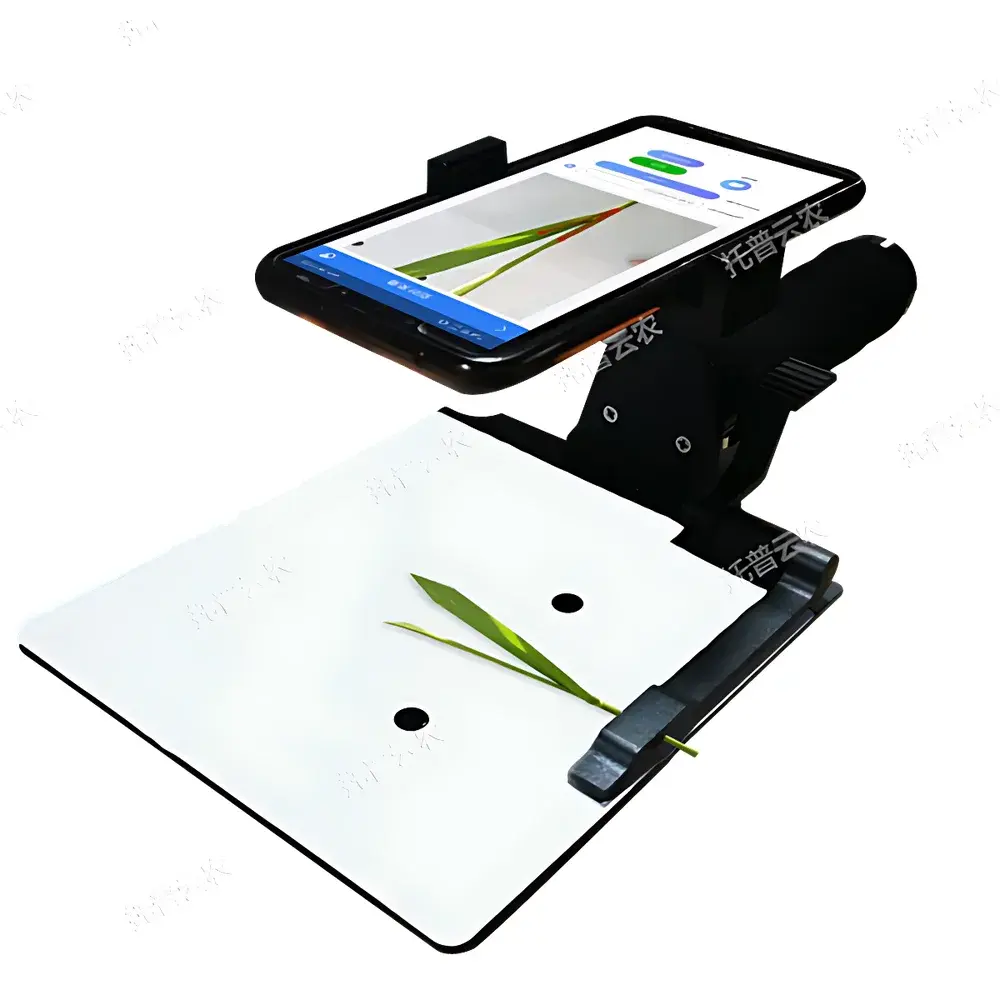
Top Cloud-agri TPZW-J-1 Handheld Crop Angle & Stem Diameter Measurement System
| Brand | Top Cloud-agri |
|---|---|
| Origin | Zhejiang, China |
| Manufacturer Type | Direct Manufacturer |
| Country of Origin | China |
| Model | TPZW-J-1 |
| Price | Upon Request |
| Dimensions | 307 × 140 × 80 mm |
| Background Material | White Matte PVC Waterproof Paper |
| Base Plate Material | Black Double-Sided Fine-Frosted Acrylic |
| Angle Measurement Range | 0–180° |
| Stem Diameter Range | 0–52 mm |
| Angular Accuracy | ≤ ±1° |
| Diameter Accuracy | ≤ ±1 mm |
| Image Resolution | 2400 × 1080 |
| Display | Color Touchscreen (Android OS) |
| Camera | 64 MP |
| Battery Capacity | 4500 mAh (≥8 h operational life) |
| Included Components | Background Fixture (1 pc), Main Measurement Unit (1 pc), Charger (1 pc) |
Overview
The Top Cloud-agri TPZW-J-1 Handheld Crop Angle & Stem Diameter Measurement System is an engineered field-deployable phenotyping instrument designed for rapid, non-destructive quantification of two critical morphological traits in cereal and brassica crops: leaf–stem insertion angle (commonly referred to as “crop angle”) and stem diameter. It operates on a calibrated image-based measurement principle—leveraging high-resolution digital imaging, fixed-distance optical geometry, and real-time edge-detection algorithms—to extract geometric parameters from standardized side-view photographs. Unlike traditional caliper- or goniometer-based manual methods, the TPZW-J-1 eliminates operator-induced variability by enforcing consistent imaging conditions: a rigid mechanical fixture ensures repeatable sample positioning, while integrated white-balance auto-correction compensates for ambient lighting fluctuations. The system is purpose-built for both in situ (live-plant) and ex situ (detached tiller/stem) measurements, supporting high-throughput phenotyping workflows in breeding programs, agronomic trials, and physiological studies where canopy architecture and structural robustness are key selection criteria.
Key Features
- Handheld, lightweight form factor (307 × 140 × 80 mm) optimized for extended field use and indoor lab deployment.
- Integrated Android-based touchscreen interface with 64-megapixel camera and 2400 × 1080 display resolution for real-time visual feedback and on-device analysis.
- Fixed-distance imaging configuration via mechanical coupling between smartphone mount and rotating stem clamp—ensuring angular reproducibility across repeated measurements.
- One-touch capture with sub-3-second processing latency; supports batch post-capture analysis for offline operation in low-connectivity environments.
- Touch-enabled manual correction layer for precise edge refinement—critical for heterogeneous stem surfaces or overlapping leaf structures.
- Dual-purpose mechanical fixture: black frosted acrylic base plate provides high-contrast background anchoring, while white matte PVC backdrop minimizes specular reflection and enables reliable threshold-based segmentation.
- Environmental resilience: no external shading required; automatic white balance and exposure adaptation maintain measurement fidelity under variable solar irradiance, cloud cover, or artificial indoor lighting.
- Onboard battery (4500 mAh) sustains ≥8 hours of continuous operation—sufficient for full-day multi-plot field surveys without recharging.
Sample Compatibility & Compliance
The TPZW-J-1 is validated for quantitative trait measurement in staple row crops including Oryza sativa (rice), Triticum aestivum (bread wheat), and Brassica napus (oilseed rape). Its 0–52 mm stem diameter range accommodates vegetative-stage tillers through reproductive-phase culms, while the 0–180° angular range covers erect, semi-erect, and prostrate growth architectures. All hardware components comply with IEC 60529 IP54-rated ingress protection standards for dust and water resistance during outdoor operation. Data output conforms to FAO Crop Ontology (CO) and MIAPPE v1.1 metadata standards for plant phenotyping data exchange. While not certified for GLP/GMP-regulated environments, the system supports audit-ready data provenance via timestamped image capture, embedded GPS coordinates (when enabled), and immutable EXCEL export with traceable revision history.
Software & Data Management
The embedded Android application generates structured datasets containing ISO 8601 timestamps, geotagged JPEG images, numerical angle (degrees) and stem diameter (mm) values, and user-annotated trial identifiers. Results are stored locally in SQLite format and exportable to .XLSX with column headers aligned to Plant Phenotyping Ontology (PPO) terms. Exported files retain original image thumbnails and support drag-and-drop integration into common statistical platforms (R, Python pandas, JMP). The software implements local-only data storage by default—no telemetry or cloud synchronization unless explicitly enabled by the user. All exported reports include version-stamped firmware identification and calibration log references for traceability in longitudinal studies.
Applications
- High-throughput screening of lodging resistance traits in early-generation wheat and rice breeding populations.
- Phenotypic validation of QTLs or CRISPR-edited alleles associated with canopy architecture modulation.
- Time-series monitoring of stem thickening dynamics under drought, nitrogen limitation, or PGR treatment regimes.
- Field-based validation of 3D reconstruction models derived from UAV or ground-based LiDAR scans.
- Educational use in plant morphology labs for teaching quantitative trait analysis and digital phenotyping fundamentals.
FAQ
What crop species are officially supported for angle measurement?
Rice (Oryza sativa), wheat (Triticum aestivum), and oilseed rape (Brassica napus) have been empirically validated. Other monocots and dicots may be measured, but accuracy should be verified against reference caliper/goniometer readings.
Does the system require internet connectivity to function?
No. All image capture, processing, and data export occur offline. Internet access is only needed for optional firmware updates or cloud-based data backup.
Can measurements be performed on plants growing in soil or hydroponic systems?
Yes. The device supports both intact field-grown plants and excised stems—provided the stem section is placed flat against the base plate with unobstructed lateral view.
How is measurement repeatability ensured across operators?
Mechanical constraints (fixed camera-to-sample distance, rotational axis alignment, and background contrast standardization) minimize inter-operator variance. Calibration verification using a physical 90° reference wedge is recommended before each daily session.
Is raw image data retained after analysis?
Yes. Every captured image is archived alongside its processed result and remains accessible for re-analysis or third-party validation.
Related Products



