
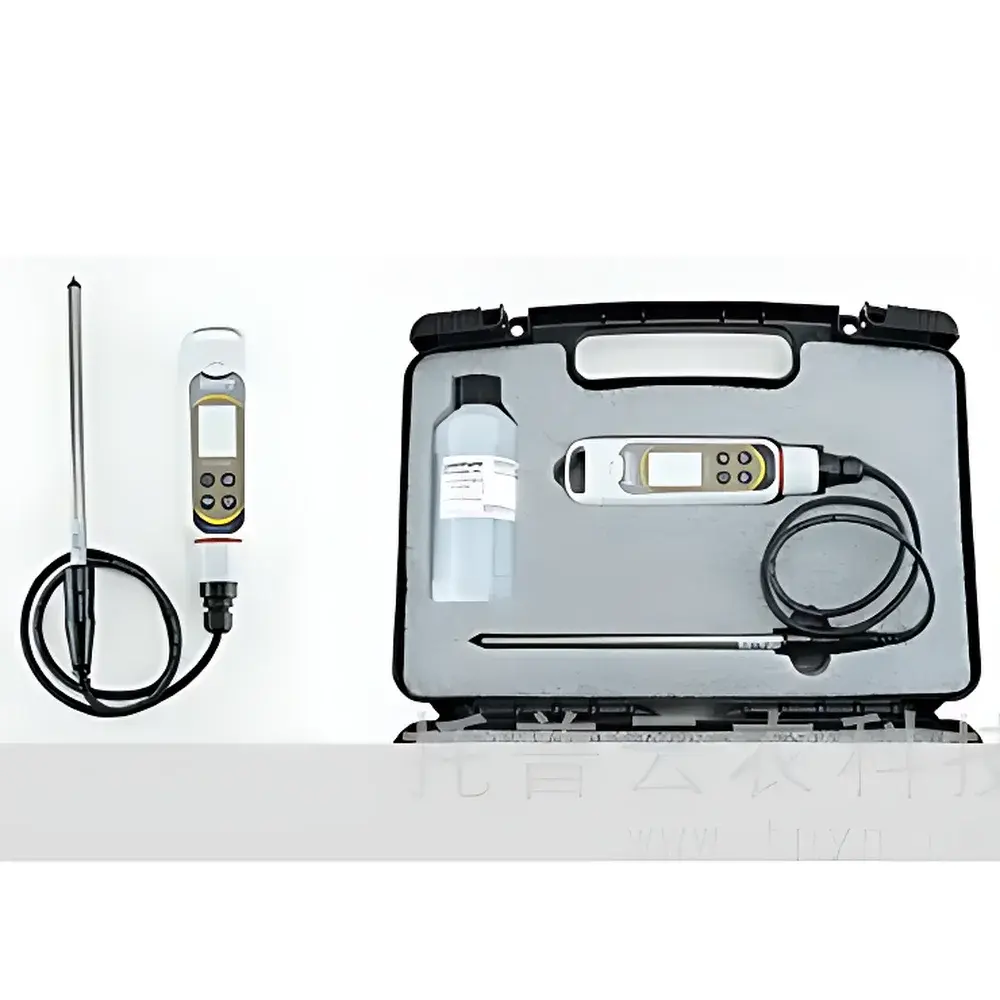
Top Cloud-agri 2266FS Portable Soil Conductivity Meter
| Brand | Top Cloud-agri |
|---|---|
| Origin | Zhejiang, China |
| Manufacturer Type | Direct Manufacturer |
| Country of Origin | China |
| Model | 2266FS |
| Pricing | Upon Request |
Overview
The Top Cloud-agri 2266FS Portable Soil Conductivity Meter is a field-deployable, multi-parameter electrical conductivity (EC) analyzer engineered for rapid, in-situ assessment of soil salinity, aqueous solutions, and organic extracts. It operates on the principle of two-electrode AC conductivity measurement—applying a low-frequency alternating current across a stainless-steel electrode pair embedded in the sensor tip—and calculating conductance based on Ohm’s law, corrected for cell geometry and temperature-dependent electrolyte mobility. Designed for agronomic precision, environmental monitoring, and soil health diagnostics, the instrument delivers traceable EC values in µS/cm, mS/cm, TDS (ppm or ppt), and practical salinity (ppt), enabling quantitative evaluation of soluble salt accumulation—a critical indicator of soil degradation, irrigation water quality, and crop stress thresholds.
Key Features
- Integrated Temperature Compensation: Built-in NTC thermistor enables automatic temperature correction (0.0–10.0% per °C coefficient, user-selectable) across the full operating range (5–45 °C), ensuring measurement stability under variable field conditions.
- Optimized Sensor Geometry: Conical stainless-steel probe (Ø 0.8 cm, L 19.5 cm; extended version 2266FSTP: Ø 0.9 cm, L 61 cm) maximizes surface contact with heterogeneous soil matrices, reducing air-gap errors and improving reproducibility in compacted or gravelly substrates.
- Multi-Range Auto-Scale Detection: Three programmable EC ranges (0.0–200 µS/cm, 200–2000 µS/cm, 2.00–20 mS/cm) with corresponding TDS (0.0–100 ppm, 100–1000 ppm, 0.1–10.00 ppt) and salinity (0.00–10.00 ppt) conversions, each with dedicated resolution settings (e.g., 0.01 mS/cm, 0.01 ppt).
- Rugged Field Design: IP67-rated enclosure ensures dust-tight operation and immersion resistance up to 1 m for 30 min; powered by four AAA alkaline cells (150 hr typical runtime); auto-power-off after 8 min of inactivity.
- High-Contrast Visual Interface: 80×100-pixel monochrome LCD with backlight supports legible data viewing under low-light canopy or shaded field conditions.
Sample Compatibility & Compliance
The 2266FS is validated for direct insertion into undisturbed soil profiles (0–30 cm depth), containerized substrates (pots, trays, hydroponic reservoirs), and liquid samples (irrigation water, leachate, nutrient solutions). Its calibration protocol supports up to three-point EC standardization using certified KCl reference solutions (e.g., 1.41 mS/cm included), aligning with ASTM D1125 and ISO 7888 for conductivity measurement traceability. While not FDA 21 CFR Part 11–compliant out-of-the-box (as it lacks audit-trail software), raw EC/TDS/salinity outputs meet GLP documentation requirements when recorded manually or via external logging systems.
Software & Data Management
The meter functions as a standalone data acquisition unit without onboard memory or Bluetooth/Wi-Fi connectivity. All measurements are displayed in real time and must be manually transcribed or captured via external digital loggers. The included calibration standards and documented procedures support repeatable inter-operator measurements under ISO/IEC 17025–aligned QA workflows. For integration into larger farm management platforms (e.g., FarmOS, AgriWebb), users may export field-collected values via spreadsheet templates aligned with OGC SensorML metadata conventions.
Applications
- Salinity mapping in greenhouse and open-field horticulture to guide irrigation scheduling and leaching fraction calculations.
- Routine monitoring of soil EC in sodic or arid-zone agricultural systems to detect early-stage salinization (EC > 4 dS/m threshold for sensitive crops).
- Quality control of irrigation water sources and recycled effluents prior to field application.
- Validation of soil amendment efficacy (e.g., gypsum, organic matter) in remediation trials targeting ion exchange capacity restoration.
- Supporting ISO 11277-compliant soil physical characterization protocols where EC serves as a proxy for pore-water chemistry.
FAQ
What is the measurement principle used by the 2266FS?
It employs a two-electrode AC conductivity method with temperature-compensated resistivity-to-conductivity conversion.
Can the probe be used in saturated paste extracts?
Yes—the sensor is compatible with filtered saturated paste extracts, provided particulate load remains below 50 mg/L to avoid electrode fouling.
Is factory calibration traceable to NIST standards?
The supplied 1.41 mS/cm KCl standard is traceable to national metrology institutes; end-user recalibration is recommended every 3 months or after 50 field insertions.
Does the device comply with CE or RoHS directives?
As a domestically certified Chinese-manufactured instrument, it conforms to GB/T 18268.1–2010 (equivalent to IEC 61326-1) for EMC and safety; RoHS compliance is verified per GB/T 26572–2011.
How does TDS conversion work on this meter?
TDS is calculated using a user-selectable linear factor (0.4–1.0), defaulting to 0.65 for general soil solutions, per ASTM D5907 guidelines.







