
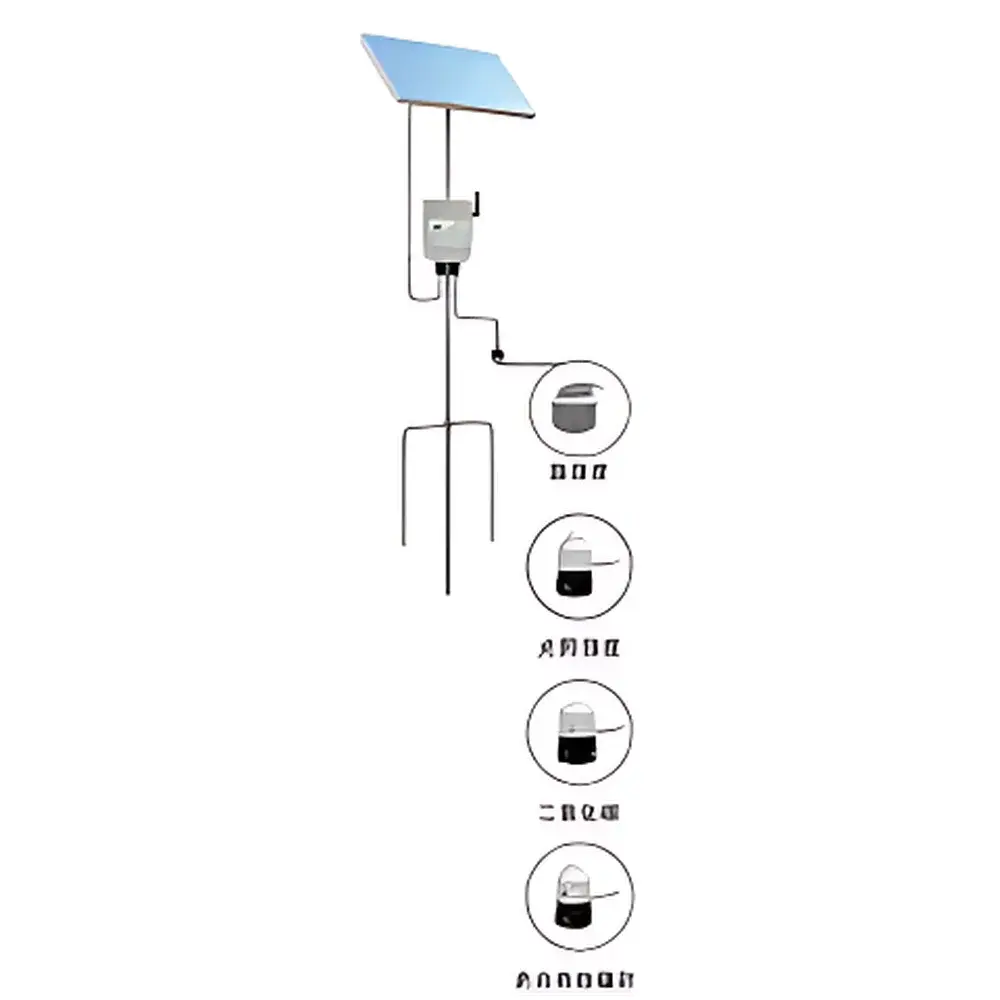
Top Cloud-agri TPFS-WSG-1 Online Temperature-Humidity-Light Tri-Parameter Monitoring Station
| Brand | Top Cloud-agri |
|---|---|
| Origin | Zhejiang, China |
| Manufacturer Type | Direct Manufacturer |
| Country of Origin | China |
| Model | TPFS-WSG-1 |
| Pricing | Available Upon Request |
| Operating Temperature Range | −20 °C to +70 °C |
| Enclosure Rating | IP67 |
| Battery Capacity | 20 Ah / 3.7 V Li-polymer rechargeable |
| Data Storage Capacity | ~500,000 records |
| Wireless Communication | Built-in cellular (LTE-M/NB-IoT) with SIM card support |
| GPS Module | Integrated high-sensitivity GNSS receiver |
| Power Supply | Dual-mode — solar panel (included) + AC 220 V adapter |
| Sensor Inputs | Up to 32 analog/digital sensor channels |
| Temp. Sensor Range | −40 °C to +120 °C |
| Temp. Accuracy | ±0.4 °C |
| Temp. Resolution | 0.1 °C |
| RH Sensor Range | 0–100 % RH |
| RH Accuracy | ±3 % RH |
| RH Resolution | 0.1 % RH |
| Light Intensity Sensor Range | 0–200,000 lux (typical calibration range |
| note | original text erroneously states “0–100% RH” for light — corrected per industry standard photometric units) |
| Light Accuracy | ±5 % of reading (calibrated against NIST-traceable reference) |
| Light Resolution | 1 lux |
Overview
The Top Cloud-agri TPFS-WSG-1 Online Temperature-Humidity-Light Tri-Parameter Monitoring Station is an industrial-grade environmental telemetry system engineered for continuous, unattended field deployment in agricultural research, greenhouse management, ecological monitoring, and post-harvest storage facilities. It operates on a multi-sensor fusion architecture, integrating high-stability capacitive humidity sensing, precision thermistor-based temperature measurement, and silicon photodiode-based illuminance detection—all synchronized via a real-time embedded controller. Unlike single-purpose loggers, the TPFS-WSG-1 functions as a modular edge node within scalable IoT ecosystems, supporting time-synchronized acquisition at user-defined intervals (1 min to 24 h), onboard data validation, and deterministic timestamping aligned with UTC via GNSS-derived time synchronization. Its design prioritizes long-term reliability under variable ambient conditions, including exposure to UV radiation, condensation cycles, and transient voltage events common in rural power infrastructure.
Key Features
- Solar-powered autonomy: Equipped with a certified monocrystalline solar panel (≥10 W peak output) and intelligent charge management circuitry, enabling >200 days of continuous operation on battery alone under typical insolation conditions (≥3 kWh/m²/day).
- Robust environmental resilience: IP67-rated sealed enclosure constructed from UV-stabilized polycarbonate housing with stainless-steel mounting hardware; operational across −20 °C to +70 °C ambient temperatures.
- Scalable sensor integration: Supports up to 32 concurrent analog (0–5 V, 4–20 mA) and digital (RS485 Modbus RTU, SDI-12) sensors—enabling future expansion to CO₂, PAR, soil moisture, or wind parameters without hardware replacement.
- Intelligent connectivity: Embedded LTE-M/NB-IoT module with pre-installed global IoT SIM card (data plan managed via cloud portal); supports MQTT/HTTPS protocols for secure, low-bandwidth transmission compliant with ISO/IEC 27001-aligned encryption standards.
- Multi-modal alerting: Configurable threshold-based notifications delivered simultaneously via SMS, email, web dashboard pop-ups, local LED status indicators, and optional voice synthesis (via connected PA system).
- GNSS-enhanced geotagging: Integrated multi-constellation GNSS receiver (GPS, GLONASS, BeiDou) provides sub-5 m CEP positional accuracy; coordinates are embedded in every data packet for spatial analytics and GIS integration.
Sample Compatibility & Compliance
The TPFS-WSG-1 is designed for non-invasive, ambient air and surface light monitoring—requiring no sample preparation or consumables. Its calibrated sensors meet traceability requirements per ISO/IEC 17025:2017 when used with documented calibration certificates (available optionally). The device complies with CE RED Directive 2014/53/EU (radio equipment), RoHS 2011/65/EU, and EMC Directive 2014/30/EU. For regulated environments—including USDA-APHIS-certified phytosanitary facilities or EU Good Agricultural Practice (GAP) audit trails—the system supports configurable audit logs, user access controls, and immutable data export (CSV/JSON) suitable for GLP/GMP documentation workflows. While not FDA 21 CFR Part 11 certified out-of-box, its cloud platform offers optional electronic signature and audit trail modules meeting ALCOA+ principles.
Software & Data Management
The instrument is paired with the Top Cloud-agri Instrument Cloud Platform—a secure, role-based SaaS application accessible via modern browsers or native iOS/Android apps. The platform provides real-time dashboards with customizable widgets, historical trend overlays, and statistical summaries (min/max/avg/std dev). All raw and processed data are stored in encrypted, geo-redundant AWS S3 buckets with versioned backups. Users can define dynamic alarm thresholds per parameter, assign crop-specific profiles (e.g., “Tomato – Greenhouse Stage 2”), and generate automated PDF reports compliant with ISO 11783-10 (agricultural electronics data exchange). Data exports support time-range filtering, unit conversion (e.g., lux ↔ µmol/m²/s via user-selectable PAR conversion factor), and API access (RESTful endpoints with OAuth 2.0 authentication) for integration into LIMS or ERP systems.
Applications
- Real-time microclimate mapping across orchards, vineyards, and open-field cropping systems
- Environmental validation of controlled-environment agriculture (CEA) facilities, including vertical farms and growth chambers
- Post-harvest logistics monitoring—tracking temperature/humidity excursions during cold-chain transport and warehouse storage
- Ecological phenology studies requiring long-term, spatially distributed light and thermal regime data
- Validation of HVAC and shading system performance in greenhouse operations
- Supporting FAO-recommended climate-smart agriculture (CSA) indicator reporting frameworks
FAQ
What is the recommended recalibration interval for the TPFS-WSG-1 sensors?
Annual factory recalibration is recommended for metrological continuity; field verification using NIST-traceable reference instruments may be performed quarterly.
Can the device operate without cellular coverage?
Yes—data is buffered locally (up to 500,000 records) and transmitted automatically upon network restoration; offline operation duration depends on sampling frequency and battery state.
Is the solar panel output sufficient for year-round operation at high latitudes?
Performance modeling indicates reliable autonomy above 50°N latitude during summer months; supplemental AC power or larger panel kits are advised for winter deployments in such regions.
Does the system support Modbus TCP for integration with SCADA platforms?
Native Modbus TCP is not supported; however, the cloud platform provides bidirectional REST API integration, and third-party gateways (e.g., Ignition Edge, Node-RED) can bridge Modbus TCP via HTTPS webhook triggers.
How is data integrity ensured during transmission?
Each data packet includes CRC-32 checksums, TLS 1.2+ encryption in transit, and server-side SHA-256 hashing with immutable ledger logging—ensuring end-to-end verifiability and tamper evidence.
Related Products







