
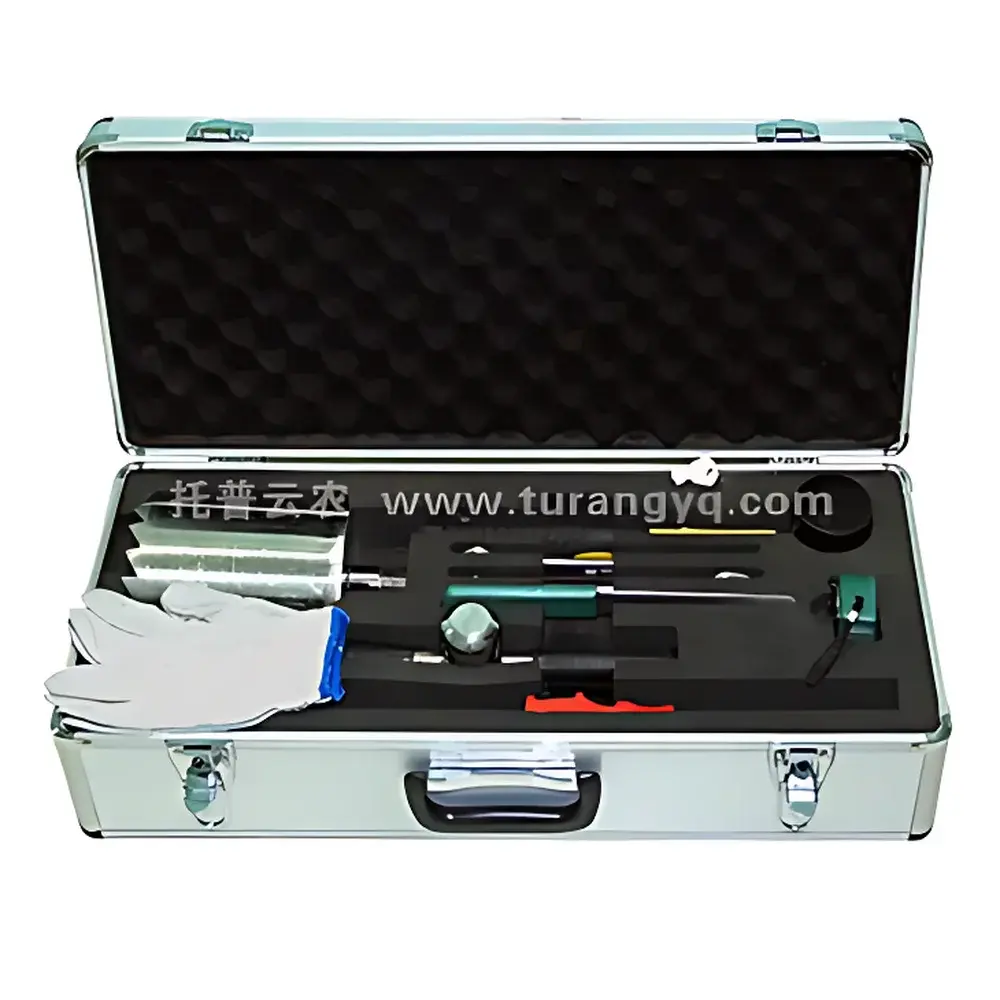
Top Cloud-agri TPGQ-1 Intact Root-Zone Soil Coring Drill
| Brand | Top Cloud-agri |
|---|---|
| Origin | Zhejiang, China |
| Manufacturer Type | OEM/ODM Manufacturer |
| Country of Origin | China |
| Model | TPGQ-1 |
| Instrument Type | Intact Soil Core Sampler for Root Zone Analysis |
| Material | AISI 304 Stainless Steel |
| Core Diameter | 108 mm (outer) / 100 mm (inner) × 130 mm height |
| Cutting Teeth | 16 precision-ground serrated teeth |
| Extension Rod | φ27 mm × 500 mm, threaded, modular |
| Packing Dimensions | 650 × 320 × 225 mm |
| Accessories | Aluminum carrying case, impact hammer, adjustable wrench, measuring tape, soil scraper, cross-head screwdriver, protective gloves |
Overview
The Top Cloud-agri TPGQ-1 Intact Root-Zone Soil Coring Drill is a field-deployable, manually operated soil sampling instrument engineered for the non-destructive retrieval of undisturbed soil monoliths containing intact root architecture. Unlike conventional augers or push probes that disrupt soil structure and shear root networks, the TPGQ-1 employs a vertically aligned, low-shear coring principle—relying on controlled axial force and optimized tooth geometry to penetrate soil profiles while preserving stratigraphic integrity, root morphology, and rhizosphere microstructure. It is specifically designed for ecological, agronomic, and forestry research where quantification of root distribution depth, lateral spread, density, and vertical continuity is essential for understanding plant-soil hydraulic coupling, nutrient foraging efficiency, carbon sequestration potential, and belowground response to climate stressors. The device operates without power sources or hydraulic systems, making it suitable for remote, off-grid, or protected natural area sampling under strict environmental protocols.
Key Features
- Intact core recovery: Precision-machined 108 mm outer diameter × 100 mm inner diameter cylindrical core barrel with 16 hardened stainless-steel serrated cutting teeth ensures minimal wall friction and consistent sample ejection.
- Modular mechanical design: Threaded connections between core barrel, extension rods, and ergonomic T-handle enable rapid assembly/disassembly; rod segments are interchangeable and scalable up to custom lengths (standard base configuration supports ≤1.5 m depth).
- Impact-assisted penetration: Integrated striking head accepts standard buffer hammers (included), enabling reliable entry into compacted, gravelly, or clay-rich horizons without pre-drilling or soil preconditioning.
- Material integrity: Fully constructed from AISI 304 stainless steel—resistant to corrosion, rust, and chemical leaching—ensuring long-term dimensional stability and compliance with ISO 11277 and ASTM D1557 soil sampling standards.
- Field-portable system: Complete kit—including core barrel, two 500 mm extension rods, impact hammer, torque wrench, soil scraper, metric tape, and custom-fitted aluminum transit case (650 × 320 × 225 mm)—fits within standard field vehicle storage compartments.
Sample Compatibility & Compliance
The TPGQ-1 is validated for use across mineral soils (sand, loam, silt, clay), organic-rich topsoils, and moderately structured subsoils (up to USDA texture class “heavy clay” with <30% gravel content). It maintains structural fidelity of roots ≥0.2 mm diameter and preserves pore network continuity in unsaturated zones. All components meet EU RoHS Directive 2011/65/EU restrictions on hazardous substances. The stainless-steel construction complies with FDA 21 CFR Part 110 for incidental contact with environmental samples intended for subsequent laboratory analysis (e.g., root biomass quantification, microbial DNA extraction, isotopic tracer studies). Documentation includes CE-conformity declaration for manual hand tools (2006/42/EC Annex IV) and traceable material certifications.
Software & Data Management
While the TPGQ-1 is a mechanical sampling tool with no embedded electronics, its design integrates seamlessly into digital soil science workflows. Core position metadata (GPS coordinates, depth interval, horizon notation, timestamp) can be logged via compatible field data capture platforms such as ESRI Field Maps, QGIS Mobile, or OpenDataKit (ODK). Each aluminum case includes a QR-coded inventory label linked to a cloud-based asset registry. Optional add-on modules—such as a calibrated depth-stop collar with millimeter刻度 scale and a root-sectioning alignment jig—are documented in ISO/IEC 17025-accredited method SOPs for reproducible subsampling. Audit trails for field deployment, maintenance, and calibration history support GLP-compliant reporting frameworks.
Applications
- Root phenotyping: Quantitative assessment of root length density (RLD), root surface area index (RSAI), and vertical root distribution in crop breeding trials (e.g., maize, wheat, rice under drought stress).
- Forest ecology: In situ excavation of fine-root turnover zones in temperate and boreal stands for 14C dating, mycorrhizal colonization mapping, and soil respiration modeling.
- Restoration monitoring: Pre- and post-intervention sampling to evaluate root establishment success in phytoremediation sites or riparian buffer zones.
- Soil physics research: Undisturbed core collection for saturated/unsaturated hydraulic conductivity measurements (using constant-head or falling-head permeameters) and X-ray CT scanning of root-soil interfaces.
- Regulatory compliance: Supporting Tier 2 site characterization under EPA SW-846 Method 5035A (soil gas sampling preparation) and ISO 10381-6 (sampling for biological parameters).
FAQ
Can the TPGQ-1 retrieve cores from rocky or stony soils?
Yes—when used with the impact hammer and appropriate extension rod configuration, it penetrates soils containing up to 15% by volume of sub-20 mm angular gravel. For higher stone content, pre-screening or alternate probe selection is recommended.
Is the core barrel compatible with standard soil lab equipment?
Yes—the 100 mm inner diameter aligns with ASTM D4220 and ISO 25619-1 core holder dimensions, enabling direct insertion into centrifuge tubes, pressure plates, or resin-impregnation rigs.
How is calibration maintained?
No electronic calibration is required. Mechanical verification includes annual thread pitch inspection, torque specification validation (25 ± 2 N·m for all connections), and visual wear assessment of cutting teeth per manufacturer’s service checklist.
Does the system support ISO/IEC 17025 traceability?
Yes—each unit ships with a unique serial number, material certification dossier, and optional third-party dimensional verification report upon request.







