
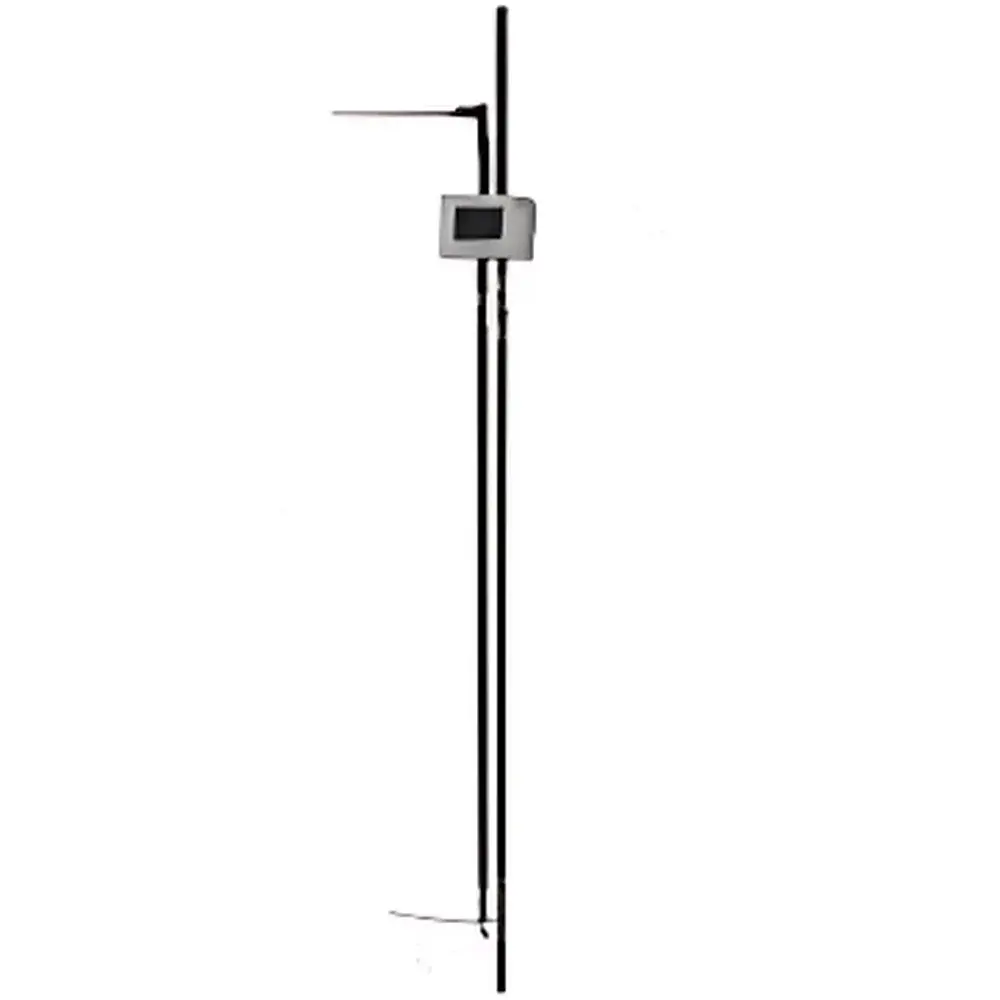
Top Cloud-agri TPZW-G-1 Portable Crop Plant Height & Ear Height Measurement System
| Brand | Top Cloud-agri |
|---|---|
| Origin | Zhejiang, China |
| Manufacturer Type | Direct Manufacturer |
| Country of Origin | China |
| Model | TPZW-G-1 |
| Pricing | Available Upon Request |
| Height Measurement Range | 100–3800 mm |
| Resolution | 1 mm |
| Accuracy | ±0.5% of reading |
| Response Time | <1 s |
| Data Storage Capacity | 200 measurement records |
| Power Supply | Rechargeable Li-ion battery |
| Operating Duration | 3–4 hours continuous use |
| Host Dimensions | 136 × 54 × 90 mm (L×D×H) + 118 × 47 × 80 mm (L×D×H) |
| Extension Pole Length | 1600–3800 mm |
| Host Weight | 1.21 kg |
| Display | 3.5-inch full-color LCD |
| Data Export | USB 2.0 interface, Excel (.xlsx) format |
| Protection | Error-prevention logic, user-initiated database backup & reset |
Overview
The Top Cloud-agri TPZW-G-1 Portable Crop Plant Height & Ear Height Measurement System is a field-deployable, non-contact optical height profiling instrument engineered for quantitative plant phenotyping in agricultural research and breeding programs. It operates on the principle of calibrated vertical displacement sensing—integrating a precision linear encoder with dual-position mechanical referencing (upper and lower pointers) to determine absolute plant height and maize ear insertion height (ear height) relative to ground level. Unlike ultrasonic or time-of-flight devices, the TPZW-G-1 employs a mechanically constrained sliding rod architecture with tactile endpoint detection, ensuring consistent contact geometry and minimizing parallax-induced error under variable lighting, wind, or canopy density conditions. Designed specifically for high-throughput field trials, it supports rapid, operator-independent acquisition of structural traits critical to ideotype selection—particularly in maize breeding where optimal plant architecture (e.g., lodging resistance, light interception efficiency, and harvest index) correlates strongly with yield stability across diverse agroecological zones.
Key Features
- Field-optimized ergonomics: Total system weight (host + pole) <2.8 kg; modular telescoping pole (1600–3800 mm) enables single-operator deployment without tripods or external power sources.
- Dual-mode measurement architecture: Switchable between “full plant height” (ground-to-apex) and “ear height” (ground-to-first ear node) modes via intuitive on-device menu navigation—eliminating manual repositioning or recalibration between measurements.
- Integrated real-time feedback: 3.5-inch high-resolution color LCD displays live height value, measurement mode, battery status, and record counter; audible confirmation tone ensures reliable data capture during rapid sequential sampling.
- Built-in data integrity safeguards: Automatic timestamping, anti-overwrite protection for unexported records, and user-controlled database backup/reset functions comply with GLP-aligned field data governance protocols.
- USB-native data workflow: All measurements are stored directly onto included USB flash drive in native Microsoft Excel (.xlsx) format—enabling immediate import into statistical packages (R, SAS, JMP) or LIMS without proprietary software dependency.
- Robust environmental tolerance: IP54-rated enclosure withstands dust ingress and incidental water exposure typical of rain-fed or irrigated field environments; operating temperature range: –10°C to +50°C.
Sample Compatibility & Compliance
The TPZW-G-1 accommodates monocot and dicot species with upright growth habit and measurable apical meristem position—including Zea mays (maize), Oryza sativa (rice), Triticum aestivum (wheat), Brassica napus (oilseed rape), Sesamum indicum (sesame), Glycine max (soybean), Sorghum bicolor (sorghum), and Gossypium hirsutum (upland cotton). It is validated for plants within 100–3800 mm stature, covering >95% of commercial cultivars at vegetative and reproductive stages. While not certified to ISO/IEC 17025 for metrological traceability, its ±0.5% accuracy meets ASTM E29-23 criteria for significant digit retention in agronomic trait quantification. The device conforms to IEC 61000-4 electromagnetic compatibility standards and supports audit-ready documentation workflows aligned with FAO’s Minimum Data Standards for Crop Phenotyping Trials.
Software & Data Management
No host PC software installation is required. Data acquisition, storage, and export occur entirely onboard via embedded firmware. Each record contains: unique sample ID (user-assigned), measurement mode flag (height/ear height), numeric value (mm), UTC timestamp (YYYY-MM-DD HH:MM:SS), and battery voltage at time of capture. The Excel output file includes column headers compatible with automated parsing scripts and integrates seamlessly with common phenotypic analysis pipelines (e.g., BreedBase, FieldBook, PhenoApp). Optional CSV export is available via firmware update. Audit trail functionality—though not Part 11-compliant—is supported through immutable record sequencing and manual checksum verification prior to USB ejection.
Applications
- Maize ideotype screening: High-resolution ear height mapping for heterosis prediction and stalk strength modeling.
- QTL mapping cohorts: Replicated phenotyping across RIL or DH populations under managed stress (drought, nitrogen limitation) to identify height-stability loci.
- Cultivar registration trials: Objective, observer-independent height reporting per UPOV TG/1/3 guidelines.
- Remote sensing ground-truthing: Calibration and validation of UAV-based canopy height models (CHM) derived from stereo RGB or LiDAR point clouds.
- Teaching & extension: Hands-on plant architecture education modules for agronomy and plant science curricula.
FAQ
Is the TPZW-G-1 suitable for measuring lodged or leaning plants?
No—it requires vertical stem orientation for accurate apex and ear node localization. Severely lodged specimens should be excluded or manually straightened prior to measurement.
Can multiple operators share calibration settings across devices?
Calibration is factory-set and non-user-adjustable; inter-unit consistency is maintained within ±0.5% tolerance per unit test report.
Does the device support Bluetooth or Wi-Fi data transmission?
No—data transfer is USB-only to ensure field reliability, cybersecurity isolation, and compatibility with air-gapped research networks.
What is the recommended maintenance interval?
Annual visual inspection of encoder rail cleanliness and pointer tip wear; no scheduled recalibration is required under normal usage conditions.
Is the USB drive formatted in FAT32 or exFAT?
FAT32—ensuring universal compatibility with Windows, macOS, and Linux systems without driver installation.






