
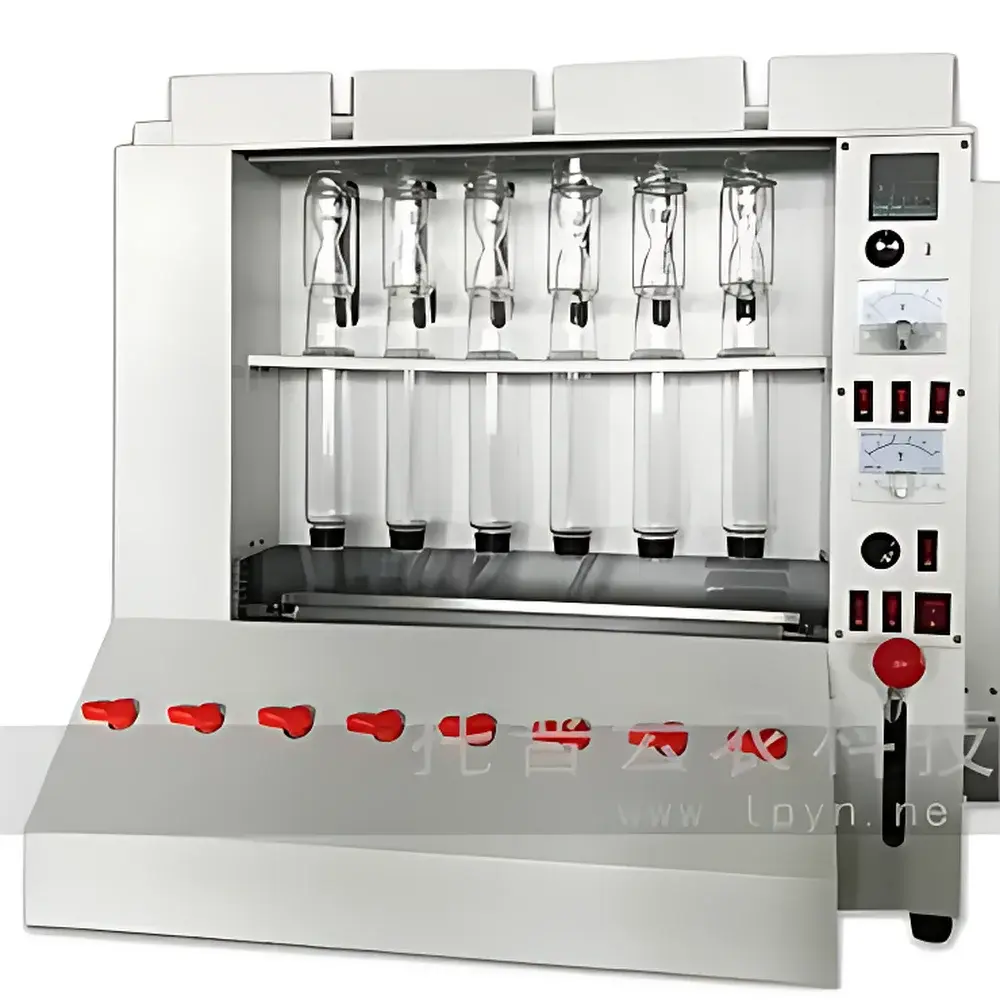
Top Cloud-agri CXC-06 Acid-Base Digestion Fiber Analyzer
| Brand | Top Cloud-agri |
|---|---|
| Origin | Zhejiang, China |
| Manufacturer Type | Direct Producer |
| Country of Origin | China |
| Model | CXC-06 |
| Price | USD 1,300 (FOB) |
| Sample Capacity | 6 samples per run |
| Repeatability Error | ≤0.4% absolute (for crude fiber content <10%) |
| Total Digestion & Filtration Time | ~100 min (acid digestion: 40 min |
| alkaline digestion | 40 min |
| filtration & washing | ~20 min) |
| Power Supply | AC 220 V / 50 Hz |
| Rated Power | 2800 W |
| Cooling Water Requirement | inlet water temperature <20 °C |
| Dimensions (W×D×H) | 670 mm × 450 mm × 670 mm |
| Net Weight | 30 kg |
Overview
The Top Cloud-agri CXC-06 Acid-Base Digestion Fiber Analyzer is a dedicated laboratory instrument engineered for the quantitative determination of crude fiber content in agricultural and feed materials according to standardized gravimetric acid-alkali digestion methodology (AOAC Official Method 962.09 and ISO 5498:2022). Crude fiber—defined as the residue remaining after sequential boiling of a sample in dilute sulfuric acid and sodium hydroxide solutions, followed by ethanol washing, drying, and ash correction—is a critical nutritional parameter in animal nutrition science, feed formulation, and quality control of cereals, forages, and processed foodstuffs. The CXC-06 implements fully automated temperature-controlled digestion cycles, integrated reflux condensation, and vacuum-assisted filtration to ensure consistent thermal exposure, minimized reagent loss, and operator-independent reproducibility across routine batch analysis.
Key Features
- Simultaneous six-position digestion block with independent temperature control per vessel (±1 °C stability), enabling parallel processing without cross-contamination.
- Dual-stage programmable heating system: precise acid digestion at 100 °C ± 2 °C (40 min), followed by alkaline digestion at identical thermal setpoint (40 min), compliant with AOAC and ISO timing tolerances.
- Integrated reflux condensers with coolant circulation interface (inlet water temperature <20 °C) to prevent volatile acid/alkali loss and maintain solution concentration integrity throughout digestion.
- Vacuum-assisted filtration module with pre-calibrated Gooch crucibles and wash cycle automation, reducing manual handling and improving filtration consistency.
- Robust stainless-steel chassis and corrosion-resistant internal chamber lining designed for long-term exposure to aggressive H2SO4 and NaOH reagents.
- Compliance-ready design: supports GLP documentation through manual logbook integration and traceable operator-defined run parameters (digestion times, temperatures, sample IDs).
Sample Compatibility & Compliance
The CXC-06 is validated for use with solid or semi-solid matrices including cereal grains (corn, wheat, barley), compound feeds, hay and silage, soybean meal, distillers’ dried grains (DDGS), and other plant-based agricultural commodities. It conforms to the procedural requirements of AOAC International Method 962.09 (“Crude Fiber in Animal Feeds”), ISO 5498:2022 (“Animal feeding stuffs — Determination of crude fibre content”), and GB/T 6434–2006 (Chinese national standard for crude fiber in feed). While not intrinsically 21 CFR Part 11–compliant due to absence of electronic audit trails, its mechanical repeatability and defined operational protocol support regulatory submission data when paired with laboratory SOPs, calibration logs, and analyst training records.
Software & Data Management
The CXC-06 operates via embedded microcontroller logic with LED-based status indicators and tactile push-button controls—no onboard software or digital interface is provided. All operational parameters (digestion duration, heating setpoints, filtration activation) are manually initiated and monitored. Data recording is performed externally using laboratory notebooks or LIMS-integrated spreadsheets. Users are advised to implement documented calibration procedures for temperature sensors (annual NIST-traceable verification recommended) and vacuum pressure gauges. For laboratories requiring electronic data capture, third-party timer-loggers or USB-connected thermocouple dataloggers may be deployed in parallel to record thermal profiles per run.
Applications
- Feed mill quality assurance: monitoring crude fiber variability across raw material lots and finished feed batches to ensure compliance with nutritional specifications (e.g., NRC guidelines for ruminant diets).
- Research laboratories studying fiber digestibility kinetics, evaluating novel feed additives, or developing low-fiber formulations for monogastric species.
- Agricultural extension services conducting on-site feed evaluation in regional livestock development programs.
- Contract testing labs performing accredited crude fiber analysis under ISO/IEC 17025:2017, where method validation and uncertainty estimation are required per EN ISO/IEC 17025 Clause 7.2.
- Educational institutions teaching classical proximate analysis techniques in animal science and food chemistry curricula.
FAQ
What standards does the CXC-06 comply with for crude fiber analysis?
It supports AOAC 962.09, ISO 5498:2022, and GB/T 6434–2006 methodologies through hardware-level adherence to digestion time, temperature, and filtration requirements.
Can the instrument handle high-ash samples such as mineral-supplemented feeds?
Yes—provided ash correction is performed post-digestion per standard protocol (incineration at 550 °C ± 10 °C in a muffle furnace), the CXC-06’s digestion performance remains unaffected.
Is distilled water required for the cooling system?
No—tap water meeting the inlet temperature specification (<20 °C) is sufficient; however, deionized water is recommended if local supply contains scale-forming minerals.
What maintenance intervals are recommended?
Daily: rinse crucibles and digestion vessels with deionized water; weekly: inspect gasket integrity and vacuum line seals; annually: verify temperature sensor accuracy against calibrated reference thermometer.
Does the unit include digestion reagents or crucibles?
No—reagents (0.125 M H2SO4, 0.125 M NaOH) and Gooch-type sintered glass crucibles must be procured separately per laboratory safety and quality protocols.





