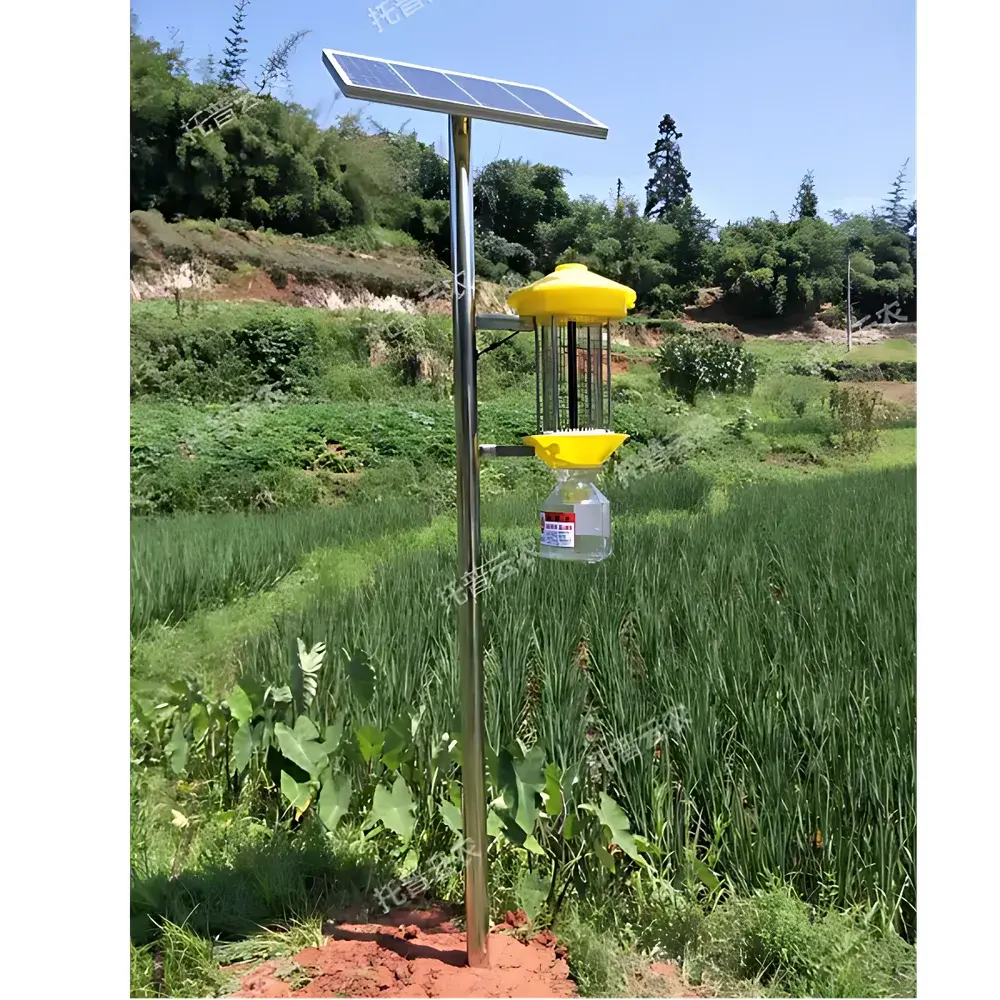
Top Cloud-agri TPSC7-1-DC IoT-Enabled Intelligent Insect Trap Lamp
| Brand | Top Cloud-agri |
|---|---|
| Origin | Zhejiang, China |
| Manufacturer Type | OEM/ODM Manufacturer |
| Country of Origin | China |
| Model | TPSC7-1-DC |
| Instrument Category | Pest Control Device |
| Power Supply | 12 V DC (Lead-Acid Battery + Solar Panel ≥40 W) |
| Grid Voltage | 5,000 V ±500 V |
| Impact Area | ≥0.25 m² |
| Rated Power / Standby Power | ≤18 W / ≤0.5 W |
| UV Light Wavelength Range | 320–680 nm |
| Effective Coverage Area | 30–50 Mu (≈2–3.3 ha) |
| Service Life | 3–5 years |
| Control Modes | Photocell-based and Time-based Scheduling |
Overview
The Top Cloud-agri TPSC7-1-DC IoT-Enabled Intelligent Insect Trap Lamp is an integrated physical pest control instrument engineered for precision deployment in agricultural, horticultural, and ecological management systems. It operates on the principle of phototactic attraction—emitting broad-spectrum visible and near-UV light (320–680 nm) to lure nocturnal lepidopteran pests—including Oraesia emarginata (Bird-beak Fruit Moth), Hypocala andremona (Withered-leaf Moth), and related fruit-piercing noctuids—toward a high-voltage electrified grid (5,000 V ±500 V). Unlike chemical interventions, this device achieves targeted mortality without pesticide residue accumulation, supporting residue-free citrus production and aligning with Integrated Pest Management (IPM) frameworks endorsed by FAO and national phytosanitary authorities.
Key Features
- Vertical-grid design enables efficient insect capture and simplified mechanical cleaning—reducing maintenance downtime and minimizing operator exposure.
- Embedded cellular (NB-IoT or LTE-M) and Wi-Fi connectivity supports real-time telemetry transmission, including GPS coordinates, device ID, orchard name, cumulative kill count, battery voltage, signal strength (RSRP/SINR), and fault diagnostics (e.g., grid short-circuit, solar charging failure).
- Multi-device fleet management via unified cloud platform: a single authenticated account can monitor and configure up to 500+ TPSC7-1-DC units across heterogeneous deployments (orchards, vineyards, nurseries, greenhouses).
- GIS-integrated dashboard allows spatial visualization and drill-down access to individual unit status—enabling agronomists and farm managers to prioritize field interventions based on georeferenced performance metrics.
- Dual operational logic: autonomous photocell-triggered activation at dusk/dawn and programmable time-scheduled operation (e.g., 19:00–05:00), configurable remotely via web portal or native iOS/Android application.
Sample Compatibility & Compliance
The TPSC7-1-DC is validated for consistent efficacy against polyphagous fruit-piercing moths under subtropical and temperate climatic conditions typical of citrus-growing regions in Southern China, Southeast Asia, and the Mediterranean basin. Its design conforms to GB/T 24689.2–2009 (Chinese National Standard for Plant Protection Equipment – Electric Insect Traps) and incorporates electrical safety measures compliant with IEC 60335-1. While not classified as a medical or food-contact device, its non-chemical mode of action supports compliance with MRL (Maximum Residue Level) requirements under EU Regulation (EC) No 396/2005 and USDA NOP organic certification criteria when deployed as part of documented IPM protocols.
Software & Data Management
Data acquisition, storage, and visualization are managed through Top Cloud-agri’s proprietary AgriCloud™ platform—a secure, role-based SaaS environment hosted on ISO/IEC 27001-certified infrastructure. All telemetry is timestamped, encrypted in transit (TLS 1.2+), and retained for ≥12 months. Audit logs record user actions (login, configuration changes, firmware updates) to support internal quality assurance and traceability requirements. Export functions generate CSV/Excel reports compatible with third-party farm management software (e.g., FarmLogs, Granular) and statistical analysis tools (R, Python pandas). Optional API integration enables automated alerts via SMS/email upon threshold breaches (e.g., low battery, zero kills over 72 h).
Applications
This instrument serves as a scalable node within precision agriculture ecosystems—deployed across citrus orchards to suppress fruit-piercing moth populations; in tobacco fields to reduce Heliothis spp. infestation; in vineyards targeting Cosmia trapezina; and in urban green belts for monitoring seasonal moth migration patterns. Its low-power architecture (≤0.5 W standby) and solar autonomy make it suitable for off-grid locations, while GIS-enabled clustering facilitates regional pest pressure mapping—informing coordinated area-wide management strategies aligned with national phytosanitary surveillance programs.
FAQ
What communication protocols does the TPSC7-1-DC support?
It utilizes NB-IoT (primary) and optional 4G LTE-M for cellular backhaul, with fallback to Wi-Fi 802.11 b/g/n for local network registration during initial setup.
Is firmware update performed remotely?
Yes—over-the-air (OTA) updates are delivered via the AgriCloud™ platform and applied during scheduled maintenance windows to ensure uninterrupted operation.
Can historical kill data be correlated with weather variables?
The platform accepts manual or automated ingestion of external meteorological feeds (temperature, RH, wind speed) to enable regression analysis of catch rate vs. environmental drivers.
Does the device meet electromagnetic compatibility (EMC) standards?
It complies with GB 17625.1–2012 (equivalent to IEC 61000-3-2) for harmonic current emissions and GB/T 17626.2–2018 (IEC 61000-4-2) for ESD immunity.
How is battery health monitored?
Real-time voltage, charge/discharge cycles, and temperature-compensated state-of-charge estimation are reported every 15 minutes—triggering proactive replacement alerts at <15% remaining capacity.
Related Products