
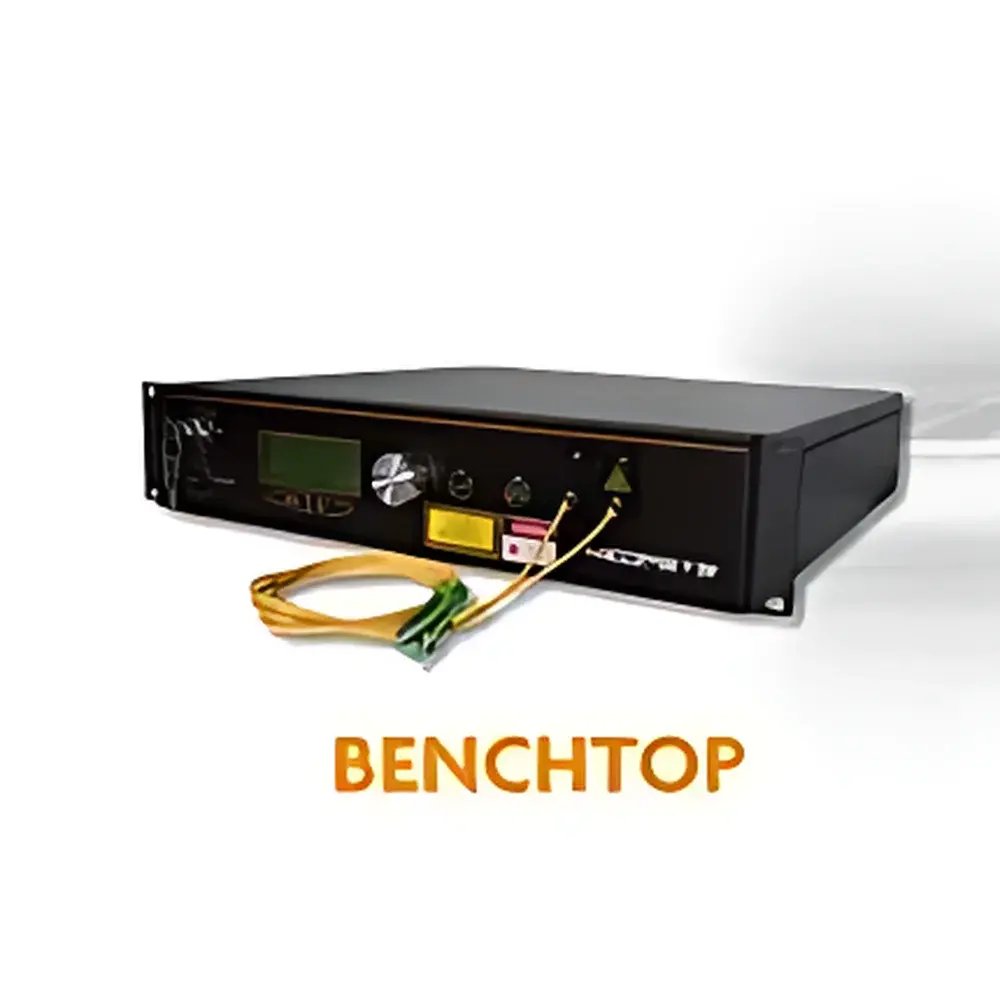
Keopsys CYFA-BO, CYFA-PB, CEFL-L-PB-HP, CEFA-C-WDM-LP & CTFA-PB Series Fiber Amplifiers
| Origin | France |
|---|---|
| Distribution Model | Authorized Distributor |
| Import Status | Imported |
| Operating Mode | CW or Pulsed |
| Laser Medium | Solid-State (Yb-, Er-, Tm-Doped Fiber) |
| Wavelength Ranges | 1060–1090 nm (Yb), 1100–1120 nm (Yb), 1527–1566 nm (C-band), 1565–1605 nm (L-band), 1900–2000 nm (Tm) |
| Saturation Output Power | Up to +42 dBm (Yb), +33 dBm (Er/L-band & Tm), +23 dBm (C-band LP) |
| Polarization | Free-running or Polarization-Maintaining (PM) |
| Integrated Pre-Amplifier | Yes (CYFA-PB, CEFL-L-PB-HP, CEFA-C-WDM-LP, CTFA-PB) |
| Input Power Range | –20 dBm to +20 dBm (model-dependent) |
Overview
The Keopsys fiber amplifier portfolio comprises a family of high-performance, turnkey optical amplifiers engineered for demanding scientific, industrial, and telecommunications applications. These amplifiers operate on the principle of stimulated emission within rare-earth-doped optical fibers—specifically ytterbium (Yb), erbium (Er), and thulium (Tm)—pumped by high-brightness laser diodes. Each series is designed for distinct spectral regimes and operational requirements: the CYFA-BO and CYFA-PB series deliver high-power continuous-wave (CW) amplification in the 1-µm band; the CEFL-L-PB-HP and CEFA-C-WDM-LP series cover the C- and L-bands of the low-loss telecom window; and the CTFA-PB series enables robust amplification in the emerging 2-µm mid-infrared region. All units feature fully integrated pump laser diodes, thermal management systems, and optical isolation—ensuring stable gain, low noise figure (45 dB). The architecture adheres to IEC 60825-1 for laser safety classification and complies with RoHS and CE directives.
Key Features
- Multi-wavelength coverage across five critical bands: 1060–1090 nm, 1100–1120 nm, 1527–1566 nm (C-band), 1565–1605 nm (L-band), and 1900–2000 nm (Tm-band)
- High saturation output power: up to +42 dBm (158 mW) for Yb-based amplifiers, enabling pumping of nonlinear frequency conversion stages or driving free-space beamlines
- Polarization-maintaining (PM) variants available across all series, supporting coherent detection, interferometric sensing, and polarization-sensitive experiments
- Integrated low-noise pre-amplifier stage in CYFA-PB, CEFL-L-PB-HP, CEFA-C-WDM-LP, and CTFA-PB models—eliminating external preamp complexity and minimizing coupling losses
- Gain flatness of ±0.5 dB over full bandwidth (CEFA-C-WDM-LP), optimized for dense wavelength-division multiplexing (DWDM) and multi-channel spectroscopy
- Thermoelectric cooler (TEC)-stabilized pump diodes and internal temperature monitoring ensure long-term gain stability (<±0.05 dB/°C drift)
Sample Compatibility & Compliance
These amplifiers interface seamlessly with standard single-mode (SMF-28), polarization-maintaining (PANDA or Bowtie), and large-mode-area (LMA) fibers via FC/APC or FC/PC connectors. They support input signals from femtosecond oscillators, narrow-linewidth DFB lasers, and modulated telecom transmitters. All units meet IEC 61300-2-4 (fiber optic connector durability), IEC 60068-2 (environmental stress testing), and EN 61000-6-3 (EMC emissions). For regulated environments—including ISO 17025-accredited calibration labs and GMP-compliant photonics manufacturing—the amplifiers provide traceable performance logs and optional analog/digital monitor outputs compatible with SCADA and LabVIEW-based process control systems.
Software & Data Management
Each amplifier includes embedded microcontroller firmware supporting RS232, USB, and optional Ethernet (TCP/IP) interfaces. The Keopsys Control Suite—a Windows/Linux-compatible GUI—enables real-time monitoring of pump current, case temperature, output power, and gain. Configuration parameters (e.g., target gain, alarm thresholds, auto-shutdown conditions) are stored in non-volatile memory. Audit trails and configuration change logs comply with FDA 21 CFR Part 11 requirements when used in validated analytical workflows. Remote scripting via Python or MATLAB APIs allows integration into automated test benches for accelerated R&D cycles.
Applications
- High-power seeding of ultrafast Ti:sapphire and OPCPA systems
- Coherent LIDAR transmitters requiring narrow linewidth and phase stability
- Fiber-optic sensor interrogation (e.g., distributed acoustic sensing, FBG arrays)
- Spectroscopic light sources for gas sensing (H2O, CO2, CH4) in the 1.5 µm and 2 µm windows
- Free-space optical communications (FSOC) ground station uplinks
- Nonlinear frequency conversion pumping (e.g., OPOs, SHG, DFG) in quantum optics laboratories
FAQ
What is the typical small-signal gain for the CEFA-C-WDM-LP amplifier at 1550 nm?
Small-signal gain exceeds 35 dB under standard operating conditions (input < –30 dBm); exact values depend on pump current and thermal setpoint.
Can the CTFA-PB amplifier be operated in pulsed mode?
No—the CTFA-PB series is optimized for CW operation; Keopsys offers separate pulsed Tm-fiber amplifier modules (e.g., PTFA series) for nanosecond/microsecond pulse amplification.
Is optical isolation included in all models?
Yes—integrated high-isolation (>30 dB) optical isolators are standard across all series to prevent back-reflection damage and gain instability.
Do these amplifiers support analog modulation of output power?
Analog modulation (0–5 V) is available as an option on CYFA-PB and CEFL-L-PB-HP models for active power stabilization in closed-loop systems.
What is the maximum allowable input polarization extinction ratio (PER) for PM versions?
For optimal performance, input PER should exceed 20 dB; lower PER may reduce effective gain and increase polarization-dependent loss (PDL).




