
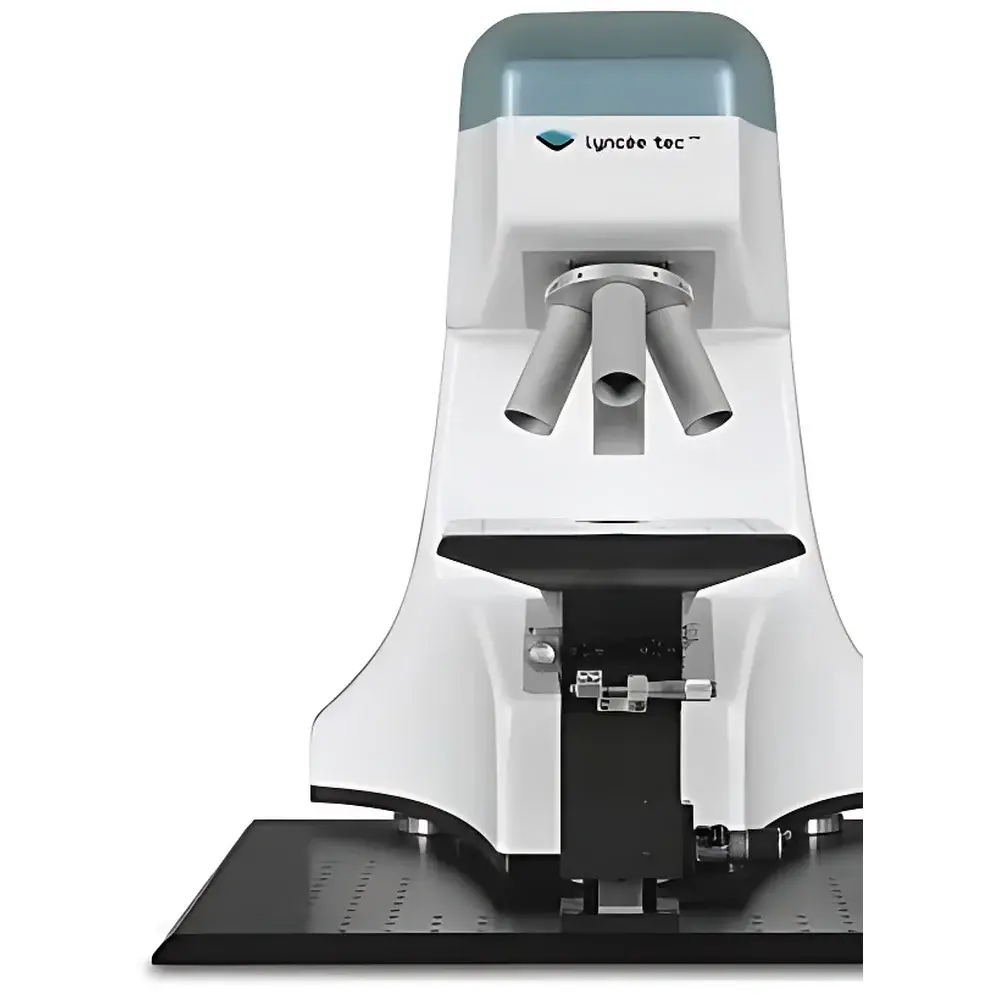
Lyncee Tec DHMT1001 Digital Holographic Microscope
| Brand | Lyncee Tec |
|---|---|
| Origin | Switzerland |
| Model | DHMT1001 |
| Light Source | Single-wavelength laser |
| Camera Resolution | 1392 × 1040 pixels, 8-bit |
| Vertical Resolution | 0.2 nm (instantaneous, in air) |
| Lateral Resolution | 300 nm (with 100× oil immersion objective, NA 1.4) |
| Imaging Speed | 15 fps at 512 × 512, 4 fps at 1024 × 1024 |
| Field of View | Up to 4.40 mm (dependent on objective) |
| Sample Stage | Manual XYZ (25 mm travel), optional motorized 2-/3-axis control |
| Software | Koala Software (C++/.NET, Windows XP-compatible) |
| Power Supply | 85–260 VAC, 50/60 Hz, <120 W |
| Dimensions | 400 × 400 × 500 mm, 34.5 kg |
Overview
The Lyncee Tec DHMT1001 Digital Holographic Microscope (DHM) is a non-invasive, label-free quantitative phase imaging system engineered for real-time, high-resolution 3D topographic analysis of transparent and semi-transparent biological specimens. Unlike conventional optical microscopy techniques that rely on intensity contrast or fluorescent labeling, DHM operates on the principle of laser interferometry: a coherent laser beam is split into object and reference arms; their interference pattern—recorded by a high-sensitivity CCD camera—is digitally reconstructed to yield quantitative phase shift maps with sub-nanometer vertical sensitivity. This enables direct measurement of optical path length differences across the sample surface, translating into precise nanoscale height profiles without physical contact or phototoxic illumination. Designed specifically for life science laboratories requiring longitudinal, dynamic observation of living cells—such as monitoring morphological changes during mitosis, membrane fluctuations, or organelle motility—the DHMT1001 delivers true 3D surface metrology at video rates while maintaining physiological conditions.
Key Features
- Real-time quantitative phase imaging (QPI) with instantaneous vertical resolution of 0.2 nm (in air) and spatial resolution of 0.6 nm
- Label-free, non-phototoxic operation: minimum illumination intensity of 1 µW/cm² ensures viability during extended time-lapse studies
- Full-field, single-shot acquisition: no mechanical scanning required—3D topography reconstructed from one hologram per frame
- High-speed imaging: up to 15 fps at reduced resolution (512 × 512) and 4 fps at full sensor resolution (1024 × 1024); optional ultra-high-speed mode supports up to 10,000 fps for transient event capture
- Flexible optical configuration: transmission-mode design optimized for live-cell cultures, microfluidic chips, hydrogels, and micro-optical components
- Modular objective support: compatibility with standard magnifications (1.25× to 100×), including long-working-distance and oil-immersion objectives (NA up to 1.4)
- Motorizable stage options: upgradeable to software-controlled 2- or 3-axis precision translation for automated multi-position imaging and z-stack acquisition
Sample Compatibility & Compliance
The DHMT1001 is validated for use with unstained, unperturbed biological samples—including adherent and suspension mammalian cells, bacteria, yeast, and thin tissue sections—as well as microfabricated devices such as lab-on-a-chip platforms and microlens arrays. Its non-contact, low-intensity illumination eliminates fixation artifacts and avoids bleaching or thermal damage. The system complies with ISO 10110-5 (optical element surface irregularity measurement) and supports traceable metrology workflows aligned with GLP and GMP documentation requirements. While not FDA-cleared as a diagnostic device, its quantitative output meets ASTM E2927-18 standards for digital holographic surface topography and is routinely cited in peer-reviewed publications for morphometric validation in cell biology and biophysics research.
Software & Data Management
Koala Software—the proprietary C++/.NET application suite developed by Lyncee Tec—provides integrated acquisition, reconstruction, visualization, and analysis tools. It enables real-time rendering of phase maps, 3D surface plots, cross-sectional profiles, and quantitative metrics including step height, roughness (Sa, Sq), volume, and temporal evolution tracking. All raw holograms and processed data are stored in vendor-neutral TIFF and HDF5 formats, supporting interoperability with MATLAB, Python (via h5py), and ImageJ/Fiji plugins. Audit trail functionality logs user actions, parameter settings, and timestamped metadata—facilitating compliance with 21 CFR Part 11 requirements when deployed in regulated environments. The software also supports batch processing, scripting via COM interface, and export of calibrated measurement reports in PDF or CSV.
Applications
- Live-cell morphodynamics: quantification of cell volume, dry mass, membrane undulation, and migration kinetics under physiological conditions
- Drug response screening: label-free detection of cytotoxicity-induced shape changes at early timepoints (e.g., rounding, blebbing, shrinkage)
- Microfluidic assay monitoring: real-time tracking of particle transport, droplet deformation, and interface dynamics within PDMS channels
- Biomechanics: measurement of red blood cell elasticity, neuronal growth cone protrusion, and cytoskeletal remodeling
- Quality control of transparent microstructures: surface flatness verification of MEMS mirrors, diffractive optical elements, and biochip substrates
- Developmental biology: 4D imaging of embryonic organoid growth and lumen formation without fixation or staining
FAQ
Does the DHMT1001 require fluorescent labeling or staining?
No. It performs quantitative phase imaging using coherent laser interferometry, eliminating the need for exogenous contrast agents.
Can it image through standard Petri dishes or glass-bottom culture plates?
Yes. Its transmission geometry and adjustable working distance (0.3–20 mm, depending on objective) accommodate common cell culture vessels.
Is the system compatible with modern Windows operating systems?
The base configuration ships with Windows XP Professional; however, Koala Software v5.2+ supports Windows 10 and 11 via virtualization or updated drivers—contact technical support for deployment guidance.
What is the maximum measurable vertical range without vertical scanning?
Up to 340 nm for smooth surfaces; extended depth profiling (>1 µm) is achieved using the optional vertical scanning mode.
How is calibration performed for quantitative measurements?
System calibration uses NIST-traceable step-height standards and built-in laser wavelength referencing; Koala Software includes automated calibration wizards and uncertainty propagation reporting.




