
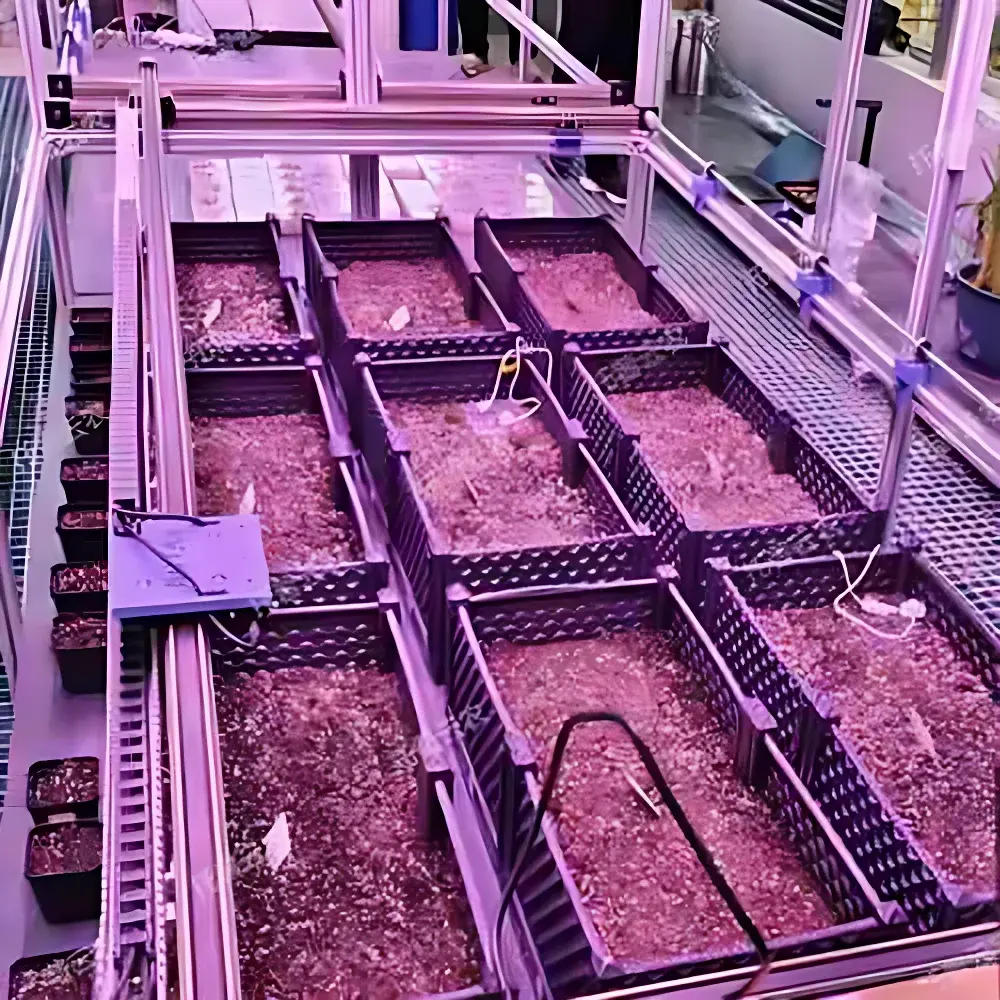
Top Cloud-agri TPN-PlantPhy Plant Phenotyping Platform with Controlled Environment Chamber
| Brand | Top Cloud-agri |
|---|---|
| Origin | Zhejiang, China |
| Manufacturer Type | Direct Manufacturer |
| Region of Origin | Domestic (China) |
| Model | TPN-PlantPhy |
| Pricing | Upon Request |
| Power Supply | AC 220 V, 50 Hz |
| Operating Temperature Range | 0–40 °C |
| Operating Relative Humidity | 40–90 % RH (non-condensing) |
| Total Power Consumption | ~500 W |
| RGB Imaging Module | 48 MP industrial camera (5312 × 6000 resolution), 1 fps capture rate |
| Depth Sensing Module | 1280 × 720 depth resolution, 1920 × 1080 RGB resolution, 30 fps output, FoV (depth): 85.2° × 58° × 94° (±3°), FoV (RGB): 69.4° × 42.5° × 77° (±3°), Min/Max Measuring Distance: 300 mm / 3 m |
| Illumination System | Uniform diffuse LED panel light source |
Overview
The Top Cloud-agri TPN-PlantPhy Plant Phenotyping Platform with Controlled Environment Chamber is an integrated hardware-software system engineered for high-resolution, non-destructive, longitudinal phenotypic monitoring of plants under precisely regulated environmental conditions. Designed for plant factories, controlled-environment growth facilities, and breeding research stations, the platform combines a climate-controlled chamber with synchronized multimodal imaging—RGB and depth sensing—to enable quantitative analysis of morphological, chromatic, and textural traits across developmental stages. Its core measurement architecture relies on calibrated visible-light imaging coupled with structured-light or time-of-flight depth acquisition, enabling robust 3D plant reconstruction and volumetric trait estimation. The system implements CCM (Color Correction Matrix)-based cross-illumination normalization to ensure spectral consistency across variable lighting regimes—a critical requirement for longitudinal studies where illumination geometry or intensity may shift over time. By integrating morphological segmentation algorithms with lightweight convolutional neural networks (CNNs), the platform achieves automated seed-point initialization, leaf-level segmentation, and pixel-wise trait mapping without manual intervention.
Key Features
- Controlled-environment integration: Fully sealed chamber with programmable temperature (0–40 °C), humidity (40–90 % RH, non-condensing), and uniform diffuse LED illumination—ensuring reproducible physiological conditions across replicates.
- Dual-spectrum imaging suite: 48 MP RGB industrial camera (5312 × 6000) for high-fidelity color and texture capture at 1 fps; synchronized depth sensor (1280 × 720 depth + 1920 × 1080 RGB) operating at 30 fps with calibrated field-of-view alignment for geometrically consistent 3D reconstruction.
- Automated trait extraction engine: Computes ≥16 morphological parameters—including plant height, canopy width/length/area/volume, canopy height ratio, compactness, eccentricity, roundness, and leaf curl index—using validated segmentation pipelines compliant with ISO 21748 and ASTM E2922 guidelines for image-based plant phenotyping.
- Chromatic quantification: Derives ≥18 color indices—including ExG (Excess Green), ExR (Excess Red), normalized RGB channels, and RHS (Royal Horticultural Society) color space mapping—enabling objective assessment of chlorophyll status, senescence progression, and stress-induced pigment shifts.
- Texture analytics module: Quantifies surface homogeneity and structural smoothness via GLCM (Gray-Level Co-occurrence Matrix)-derived metrics—including contrast, entropy, and uniformity—supporting detection of epidermal anomalies, disease lesions, or water-stress-induced microstructural changes.
- Secure, scalable data infrastructure: Local encrypted storage with configurable retention policies; metadata-tagged dataset versioning; export support for CSV, HDF5, and FAIR-compliant NetCDF formats; optional integration with LIMS or ELN systems via RESTful API.
Sample Compatibility & Compliance
The TPN-PlantPhy platform accommodates a broad range of plant materials—from germinating seeds in multi-well trays to mature rosettes and upright crops (e.g., Arabidopsis, lettuce, tomato, wheat, rice) grown in hydroponic or substrate-based systems. Its modular chamber design supports standardized tray dimensions (up to 600 × 400 mm) and adjustable imaging height (300–3000 mm), ensuring compatibility with diverse growth containers and developmental stages. All optical components meet IEC 62471 photobiological safety standards for LED lighting. Software workflows adhere to GLP principles, including full audit trails, user authentication, electronic signatures, and FDA 21 CFR Part 11–compliant data integrity controls when configured for regulated environments.
Software & Data Management
The proprietary TopPheno™ Analysis Suite provides a browser-based interface with role-based access control and offline operation capability. Image preprocessing includes flat-field correction, vignetting compensation, and CCM-driven illumination normalization. Trait computation pipelines are containerized (Docker) for reproducibility and version traceability. Batch processing supports parallelized analysis of hundreds of images per hour. Raw and processed datasets are stored with embedded MIAPPE (Minimum Information About a Plant Phenotyping Experiment) metadata. Export modules generate publication-ready figures and statistical summaries compatible with R, Python (scikit-image, PlantCV), and MATLAB workflows. Optional cloud synchronization enables cross-site collaboration while maintaining local data sovereignty.
Applications
- High-throughput phenotyping in forward and reverse genetics programs—enabling QTL mapping and GWAS validation through time-series trait trajectories.
- Controlled-environment screening for abiotic stress tolerance (drought, heat, salinity) using dynamic canopy closure rate, thermal dissipation efficiency, and pigment stability indices.
- Optimization of LED spectral recipes in vertical farming by correlating light quality with morphometric outputs (e.g., stem elongation, leaf expansion rate).
- Pre-breeding selection of ideotypes for mechanized harvesting—leveraging compactness, symmetry, and lodging resistance metrics derived from 3D point-cloud analysis.
- Validation of digital twin models in crop simulation frameworks (e.g., APSIM, DSSAT) using empirically measured organ-level growth dynamics.
FAQ
Is the system compatible with third-party environmental control systems?
Yes—the TPN-PlantPhy supports Modbus TCP and BACnet/IP protocols for bidirectional integration with external HVAC, irrigation, or CO₂ controllers.
Can the software be deployed on-premises without internet connectivity?
Absolutely—all core functionality operates in air-gapped mode; cloud features are opt-in and require explicit configuration.
Does the system support multi-timepoint 3D reconstruction for growth modeling?
Yes—time-synchronized RGB-D stacks can be registered and fused into voxel-based growth maps with sub-millimeter spatial registration accuracy.
What calibration standards are included for color and depth accuracy verification?
The platform ships with NIST-traceable X-Rite ColorChecker Passport and certified planar calibration targets for both RGB and depth modules, accompanied by automated calibration reporting.
How is data provenance maintained during long-term experiments spanning months?
Each image is stamped with hardware-acquired timestamps, environmental sensor logs (T/RH/light intensity), and cryptographic hash signatures—ensuring full traceability per ALCOA+ (Attributable, Legible, Contemporaneous, Original, Accurate, Complete, Consistent, Enduring, Available) principles.




