
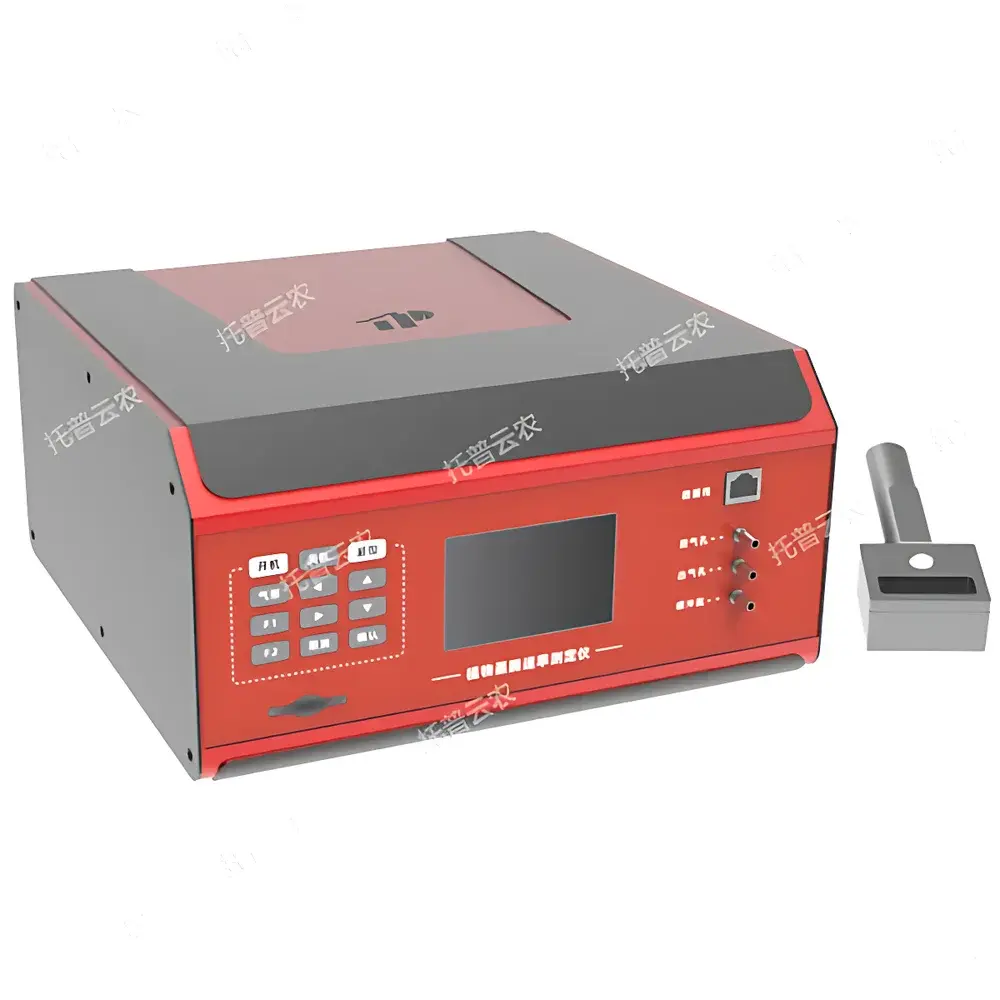
Top Cloud-agri TPZT-1000 Portable Plant Transpiration Rate & Stomatal Conductance Analyzer
| Brand | Top Cloud-agri |
|---|---|
| Origin | Zhejiang, China |
| Manufacturer Type | Direct Manufacturer |
| Country of Origin | China |
| Model | TPZT-1000 |
| Air Temperature Range | 0–50 °C, Resolution: 0.1 °C, Accuracy: ±0.2 °C |
| Air Humidity Range | 0–100% RH, Resolution: 0.1% RH, Accuracy: ≤±3% RH |
| Leaf Temperature Range | 0–50 °C, Resolution: 0.1 °C, Accuracy: ±0.2 °C |
| PAR Range | 0–2500 μmol·m⁻²·s⁻¹, Accuracy: <5 μmol·m⁻²·s⁻¹ |
| Flow Rate Range | 0–1 L/min, Resolution: 0.1 L/min |
| Display | 320×160 dot-matrix LCD with Chinese interface |
| Standard Leaf Chamber Dimensions | 55×20 mm (customizable) |
| Data Storage | 2 GB microSD card |
| Power Supply | DC 7.4 V rechargeable Li-ion battery, continuous operation: 7–9 h |
Overview
The Top Cloud-agri TPZT-1000 Portable Plant Transpiration Rate & Stomatal Conductance Analyzer is a field-deployable, open-system gas exchange instrument engineered for real-time, non-destructive quantification of plant water vapor flux and stomatal behavior. It operates on the principle of steady-state diffusion analysis: by precisely controlling and measuring airflow across a sealed leaf chamber, the system calculates transpiration rate (E, in mmol·m⁻²·s⁻¹) and stomatal conductance (gs, in mol·m⁻²·s⁻¹) using simultaneous high-resolution measurements of leaf temperature, ambient air temperature and relative humidity, photosynthetically active radiation (PAR), and volumetric flow rate. Designed for ecophysiological fieldwork and controlled-environment phenotyping, the TPZT-1000 delivers reproducible, traceable data aligned with standard methodologies described in ASTM E1334 (Standard Guide for Measurement of Plant Water Status) and ISO 11274 (Soil Quality — Determination of Water Retention Characteristics). Its compact architecture supports rapid deployment in orchards, agroforestry plots, greenhouse trials, and natural vegetation stands without requiring external power or compressed gas sources.
Key Features
- Integrated multi-sensor measurement platform: Simultaneous acquisition of leaf temperature (infrared thermopile), ambient air temperature/humidity (capacitive hygrometer), PAR (quantum sensor calibrated to NIST-traceable standards), and mass flow (thermal anemometer).
- Modular leaf chamber design: Standard 55 × 20 mm rectangular chamber optimized for dicot leaves; optional circular, elliptical, or custom-sized chambers available for monocots, conifer needles, or juvenile foliage.
- Real-time calculation engine: Onboard firmware computes transpiration rate (E), stomatal conductance (gs), vapor pressure deficit (VPD), and intrinsic water-use efficiency (iWUE = A/gs) using internationally accepted physical equations (e.g., Penman-Monteith derivations for gs).
- Field-rugged human interface: Backlit 320×160 pixel monochrome LCD with intuitive Chinese-language menu navigation, real-time graphing of parameter trends, and immediate numeric readout of all derived and raw variables.
- Battery-operated portability: Integrated 7.4 V Li-ion battery enables 7–9 hours of continuous measurement under typical field conditions (25 °C, 50% RH, 300 μmol·m⁻²·s⁻¹ PAR); USB-C charging and low-power sleep mode extend operational readiness.
Sample Compatibility & Compliance
The TPZT-1000 accommodates a broad spectrum of plant morphologies through interchangeable chamber configurations, validated for use with herbaceous crops (e.g., wheat, rice, tomato), woody perennials (apple, grapevine), forage species (alfalfa, ryegrass), and native shrubs. All sensors comply with IEC 60751 (Pt100 temperature sensor accuracy class B), ISO 7726 (ergonomic thermal environment instrumentation), and DIN 5031-10 (spectral responsivity calibration for PAR sensors). Data acquisition meets GLP-aligned requirements: timestamped entries, operator ID logging (via optional alphanumeric input), and immutable SD card storage supporting audit-ready export to CSV or Excel-compatible formats. While not certified to FDA 21 CFR Part 11, the system supports manual electronic record integrity protocols required for academic publication and grant-funded research reporting.
Software & Data Management
Raw and processed data are stored locally on a removable 2 GB microSD card in structured .csv format, including header metadata (date, time, chamber ID, operator tag, environmental conditions). Optional PC software (Windows/macOS compatible) enables post-hoc batch analysis, baseline correction, diurnal curve fitting, and export to common statistical platforms (R, Python pandas, JMP). The software includes built-in validation checks for sensor drift detection (e.g., PAR zero-offset verification at night), outlier flagging based on VPD-driven physiological plausibility thresholds, and automated unit conversion (e.g., mmol·m⁻²·s⁻¹ ↔ g·m⁻²·h⁻¹). No cloud synchronization or proprietary file locking is implemented—ensuring full user ownership and long-term archival compatibility.
Applications
- Drought stress phenotyping: Quantifying dynamic gs responses to progressive soil drying or vapor pressure deficit manipulation in breeding programs.
- Irrigation scheduling optimization: Correlating real-time transpiration rates with soil moisture sensor networks to refine evapotranspiration-based irrigation triggers.
- Climate change physiology: Assessing interspecific differences in stomatal sensitivity to elevated CO₂ or temperature gradients across elevational transects.
- Educational laboratories: Teaching core concepts of plant water relations, energy balance, and gas exchange biophysics using hands-on, repeatable experiments.
- Urban forestry monitoring: Evaluating transpirational cooling capacity of street trees under heat island conditions using repeated midday measurements.
FAQ
What is the recommended calibration frequency for the TPZT-1000 sensors?
We recommend field calibration of the humidity and temperature sensors before each major experimental campaign using saturated salt solutions (e.g., LiCl for 11% RH, NaCl for 75% RH) and a NIST-traceable reference thermometer. PAR sensor calibration should be verified annually against a laboratory-grade spectroradiometer.
Can the TPZT-1000 measure net photosynthesis (An)?
No—the TPZT-1000 is configured exclusively for water vapor flux analysis. It does not incorporate CO₂ analyzers or infrared gas analyzers (IRGA), and therefore cannot compute carbon assimilation rates. It is complementary to dedicated photosynthesis systems such as the LI-6400XT or Walz GFS-3000.
Is the leaf chamber suitable for measuring small or compound leaves?
Yes—custom chamber geometries (e.g., 15 mm diameter circular, 10×10 mm square) can be ordered to accommodate young seedlings, fern pinnae, or legume leaflets. Chamber gasket materials are silicone-based to ensure seal integrity on waxy or hairy abaxial surfaces.
Does the device support external GPS or environmental dataloggers?
The TPZT-1000 does not feature built-in GPS or analog input ports. However, its timestamped CSV output allows post-acquisition spatial alignment using third-party GIS tools when paired with handheld GPS units or site-specific georeferenced sampling protocols.
How is data integrity maintained during extended field deployments?
The microSD card implements wear-leveling and error-correcting code (ECC) logic. Each measurement record includes CRC-16 checksums, and the device performs automatic file-system consistency checks upon startup and shutdown to prevent corruption from abrupt power loss.
Related Products





