
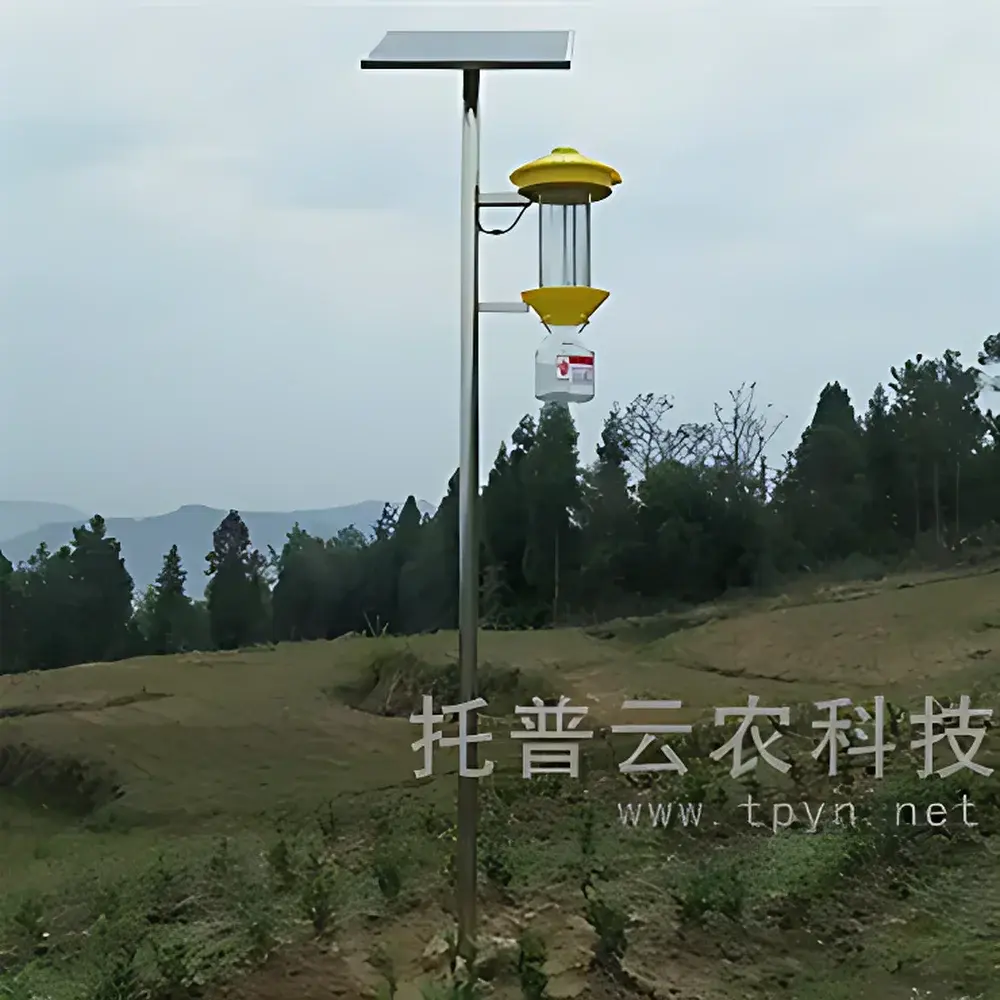
Top Cloud-agri TPSC3-3 Solar-Powered Photocatalytic Insect Trap
| Brand | Top Cloud-agri |
|---|---|
| Origin | Zhejiang, China |
| Manufacturer Type | OEM/ODM Manufacturer |
| Product Origin | Domestic (China) |
| Model | TPSC3-3 |
| Price | USD 760 (FOB Zhejiang) |
| Solar Panel | Monocrystalline Silicon, ≥50 W |
| Battery | Integrated Lithium-ion, ≥24 Ah |
| Operating Voltage | Safe-Low-Voltage DC Output |
| Grid Voltage | ≥4000 V |
| Grid Wire Diameter | ≥2 mm |
| Wire Spacing | ≤12 mm |
| Capture Area | ≥0.15 m² |
| Pole Height | ≥2.6 m, Ø63 mm |
| LED Lamp Tube | ≥33 cm length, ≥80 high-efficiency UV-A LEDs, 8-sided circular emission array |
| Heat Dissipation | Aluminum Core ≥30 cm |
| Protection Features | Rain Control, Light Control, Time Control, Auto-Cleaning Mechanism, Lightning Protection (Ground Resistance ≤4 Ω) |
Overview
The Top Cloud-agri TPSC3-3 Solar-Powered Photocatalytic Insect Trap is an autonomous, off-grid pest management instrument engineered for long-term deployment in remote agricultural fields, orchards, tea plantations, and ecological reserves where grid electricity is unavailable or unreliable. It operates on the principle of phototactic attraction—emitting targeted UV-A radiation (320–400 nm) to stimulate visual orientation responses in nocturnal flying insects, followed by electrocution via a high-voltage stainless-steel grid. Unlike chemical insecticides or manual trapping methods, this device delivers non-residual, species-selective control without introducing active ingredients into soil or water systems. Its integrated solar energy architecture enables continuous operation across seasonal variations, including overcast and rainy conditions, supporting sustainable integrated pest management (IPM) frameworks aligned with FAO’s Good Agricultural Practices (GAP) and China’s Green Food Production Standards.
Key Features
- Stainless-steel structural pole (Ø63 mm, ≥2.6 m height) with corrosion-resistant anodized finish for outdoor durability in humid, saline, or acidic soil environments.
- Modular, snap-fit collection tray with transparent polycarbonate lid—designed for rapid field inspection, specimen retrieval, and quantitative pest density assessment.
- Dual-layer insulation system isolating high-voltage grid circuitry from low-voltage control electronics; HV and LV wiring routed through separate sealed conduit pathways to eliminate cross-interference and ensure operator safety.
- UV-A LED lamp tube featuring 80+ high-luminance diodes arranged in an octagonal radial configuration—optimized for omnidirectional irradiance uniformity and spectral consistency over >10,000 hours L70 lifetime.
- Intelligent environmental adaptation: light-sensing photocell triggers activation at dusk; rain sensor suspends operation during precipitation; programmable timer supports multi-stage nightly cycles (e.g., 6 h ON / 2 h OFF).
- Self-cleaning mechanical wiper mechanism activated hourly to remove insect residue from grid surfaces—maintaining consistent discharge efficiency and minimizing maintenance intervals.
- Built-in lightning protection system compliant with IEC 62305-3:2010, with grounding resistance verified ≤4 Ω—critical for installation in open-field topographies prone to atmospheric discharge.
Sample Compatibility & Compliance
The TPSC3-3 is validated for monitoring and suppression of Lepidoptera (moths), Coleoptera (beetles), Diptera (flies), and Hemiptera (leafhoppers)—key vectors of crop pathogens such as rice blast fungus (Magnaporthe oryzae) and citrus greening (Candidatus Liberibacter asiaticus). Its capture efficiency has been field-tested under GB/T 24689.2–2009 (Chinese National Standard for Plant Protection Equipment) and meets IP65 ingress protection rating per IEC 60529. While not classified as a medical or laboratory diagnostic device, its data output (daily catch volume, species composition via morphological ID) supports GLP-aligned field trial documentation when paired with standardized sampling protocols (e.g., ISO 7816-2 for biological sample logging).
Software & Data Management
The TPSC3-3 operates as a standalone hardware unit without embedded Wi-Fi or cloud connectivity. However, it supports interoperability with Top Cloud-agri’s AgriSense™ Field Data Platform via optional RS-485 or LoRaWAN add-on modules (sold separately). When integrated, trap status—battery voltage, solar charge rate, grid continuity, and cumulative operating hours—is transmitted to centralized dashboards for spatial-temporal pest outbreak mapping. All firmware adheres to IEC 62443-3-3 cybersecurity baseline requirements, and audit logs comply with traceability mandates under China’s Agricultural Product Quality and Safety Law (2023 Amendment). Raw catch data export is compatible with Excel (.csv), QGIS (.shp), and R statistical environments for regression modeling of pest population dynamics.
Applications
- Large-scale monitoring of Chilo suppressalis (striped stem borer) in paddy ecosystems, enabling early-warning thresholds for targeted biocontrol intervention.
- Border surveillance of invasive species—including Spodoptera frugiperda (fall armyworm)—in transboundary agroecological corridors.
- Organic certification compliance: documented reduction in synthetic pyrethroid applications across certified tea estates in Zhejiang and Fujian provinces.
- Educational deployment in agricultural extension centers for hands-on training in IPM strategy design, phenology tracking, and resistance management planning.
- Baseline entomological surveys prior to pesticide registration trials—providing pre-treatment pest abundance metrics required by OECD 508 guidelines.
FAQ
Does the TPSC3-3 require external power or grid connection?
No. It is fully self-sufficient, powered exclusively by its integrated 50 W monocrystalline solar panel and 24 Ah lithium-ion battery.
Can the device operate continuously during extended rainy periods?
Yes. With full solar charge, the battery sustains ≥7 days of uninterrupted operation under zero-insolation conditions.
Is the high-voltage grid safe for non-target organisms and field personnel?
The grid operates at ≥4000 V but delivers microsecond-duration pulses with current limited to <5 mA—meeting IEC 61000-4-5 surge immunity and EN 60335-1 safety standards for outdoor electrical equipment.
How is pest identification supported?
The transparent collection tray enables in situ morphological examination; specimens may be transferred to digital microscopes (e.g., Dino-Lite AM4113X) for taxonomic verification using FAO’s Pest Diagnostic Keys.
What maintenance schedule is recommended?
Bi-weekly visual inspection of grid integrity and LED output; quarterly cleaning of solar panel surface; annual battery capacity verification using a calibrated DC load tester.






