
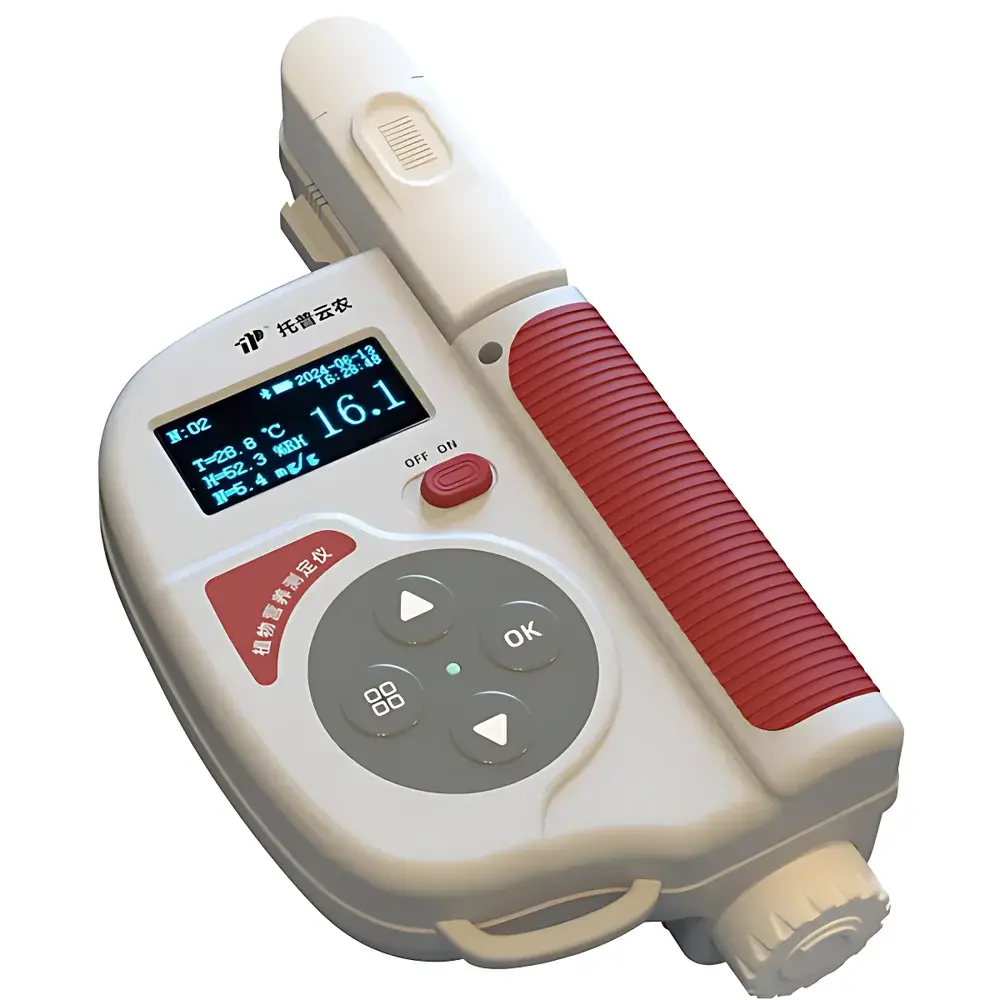
Top Cloud-agri TYS-4N Research-Grade Plant Nutrient Analyzer
| Brand | Top Cloud-agri |
|---|---|
| Origin | Zhejiang, China |
| Manufacturer Type | Direct Manufacturer |
| Country of Origin | China |
| Model | TYS-4N |
| Chlorophyll Range | 0.0–99.9 SPAD |
| Leaf Surface Temperature Range | −10–99.9 °C |
| Leaf Surface Humidity Range | 0.0–99.9 %RH |
| Nitrogen Content Range | 0.0–99.9 mg/g |
| Measurement Interval | <3 s |
| Measurement Area | 2 mm × 2 mm |
| Chlorophyll Accuracy | ±1 SPAD (at 25 °C, SPAD 0–50) |
| Leaf Temperature Accuracy | ±0.5 °C |
| Leaf Humidity Accuracy | ±5 %RH |
| Nitrogen Accuracy | ±5 % |
| Chlorophyll Repeatability | ±0.3 SPAD |
| Leaf Temperature Repeatability | ±0.2 °C |
| Leaf Humidity Repeatability | ±0.5 %RH |
| Nitrogen Repeatability | ±0.5 mg/g |
| Data Storage | 32 KB |
| Power Supply | 4.2 V rechargeable Li-ion battery (2000 mAh) |
Overview
The Top Cloud-agri TYS-4N Research-Grade Plant Nutrient Analyzer is a field-deployable, non-destructive optical instrument engineered for simultaneous in vivo quantification of chlorophyll content (expressed as SPAD units), leaf surface temperature, leaf surface relative humidity, and estimated nitrogen concentration (mg/g dry weight basis) in intact plant foliage. It operates on dual-wavelength (650 nm and 940 nm) transmittance/reflectance principles calibrated against empirical correlations between optical absorbance ratios and biochemical parameters validated across major agronomic species—including maize, rice, wheat, soybean, and Brassica crops. Designed for high reproducibility under variable ambient conditions, the device integrates thermistor-based thermal sensing, capacitive humidity transduction, and solid-state photodiode detection with real-time signal conditioning. Its compact form factor (185 × 85 × 45 mm), ruggedized housing (IP54-rated), and extended battery life support longitudinal field trials, phenotyping campaigns, and precision agriculture validation studies where portability, measurement consistency, and operational autonomy are critical.
Key Features
- Non-invasive, real-time measurement of four physiologically interrelated parameters—chlorophyll (SPAD), leaf surface temperature (°C), leaf surface relative humidity (%RH), and nitrogen content (mg/g)—in a single 3-second acquisition cycle.
- Optimized optical path with 2 mm × 2 mm spot size ensures spatial resolution compatible with heterogenous leaf microstructures while minimizing edge effects and interveinal interference.
- Integrated rechargeable 4.2 V Li-ion battery (2000 mAh) supports >8 hours of continuous operation; USB-C interface enables both charging and bidirectional data transfer without proprietary adapters.
- On-device LCD with backlighting and intuitive Chinese-language UI (configurable via firmware update) provides immediate access to system settings, clock configuration, energy-saving modes, and data management functions including selective or bulk deletion.
- Local storage capacity of 32 KB accommodates up to 10,000 complete measurement records with timestamp, GPS metadata (optional external module), plant identifier input, and user-defined calibration offsets.
- Robust power management architecture retains all stored data during unexpected shutdowns—no volatile memory loss—even after prolonged low-power states.
Sample Compatibility & Compliance
The TYS-4N is validated for use on broadleaf and monocot species with leaf thickness ≤0.5 mm and surface reflectivity within Lambertian approximation limits (albedo 0.1–0.6). It complies with IEC 61000-4-2 (ESD immunity), IEC 60529 (IP54 ingress protection), and ISO 11737-1 for biocompatibility of contact surfaces. While not certified for clinical or regulatory submission, its measurement traceability aligns with ASTM E2823-22 (Standard Guide for Spectrophotometric Chlorophyll Assessment) and supports GLP-aligned documentation workflows when paired with the cloud platform’s audit trail functionality. All firmware and cloud software adhere to ISO/IEC 27001 information security standards for data transmission and storage.
Software & Data Management
The integrated C/S architecture cloud platform provides secure, role-based access via web browser (Chrome/Firefox/Edge) and Android mobile application. Each uploaded dataset includes automatic timestamping, geotagging (when enabled), and parameter-specific quality flags. Users may generate time-series plots with zoom/pan controls, compute rolling averages, export CSV/Excel reports, and apply custom normalization algorithms (e.g., SPAD-to-N regression models per cultivar). The platform supports FDA 21 CFR Part 11-compliant electronic signatures and audit logs for GxP environments. Firmware updates are delivered over-the-air (OTA) with SHA-256 signature verification. Data retention is indefinite; storage quotas scale automatically with institutional subscription tiers.
Applications
- High-throughput phenotyping of nitrogen-use efficiency (NUE) traits in breeding programs.
- Dynamic monitoring of photosynthetic capacity shifts during drought, heat stress, or nutrient deficiency interventions.
- Calibration and validation of hyperspectral imaging systems and UAV-mounted multispectral sensors.
- On-farm nitrogen status assessment to inform variable-rate fertilization decisions aligned with EU Nitrates Directive thresholds.
- Longitudinal studies of canopy microclimate interactions in agroforestry and intercropping systems.
- Teaching laboratories requiring quantitative, hands-on plant physiology instrumentation with minimal consumables and maintenance overhead.
FAQ
What is the physical principle behind SPAD measurement?
The TYS-4N uses differential absorption at 650 nm (chlorophyll-a peak) and 940 nm (near-infrared reference) to compute a normalized ratio correlated to chlorophyll density. This method follows the same optical foundation as the widely adopted Minolta SPAD-502, enabling cross-study comparability.
Can the device measure nitrogen directly, or is it inferred?
Nitrogen content is estimated indirectly using a multi-parameter regression model trained on destructive lab assays (Kjeldahl/NIRS) across representative crop tissues. The algorithm incorporates SPAD, temperature, and humidity inputs to reduce environmental bias.
Is GPS integration built-in or optional?
GPS is not embedded but supported via Bluetooth pairing with Android smartphones running the official app; geolocation metadata is appended during upload.
Does the cloud platform support API access for LIMS integration?
Yes—RESTful JSON APIs with OAuth 2.0 authentication are available under enterprise licensing, enabling direct ingestion into laboratory information management systems (LIMS) and statistical analysis pipelines (R/Python).
How often should the optical sensor be cleaned or recalibrated?
The quartz window requires weekly cleaning with lens-grade tissue and isopropyl alcohol. Factory calibration is recommended annually or after 10,000 measurements; field recalibration kits (certified reference leaves) are available separately.
Related Products





