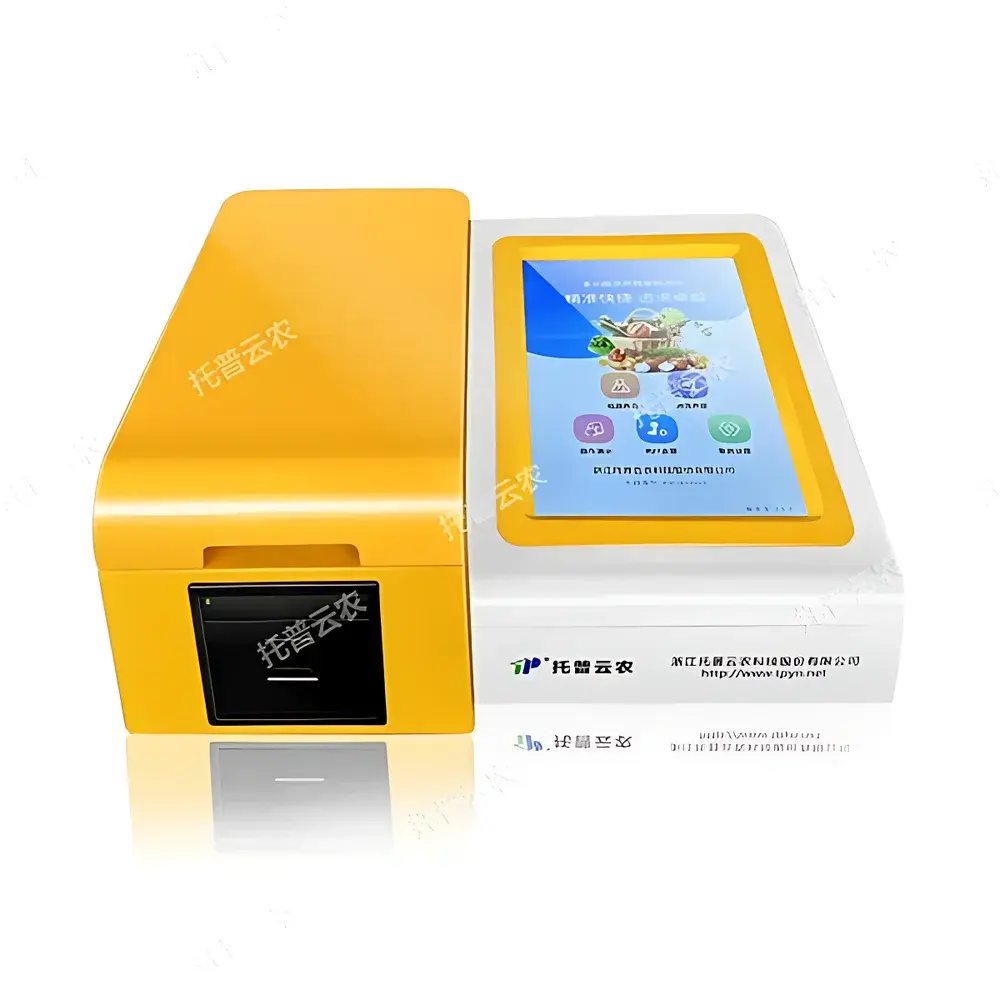
Top Cloud-agri TP-SJ-12 Multi-Function Food Safety Analyzer
| Brand | Top Cloud-agri |
|---|---|
| Origin | Zhejiang, China |
| Manufacturer Type | Direct Producer |
| Country of Origin | China |
| Model | TP-SJ-12 |
| Pricing | Available Upon Request |
Overview
The Top Cloud-agri TP-SJ-12 Multi-Function Food Safety Analyzer is an integrated, field-deployable analytical platform engineered for rapid, on-site screening of chemical contaminants, biological toxins, and adulterants across the food supply chain. It combines dual optical detection architectures—12-channel multi-wavelength photometric absorption spectroscopy (340–850 nm) and triple-channel lateral-flow immunochromatographic strip analysis (colloidal gold-based)—to deliver quantitative and semi-quantitative results within seconds. The instrument operates on a validated photometric principle: absorbance (A) is measured per Beer-Lambert law (A = ε·c·l), while colloidal gold signal intensity is quantified via reflectance imaging and CT-line ratio algorithms. Designed for regulatory-compliant pre-screening in agricultural cooperatives, food processing facilities, market supervision stations, and third-party testing labs, the TP-SJ-12 supports early hazard identification aligned with national food safety standards (GB 2763, GB 5009 series) and international reference frameworks including Codex Alimentarius guidelines.
Key Features
- Integrated dual-module architecture: 12 independent photometric channels + 3 colloidal gold strip readers—enabling concurrent analysis of diverse analyte classes without hardware reconfiguration.
- 10.1-inch capacitive touch display running Android OS 9.0, optimized for glove-compatible operation and intuitive workflow navigation with context-aware prompts.
- Built-in thermal printer supporting three output formats: A4 diagnostic reports, peel-off adhesive compliance labels (for traceability tagging), and batch-certification stickers compliant with GB/T 19001 traceability requirements.
- Real-time data synchronization via dual-network redundancy: IEEE 802.11ac Wi-Fi + 10/100 Mbps Ethernet (RJ45); optional LTE/4G module enables geotagged uploads to cloud platforms with TLS 1.2 encryption.
- On-device data integrity safeguards: Automatic timestamping, operator ID logging, and immutable audit trails—structured to support GLP-aligned documentation and FDA 21 CFR Part 11–compatible electronic records when deployed with validated cloud services.
- Modular expandability: Pre-defined firmware slots for future method validation; hardware-ready interfaces for peripheral modules (e.g., portable centrifuge, sample homogenizer, barcode scanner).
Sample Compatibility & Compliance
The TP-SJ-12 accepts liquid extracts, supernatants, and lateral-flow test strips prepared from raw or processed matrices—including fresh produce, cereals, meat homogenates, aquatic tissue lysates, dairy products, honey, herbal supplements, cosmetics, and environmental swabs. Sample preparation follows standardized extraction protocols referenced in GB/T 5009.x, SN/T 1943, and AOAC Official Methods®. Detection capabilities cover >150 validated targets, grouped into six regulatory categories: pesticide residues (organophosphates, carbamates, pyrethroids), veterinary drug residues (β-agonists, fluoroquinolones, nitrofurans, sulfonamides), mycotoxins (aflatoxin B1, zearalenone, deoxynivalenol), food additives & adulterants (formaldehyde, Sudan dyes, melamine), heavy metals (Cd, Pb, As via colorimetric chelation assays), and pathogen antigens (Salmonella spp., E. coli O157:H7). All onboard assays are verified against reference materials certified by CNAS-accredited providers (e.g., NIM, CICR) and meet repeatability criteria (CV < 1% intra-assay; <3% inter-batch) per ISO 5725-2.
Software & Data Management
The embedded Android application provides role-based access control (administrator, technician, auditor), configurable reporting templates (PDF/CSV), and automated statistical summaries (mean, SD, pass/fail rate per batch). Data flows through a secure RESTful API to the Top Cloud-agri AgriTrace™ cloud platform, enabling cross-facility dashboards, trend analysis over time-series, and integration with provincial food safety monitoring systems (e.g., Zhejiang Provincial Market Supervision Platform). Audit logs record every measurement event—including environmental temperature/humidity (via optional sensor), calibration status, and user authentication—retained for ≥18 months per GB/T 22239 (China’s Cybersecurity Level Protection Standard). Optional 21 CFR Part 11 add-on package delivers electronic signature enforcement, biometric login, and change-control history for GMP-regulated environments.
Applications
- Pre-harvest surveillance: Field-level pesticide residue screening in leafy vegetables, fruits, and tea leaves prior to distribution.
- Processing line QC: Real-time verification of preservative levels (sodium nitrite, SO₂), oil quality indices (peroxide value, acid value), and adulterant presence (melamine in milk powder).
- Retail market inspection: Rapid verification of labeling claims (e.g., organic certification, gluten-free status) and detection of banned substances (clenbuterol in pork, rhodamine B in chili powder).
- Regulatory enforcement: Mobile deployment by municipal food safety bureaus for unannounced inspections at wet markets, school canteens, and catering hubs.
- Research & method development: Platform for validating novel lateral-flow assays or adapting existing kits to local matrix interference profiles.
FAQ
What regulatory standards does the TP-SJ-12 comply with for data integrity?
It meets GB/T 22239 Level 2 cybersecurity requirements and supports implementation of 21 CFR Part 11 controls when paired with validated cloud infrastructure and electronic signature modules.
Can the instrument validate test strips from third-party manufacturers?
Yes—user-defined calibration curves and threshold parameters can be loaded for non-proprietary lateral-flow assays, provided they conform to standard CT-line geometry and gold nanoparticle conjugate specifications.
Is routine recalibration required between sample batches?
No. Built-in auto-zero and reference channel compensation eliminate manual recalibration; only annual verification against NIST-traceable neutral density filters is recommended.
How is measurement uncertainty managed across different environmental conditions?
Ambient light rejection is achieved via pulsed LED excitation synchronized with CMOS sensor gating; temperature drift is compensated using real-time thermistor feedback in absorbance calculations.
What level of technical support is available for method transfer?
Top Cloud-agri provides documented SOPs, matrix-matched recovery studies, and remote assistance for assay adaptation—subject to formal method validation agreement under ISO/IEC 17025 framework.