
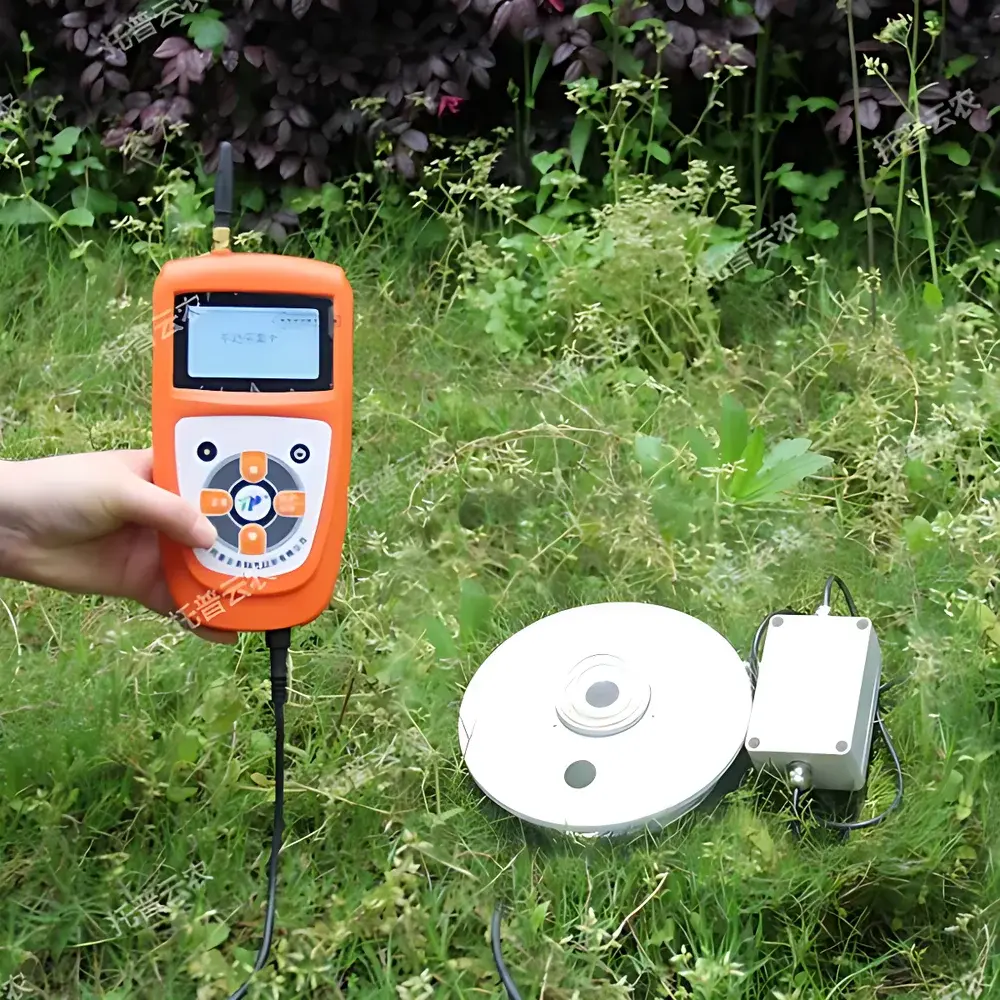
Top Cloud-agri TPJ-24-G Solar Radiation Data Logger
| Brand | Top Cloud-agri |
|---|---|
| Origin | Zhejiang, China |
| Manufacturer Type | OEM/ODM Producer |
| Country of Origin | China |
| Model | TPJ-24-G |
| Pricing | Available Upon Request |
| Measurement Range | 0–2000 W/m² |
| Spectral Response | 300–3000 nm (0.3–3 µm) |
| Sensitivity | 7–14 µV/(W·m⁻²) |
| Internal Memory | 30,000 records (Flash) + optional 4 GB microSD card |
| Data Transmission | GPRS wireless upload with configurable interval or on-demand push |
| Power Supply | 7.4 V / 2.8 Ah Li-ion battery (with low-voltage warning & charging protection) |
| external DC input | 8.4 V ≥1000 mA |
| GPS | Integrated module for automatic geotagging of each measurement |
| Sensor Expansion | Up to 32 analog/digital sensors via IP67-rated hub |
| Operating Temperature | -20°C to +60°C |
| Display | Dot-matrix LCD with full Chinese menu interface |
| Software | Cloud-based C/S architecture platform supporting web and mobile (iOS/Android) access, data visualization (trend curves & tabular reports), export (CSV, PDF), audit-ready storage, and remote firmware updates |
Overview
The Top Cloud-agri TPJ-24-G Solar Radiation Data Logger is a field-deployable, microprocessor-controlled instrument engineered for continuous, high-fidelity monitoring of global solar irradiance—commonly referred to as total solar radiation. It operates on the thermopile principle: incident broadband radiation (300–3000 nm) heats a blackened thermal sensor surface, generating a proportional millivolt-level output calibrated in W/m². Unlike photodiode-based sensors, the TPJ-24-G’s thermopile detector ensures spectrally flat response across the solar spectrum—including near-ultraviolet and near-infrared bands—making it suitable for meteorological validation, agronomic light-use efficiency studies, photovoltaic site assessment, and climate monitoring applications compliant with ISO 9060:2018 Class C specifications. Its compact, ruggedized enclosure (IP65-rated housing) supports unattended operation in outdoor environments, while integrated GPS enables spatially referenced data logging essential for distributed sensor networks and long-term environmental datasets.
Key Features
- Integrated GPRS modem enabling secure, encrypted data transmission to cloud servers at user-defined intervals (5 minutes to 99 hours) or on manual trigger
- Dual-storage architecture: 30,000 records retained in non-volatile Flash memory plus expandable microSD capacity (up to 4 GB standard, scalable)
- Built-in 7.4 V / 2.8 Ah lithium-ion battery with intelligent charge management, low-voltage alerting, and seamless transition to external 8.4 V DC power supply
- High-contrast dot-matrix LCD with full Chinese graphical interface—displaying real-time irradiance values, timestamp, GPS coordinates, memory status, and system diagnostics
- Modular sensor expansion via IP67-rated multi-channel hub; supports up to 32 heterogeneous analog/digital sensors (e.g., PAR, UV-A/B, temperature, humidity) without cross-interference
- Voice feedback capability: configurable Mandarin Chinese audio prompts for operational status, measurement confirmation, and threshold-triggered alarms
- Onboard GPS receiver providing WGS84 latitude/longitude and altitude metadata synchronized with each irradiance reading
Sample Compatibility & Compliance
The TPJ-24-G is designed for open-field deployment under natural sunlight conditions and is compatible with standard mounting hardware (e.g., leveling base, tilt-adjustable tripod). Its spectral response aligns with the ASTM G173-03 reference solar spectral irradiance distribution and meets the minimum performance criteria outlined in ISO 9060:2018 for “secondary standard” pyranometers (Class C). While not certified to IEC 61724-1 for PV monitoring, its calibration traceability supports use in GLP-aligned agricultural research, ecological flux studies, and educational field labs. All firmware and cloud platform operations adhere to basic cybersecurity hygiene standards—including TLS 1.2 encryption for data-in-transit and role-based access control within the management portal.
Software & Data Management
The proprietary Instrument Cloud Platform employs a client-server architecture accessible via HTTPS-secured web browsers (Chrome, Edge, Safari) and native iOS/Android applications. Data ingestion supports both GPRS streaming and USB mass-storage mode for offline synchronization. Each dataset is permanently time-stamped, geotagged, and associated with device-specific metadata (firmware version, sensor ID, calibration date). The platform delivers interactive time-series plots, customizable statistical summaries (min/max/avg/std dev), and exportable reports in CSV, Excel, and PDF formats. Audit-trail functionality logs all user actions (login, download, deletion, configuration changes), satisfying basic documentation requirements for academic integrity and internal QA processes. Over-the-air (OTA) firmware updates ensure long-term maintainability without physical device retrieval.
Applications
- Agricultural microclimate monitoring: quantifying photosynthetically active radiation (PAR) proxies and daily insolation totals for crop modeling and irrigation scheduling
- Renewable energy site feasibility: preliminary solar resource assessment prior to PV or CSP system design
- Environmental education: hands-on atmospheric science experiments in university field courses and K–12 STEM outreach programs
- Ecological research: correlating irradiance patterns with phenological events, canopy transpiration, or soil moisture dynamics
- Urban heat island studies: comparative irradiance mapping across land-cover gradients (e.g., asphalt vs. green roofs)
- Calibration verification: serving as a reference-grade field check for higher-tier pyranometers in maintenance cycles
FAQ
What is the calibration uncertainty of the TPJ-24-G sensor?
The manufacturer specifies factory calibration against a NIST-traceable reference pyranometer; however, no stated expanded uncertainty (k=2) is published. Users requiring metrological traceability should perform periodic recalibration at an accredited laboratory.
Can the device operate continuously for more than one week on battery alone?
Yes—under typical logging intervals (e.g., 15-minute sampling) and ambient temperatures between 15–25°C, battery life exceeds 14 days. Power consumption increases with GPRS transmission frequency and GPS acquisition duty cycle.
Is the cloud platform compliant with FDA 21 CFR Part 11 or EU Annex 11?
No—the platform does not implement electronic signature workflows, audit trail immutability guarantees, or system validation documentation required for regulated GxP environments.
Does the unit support Modbus or SDI-12 communication protocols?
No—sensor communication is proprietary and limited to the designated hub interface. Third-party integration requires API access via the cloud platform’s RESTful endpoints (available upon enterprise licensing).
How is data security handled during wireless transmission?
GPRS payloads are encrypted using AES-128 prior to transmission; TLS 1.2 secures all web and mobile app connections to the cloud server.
Related Products







