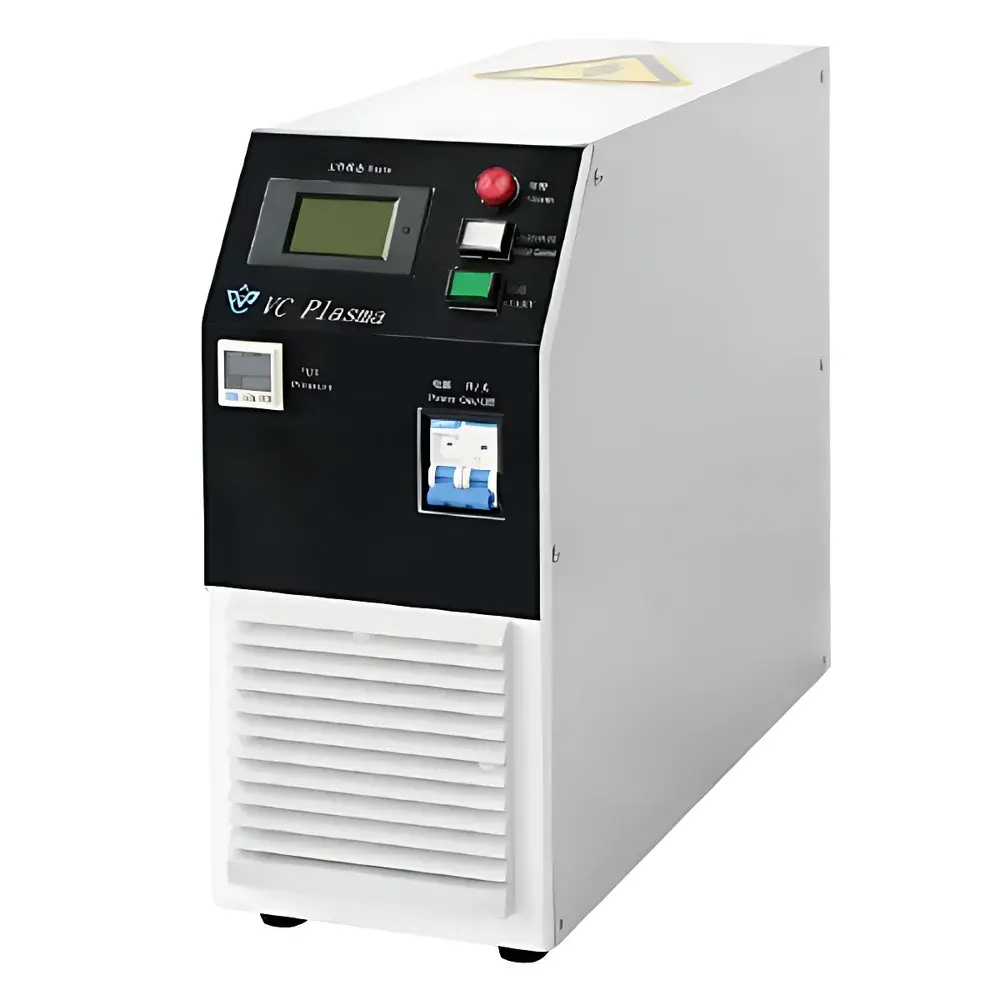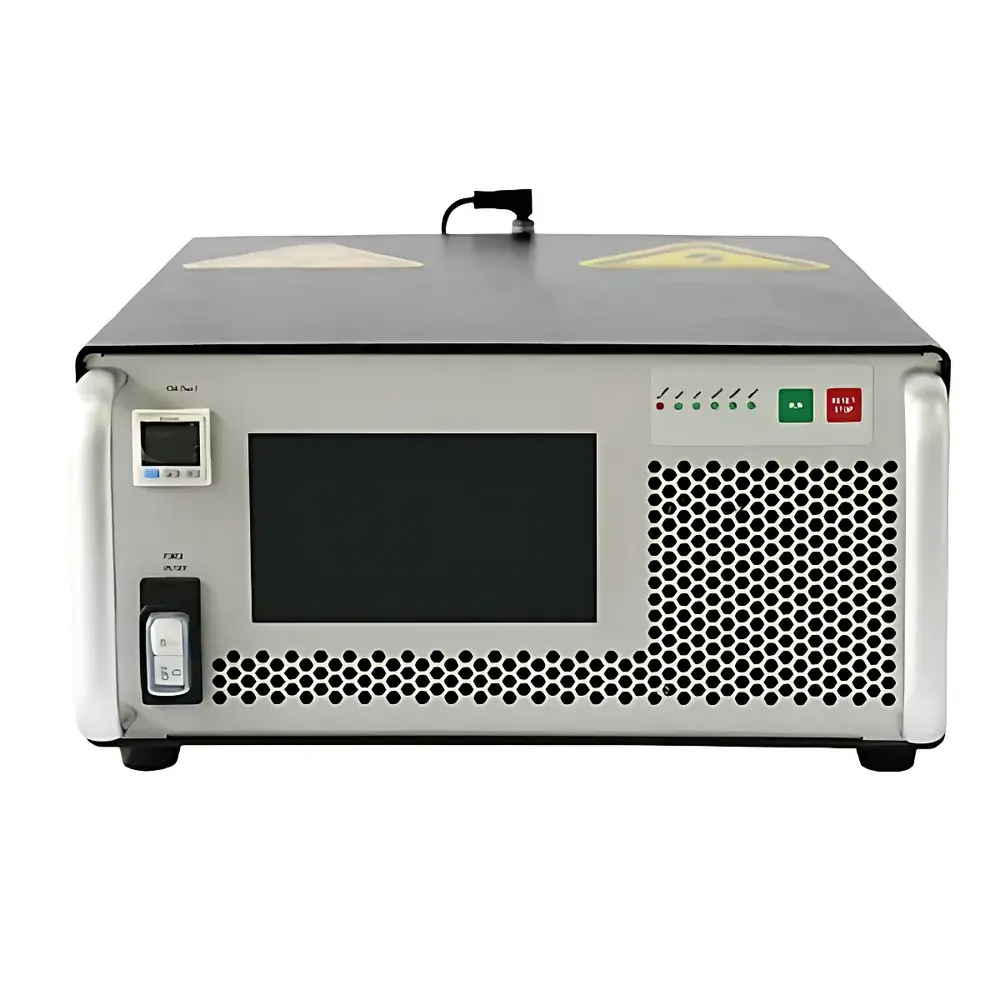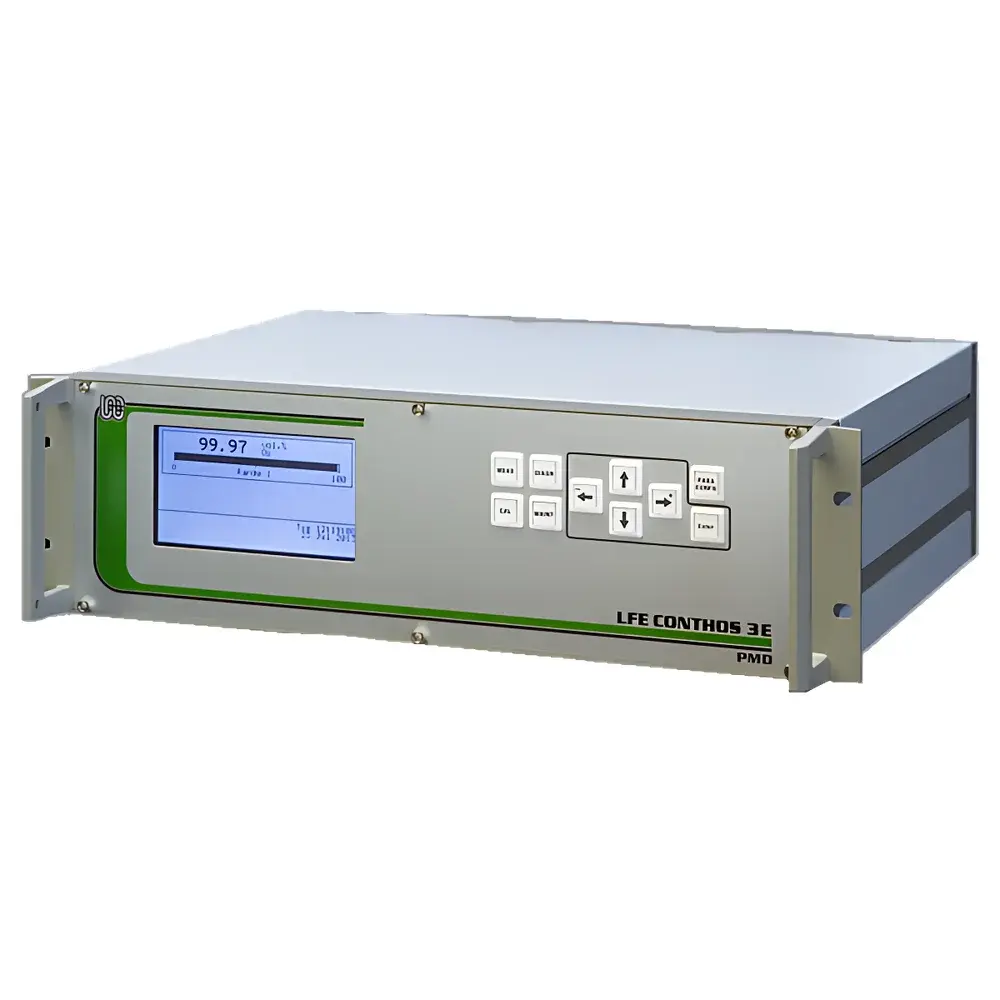
ONUEE CONTHOS 3E PMD In-Line Oxygen Analyzer
| Brand | ONUEE |
|---|---|
| Origin | Germany |
| Model | CONTHOS 3E PMD |
| Measurement Principle | Temperature-Controlled Paramagnetic (Dumbbell-Type) Sensor |
| Response Time | <5 s (gas-flow- and configuration-dependent, configurable integration time) |
| Measuring Ranges | Up to 3 independently configurable, switchable ranges (standard: 0–100% O₂ or 0–25% O₂ |
| min. range | 0–5% O₂ |
| max. range | 0–100% O₂) |
| Detection Limit | <1% of span |
| Repeatability | <±0.03% O₂ |
| Inherent Linearity / Accuracy | ±0.1% O₂ (full scale) |
| Zero Drift | <±0.1% O₂/week |
| Temperature Effect | Zero shift <±0.5% O₂ per 10 K |
| Tilt Sensitivity | Baseline shift of 0.02% O₂ per 1° deviation from horizontal |
| Calibration | Manual 2-point (zero/span) |
| Pressure Compensation | Optional, 800–1200 mbar abs (extendable on request) |
| Interference Compensation | Static and dynamic correction supported (requires proportional selectivity signal for dynamic mode) |
| Operating Detector Temperature | 55 °C |
| Enclosure Rating | IP65 (per EN 60529) |
| Output Interfaces | RS-485 (Modbus RTU), optional digital I/O panel for external range switching and threshold logic |
Overview
The ONUEE CONTHOS 3E PMD is a high-integrity, in-line oxygen analyzer engineered for continuous, real-time monitoring of O₂ concentration in industrial process gas streams. It employs a third-generation microprocessor-controlled paramagnetic detection system—specifically, a temperature-stabilized dumbbell-type paramagnetic sensor—leveraging the unique magnetic susceptibility of molecular oxygen. Unlike electrochemical or zirconia-based analyzers, this principle delivers intrinsic selectivity for O₂ without cross-sensitivity to CO₂, CO, CH₄, H₂O vapor, or most inert gases, provided background matrix interference is evaluated and compensated where necessary. The sensor operates at a precisely maintained 55 °C to minimize thermal drift and ensure long-term baseline stability. Designed for integration into safety-critical and regulatory-compliant environments—including inerting systems, biogas upgrading, air separation units (ASUs), and combustion control loops—the CONTHOS 3E PMD meets the functional safety expectations of continuous emission monitoring (CEM) and process optimization applications in power generation, metallurgy, petrochemical, and chemical manufacturing.
Key Features
- Paramagnetic dumbbell sensor with active temperature control (55 °C) for enhanced zero stability and repeatability (<±0.03% O₂)
- Configurable multi-range operation: up to three independent, software-switchable measuring ranges (e.g., 0–5%, 0–25%, 0–100% O₂), each individually calibrated and scaled
- Optional integrated pressure compensation module (800–1200 mbar abs), eliminating span shift under variable process pressure conditions
- Self-diagnostic capability including sensor health monitoring, temperature validation, and signal integrity verification
- Robust mechanical design compliant with IP65 ingress protection; corrosion-resistant sensor housing options available for aggressive gas matrices (e.g., solvent-laden or acidic streams)
- Intrinsically safe measurement unit option (Ex ia IIC T4 Ga) for installation in hazardous areas handling flammable gas mixtures
- Configurable response time (<5 s typical T₉₀, adjustable via integration time setting) optimized for both fast transient detection and noise-reduced averaging
Sample Compatibility & Compliance
The CONTHOS 3E PMD is validated for use with dry or moderately humid gas streams containing O₂ concentrations from 0–5% up to 0–100% by volume. While paramagnetism provides inherent O₂ specificity, trace-level paramagnetic interferences—such as NO, NO₂, or O₃—must be assessed during system commissioning. For complex matrices (e.g., syngas, landfill gas, or refinery off-gas), optional dynamic interference compensation is supported when a proportional reference signal (e.g., from an auxiliary IR or TCD channel) is available. The analyzer complies with CE marking requirements (2014/30/EU EMC Directive, 2014/35/EU LVD), and its hardware architecture supports audit-ready operation under GLP and GMP frameworks. When equipped with Modbus RTU logging and digital I/O event tagging, it satisfies foundational data integrity criteria aligned with FDA 21 CFR Part 11 for electronic records in regulated industries.
Software & Data Management
Configuration, calibration, and diagnostics are managed via the embedded web interface or local keypad navigation. All operational parameters—including range selection, pressure compensation status, integration time, and alarm thresholds—are stored in non-volatile memory with timestamped change logs. The RS-485 interface implements standard Modbus RTU protocol (function codes 03h, 06h, 10h), enabling seamless integration into DCS, SCADA, or MES platforms. Optional digital I/O panel supports hardwired range switching, external zero/span triggers, and discrete alarm outputs with configurable hysteresis. Firmware updates are performed via secure HTTP upload with SHA-256 signature verification. No proprietary software drivers are required; all communication layers adhere to open industrial protocols.
Applications
- Combustion efficiency optimization and flue gas O₂ trim control in coal-, gas-, and biomass-fired power plants
- Oxygen monitoring in inerting systems for explosion prevention in silos, reactors, and solvent recovery units
- Purity verification of gaseous oxygen produced in cryogenic air separation plants (ASUs)
- Real-time O₂ leak detection and quality assurance in biogas upgrading facilities (e.g., membrane or PSA tail-gas streams)
- Process gas analysis in ferrous and non-ferrous metallurgical processes, including ladle degassing and vacuum oxygen decarburization (VOD)
- Continuous O₂ surveillance in chemical synthesis reactors where stoichiometric control or catalyst protection is critical
FAQ
What makes the dumbbell-type paramagnetic sensor more stable than conventional O₂ analyzers?
Its physical measurement principle relies on torque displacement of a suspended dumbbell within a magnetic field gradient—directly proportional to O₂ concentration—without consumables or catalytic surfaces. Combined with active temperature stabilization at 55 °C, this yields superior zero stability (<±0.1% O₂/week) and immunity to poisoning.
Can the CONTHOS 3E PMD measure O₂ in wet or corrosive gas streams?
Yes—optional sensor housings constructed from Hastelloy C-276 or PTFE-lined stainless steel accommodate aggressive media. For high-humidity applications, sample conditioning (e.g., Nafion dryers or chiller-based dew point control) upstream of the analyzer is recommended to avoid condensation-induced drift.
Is automatic calibration supported?
Manual two-point calibration (zero and span) is standard. Remote or automated calibration is enabled via RS-485 Modbus commands or digital I/O triggers—provided certified calibration gases and appropriate valving are integrated into the sample system.
How is interference from other paramagnetic gases handled?
Static interference (e.g., fixed NO background) is corrected via offset adjustment. Dynamic interference requires a secondary, selective detector (e.g., NO-specific chemiluminescence or IR channel) feeding a proportional correction signal into the analyzer’s compensation algorithm—available when digital I/O or Modbus is configured.
Does the device support SIL-rated safety functions?
While the CONTHOS 3E PMD itself is not SIL-certified, its fail-safe outputs, diagnostic coverage (>90%), and deterministic response behavior enable integration into SIL 2 safety instrumented systems (SIS) when deployed per IEC 61511 guidelines with appropriate system-level validation.