
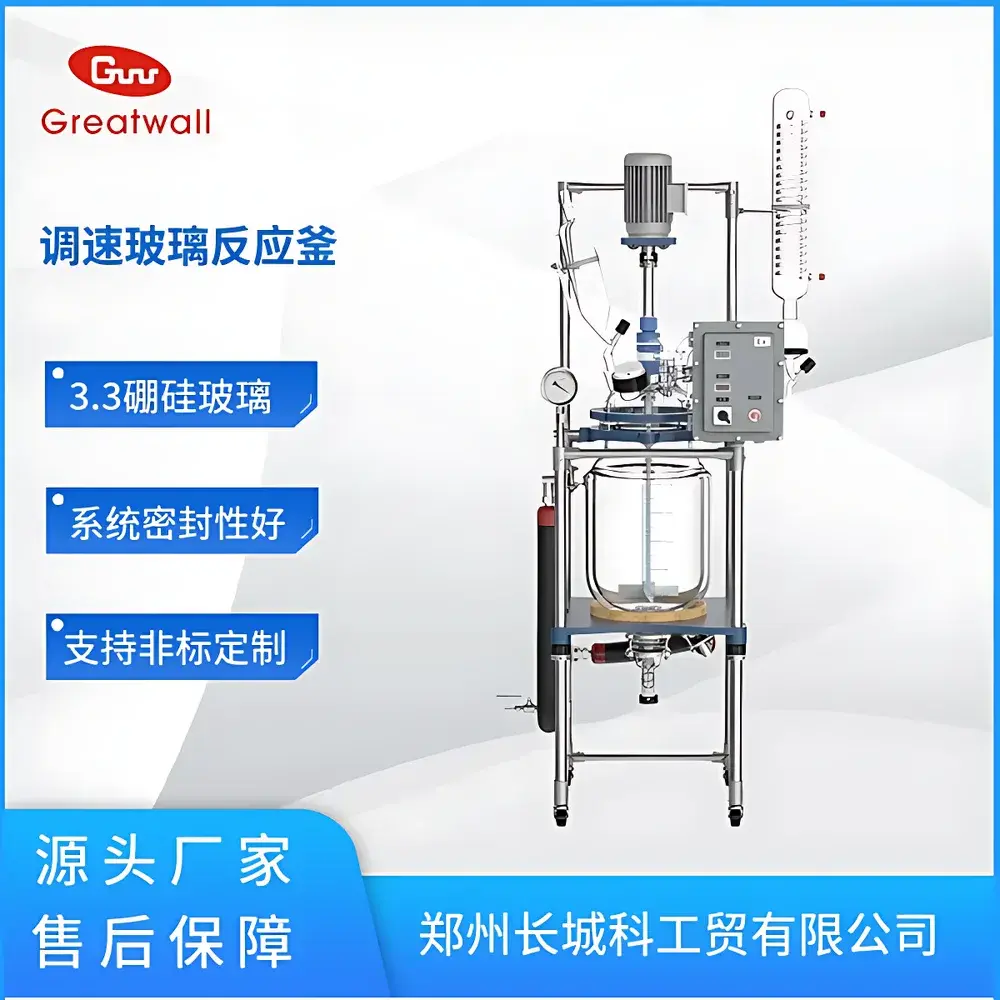
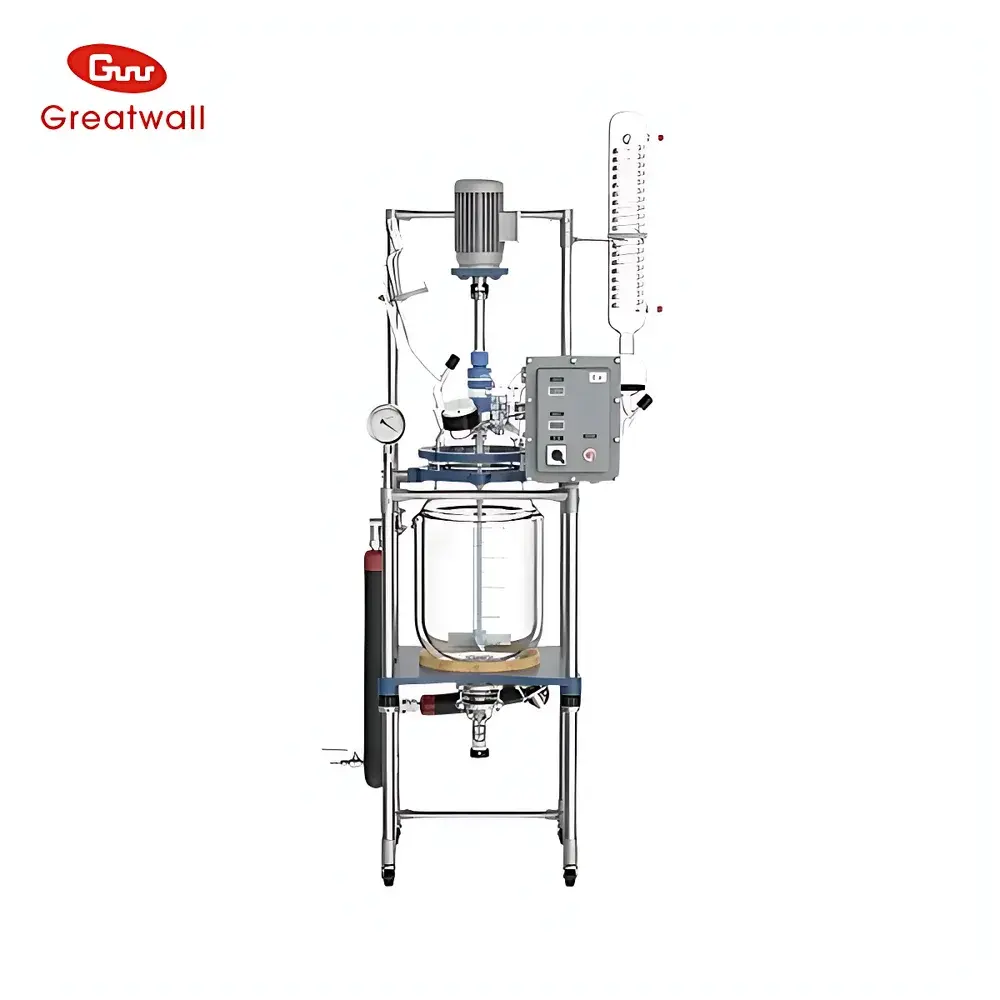
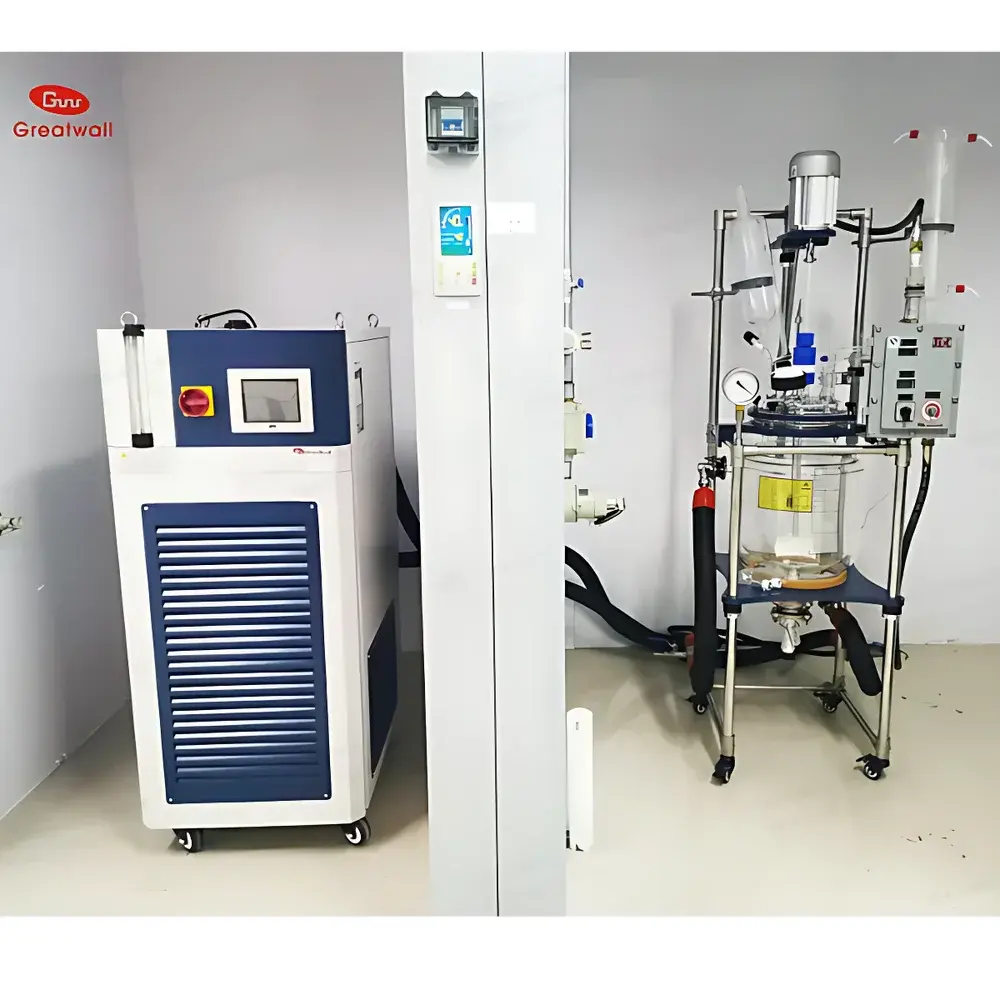
Great Wall GR-20Ex Explosion-Proof Double-Jacketed Glass Reactor
| Brand | Great Wall |
|---|---|
| Origin | Henan, China |
| Manufacturer Type | Direct Manufacturer |
| Country of Origin | China |
| Model | GR-20Ex |
| Capacity | 20 L |
| Working Pressure Range | –0.1 MPa to 0 MPa (vacuum to atmospheric) |
| Jacket Pressure Rating | ≤ 0.03 MPa |
| Vacuum Level | 0.095 MPa (abs) |
| Operating Temperature Range | –80 °C to +200 °C |
| Vessel Material | ASTM E438 Type I, Class A borosilicate 3.3 glass |
| Stirring Speed Range | 50–500 rpm |
| Speed Accuracy | ±1 rpm |
| Motor Type | Ex db IIB T4 Gb certified explosion-proof three-phase asynchronous motor |
| Power | 180 W |
| Stirrer Shaft Material | 06Cr19Ni10 stainless steel with PTFE cladding |
| Impeller Material | PTFE-coated 06Cr19Ni10 |
| Sealing System | Vacuum-rated mechanical seal with PTFE bearing |
| Condenser Surface Area | 0.341 m² |
| Electrical Supply | 220–240 V~, 50/60 Hz |
| Ambient Operating Conditions | 5–35 °C, ≤70% RH |
| Dimensions (W×D×H) | ~825 × 720 × 1960 mm |
| Net Weight | ~80 kg |
Overview
The Great Wall GR-20Ex Explosion-Proof Double-Jacketed Glass Reactor is an engineered solution for safe, precise, and scalable laboratory-scale chemical synthesis under controlled thermal and pressure conditions. Designed in accordance with IEC 60079-0 and IEC 60079-1 standards for explosive atmospheres, the reactor integrates a dual-wall borosilicate 3.3 glass vessel—where the annular jacket enables simultaneous heating/cooling via external circulators—within a robust, corrosion-resistant support frame. Its core function is to facilitate exothermic/endothermic reactions, solvent reflux, vacuum distillation, crystallization, and polymerization while maintaining strict containment integrity and operator safety in Class I, Division 2 (Zone 2) hazardous environments. The reactor operates within a verified thermal envelope of –80 °C to +200 °C and supports vacuum levels down to 0.095 MPa (abs), making it suitable for low-boiling-point solvent handling, moisture-sensitive chemistry, and air-free reaction protocols. All wetted surfaces are constructed from ASTM E438-compliant borosilicate 3.3 glass, ensuring high hydrolytic resistance, thermal shock tolerance (ΔT ≤ 80 °C), and optical clarity for real-time process observation.
Key Features
- Explosion-proof certification: Motor and control cabinet rated Ex db IIB T4 Gb per IEC 60079-1, enabling safe operation in flammable vapor environments.
- Borosilicate 3.3 glass vessel: Complies with DIN ISO 3585; exhibits coefficient of thermal expansion ≤ 3.3 × 10⁻⁶ K⁻¹ and softening point ≥ 820 °C.
- Double-jacket design: 9 L jacket volume accommodates standardized 35 mm inlet/outlet ports with stainless-steel insulated flexible hoses to eliminate thermal stress at connections.
- PTFE-clad stirring system: 06Cr19Ni10 (AISI 304) shaft with full PTFE overmolding; four-blade inclined turbine impeller optimized for uniform shear distribution and minimal vortex formation.
- Vacuum-compatible mechanical seal: Dual-face, spring-loaded design with PTFE seating surfaces; validated for continuous operation at ≤ 0.095 MPa (abs) without leakage or lubricant migration.
- Modular top plate: Six standardized ground-glass ports (215 mm法兰, 50#, S51, 35#, 40/38, 80#) allow flexible integration of condensers, dropping funnels (2000 mL), temperature probes (PT100, ±0.1 °C), and inert gas inlets.
- Mobility & stability: Powder-coated 06Cr19Ni10 frame with aluminum alloy structural elements and locking casters for repositioning and vibration-dampened stationary use.
Sample Compatibility & Compliance
The GR-20Ex is compatible with organic solvents (e.g., THF, DMF, acetone), aqueous acids/bases (pH 1–13), and halogenated compounds—provided operating temperatures remain within the glass’s thermal limits and pressure differentials do not exceed jacket rating (≤ 0.03 MPa). It meets material compatibility requirements outlined in ASTM D543 and ISO 15142-1 for laboratory glassware. Structural design adheres to PED 2014/68/EU Annex I essential safety requirements for pressure equipment, with documentation supporting conformity assessment for non-harmonized pressure vessels. Electrical integration complies with EN 61000-6-2 (immunity) and EN 61000-6-4 (emission). For GLP/GMP-regulated workflows, optional audit-trail-capable digital controllers (not included standard) may be integrated to satisfy FDA 21 CFR Part 11 data integrity expectations.
Software & Data Management
The base configuration features analog-digital hybrid instrumentation: LED-based rpm display (±1 rpm resolution), PT100 temperature readout (±0.1 °C), and manual frequency-controlled motor regulation. Optional upgrades include a programmable logic controller (PLC) module with RS485 Modbus RTU interface, enabling remote parameter logging, setpoint ramping, and alarm-triggered shutdown sequences. Data export formats include CSV and .txt; timestamped records support traceability for internal quality audits. While the standard unit does not embed proprietary software, its open communication protocol allows integration into LabArchives, DeltaV, or custom SCADA platforms via third-party gateways—facilitating centralized monitoring in multi-reactor laboratories.
Applications
- Pharmaceutical process development: Catalytic hydrogenation, Grignard reactions, and API crystallization under nitrogen/argon blanket.
- Academic research: Kinetic studies of esterification, transesterification, and click chemistry requiring precise temperature ramping and vacuum-assisted byproduct removal.
- Materials science: Sol-gel synthesis of metal oxides, nanoparticle precipitation, and polymer emulsion preparation with shear-sensitive monomers.
- Agrochemical formulation: Stability testing of active ingredients in solvent blends under accelerated aging conditions (e.g., 40 °C/75% RH simulated storage).
- Teaching laboratories: Demonstrating Le Chatelier’s principle, equilibrium shifts under vacuum, and heat transfer dynamics in jacketed systems.
FAQ
What certifications apply to the GR-20Ex motor and electrical enclosure?
The motor and control box carry Ex db IIB T4 Gb marking per IEC 60079-1, indicating suitability for Group II (non-mining) explosive gases, Category 2G equipment, and surface temperature class T4 (maximum 135 °C).
Can the reactor be operated under positive pressure?
No. The GR-20Ex is rated for vacuum-to-atmospheric operation only (–0.1 MPa to 0 MPa); pressurized use requires alternative vessel designs compliant with ASME BPVC Section VIII.
Is PTFE used in all sealing components?
PTFE is employed in the mechanical seal faces, stirrer bearing, and gasketing for ports; however, the main vacuum seal utilizes fluorocarbon elastomer (FKM) O-rings compatible with wide-spectrum solvents and thermal cycling.
What maintenance intervals are recommended for the stirring mechanism?
Inspect mechanical seal integrity and bearing play every 500 operational hours; replace PTFE wear components annually or after exposure to abrasive slurries.
Does the unit support automated temperature control via external circulator feedback?
Yes—when paired with a compatible programmable chiller/heater (e.g., Huber Ministat), the PT100 output can feed into the circulator’s analog input for closed-loop jacket temperature regulation.



