
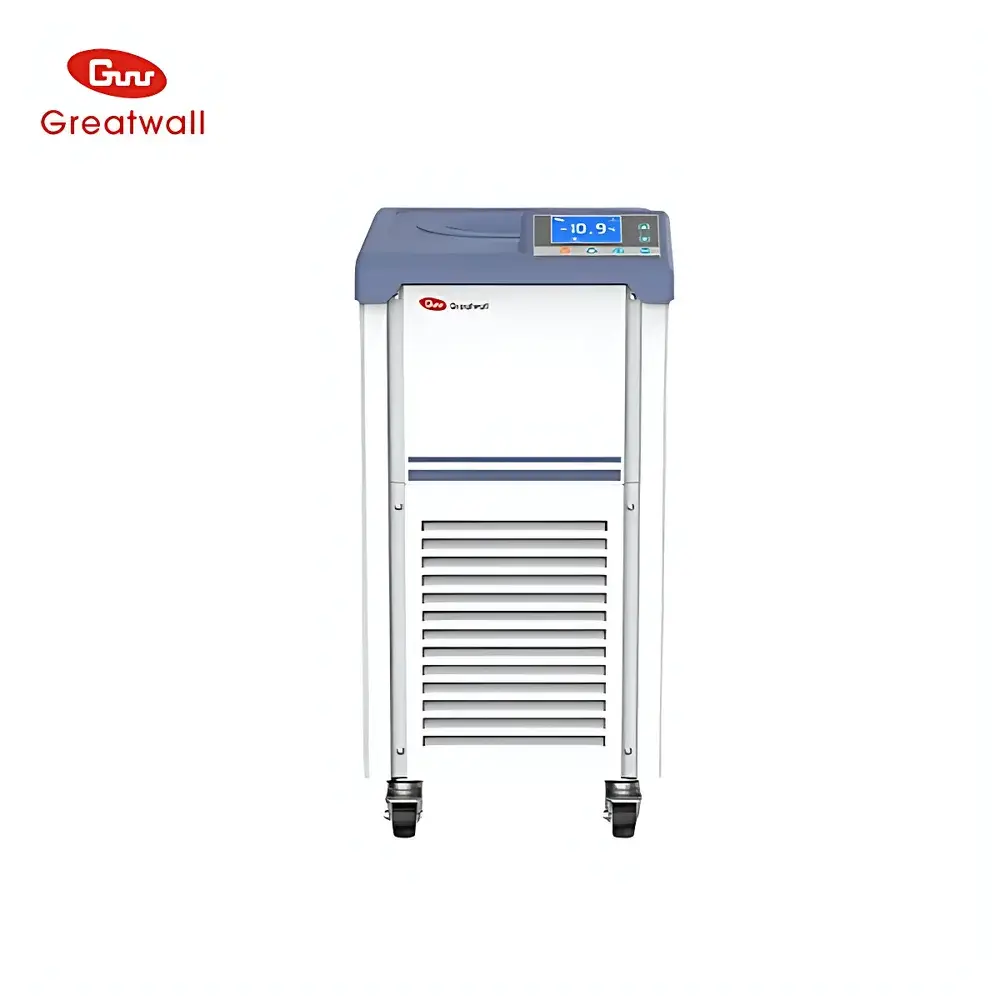
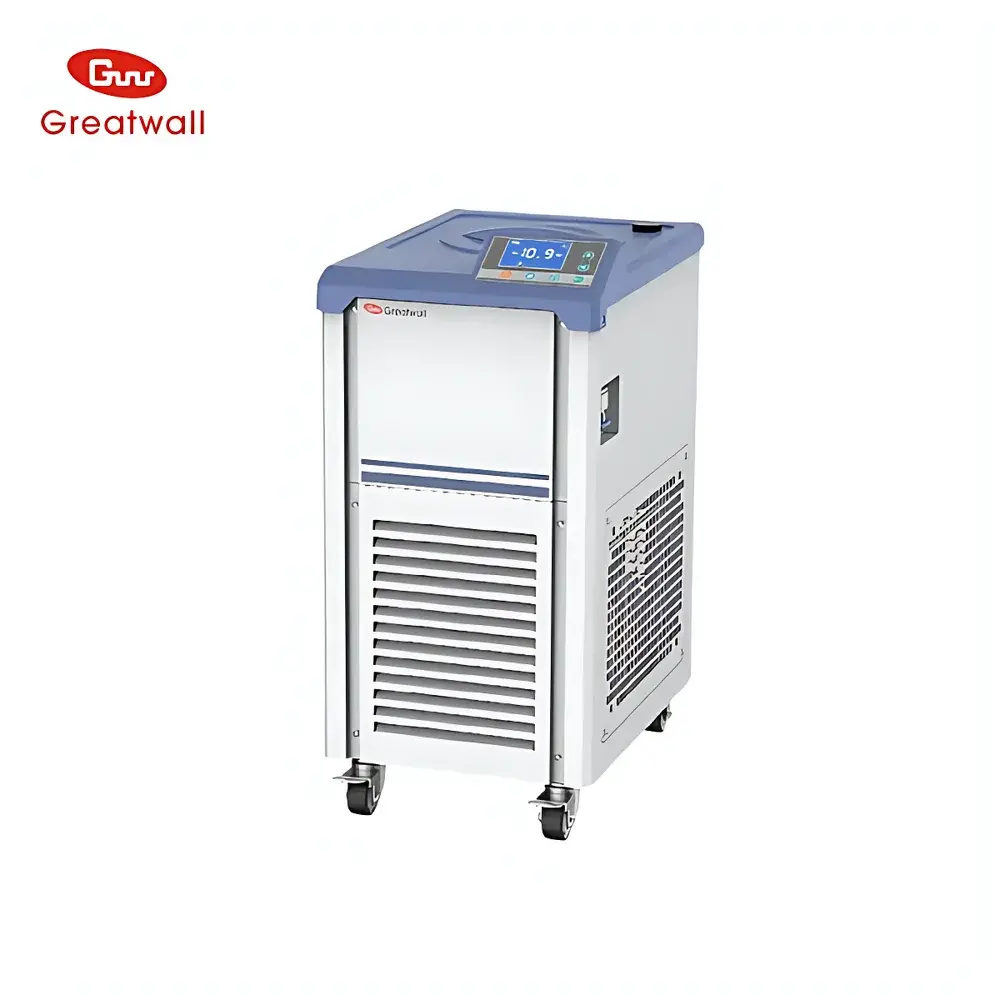
The Great Wall DLSB-5/20C Low-Temperature Circulating Chiller
| Brand | The Great Wall |
|---|---|
| Origin | Henan, China |
| Manufacturer Type | Direct Manufacturer |
| Country of Origin | China |
| Model | DLSB-5/20C |
| Instrument Type | Vertical |
| Temperature Uniformity | ±2 °C |
| Operating Temperature Range | −20 °C to 25 °C |
| Bath Volume | 5 L |
| Dimensions (W×D×H) | 335 mm × 473 mm × 684 mm |
| Net Weight | 40 kg |
| Display Resolution | 0.1 °C |
| Communication Interface | RS485 with Modbus RTU protocol |
| Compressor Start Delay Protection | Yes |
| Overcurrent Protection | Yes |
| Certified | CE (TÜV certified models) |
| Refrigerant | R404A |
| Max Flow Rate | 22 L/min |
| Max Pressure | 1.1 bar |
| Cooling Capacity | 680 W at 10 °C, 600 W at 0 °C, 520 W at −10 °C, 360 W at −20 °C |
| Sensor Type | Pt100 |
| Protection Features | Delay, overcurrent, overheat, high-pressure, grounding |
| IP Rating | IP20 |
| Ambient Operating Conditions | 5–35 °C, ≤70% RH |
| Power Supply | 220 V~, 50 Hz |
| Fluid Connection | 1/2″ BSP ports |
| Tubing Compatibility | Silicone rubber hose (Φ13 mm OD × Φ9 mm ID) |
| Bath Material | AISI 304 stainless steel |
| Test Condition | Ambient temperature 25 °C |
Overview
The Great Wall DLSB-5/20C Low-Temperature Circulating Chiller is an engineered thermal management system designed for precise, stable, and continuous delivery of chilled liquid coolant to external laboratory equipment. Based on vapor-compression refrigeration using R404A—azeotropic blend refrigerant—the unit maintains setpoint temperatures from −20 °C to +25 °C with a stability of ±2 °C across the 5-liter stainless steel (AISI 304) bath. Its vertical architecture optimizes footprint efficiency while accommodating integrated circulation pumps capable of delivering up to 22 L/min at 1.1 bar maximum pressure. Unlike passive cooling baths or dry ice-based alternatives, the DLSB-5/20C provides active, closed-loop temperature control—essential for reproducible low-temperature reaction kinetics, condenser load management in rotary evaporation, and thermal conditioning of sensitive optical or electronic components.
Key Features
- High-fidelity LCD controller with 0.1 °C display resolution and intuitive menu navigation for setpoint, ramp rate, and hold time configuration
- RS485 serial interface compliant with Modbus RTU protocol—enables integration into centralized lab automation systems and SCADA environments for remote monitoring and scheduled operation
- Compressor start-delay protection prevents mechanical stress during frequent power cycling; safeguards against premature wear under intermittent duty cycles
- Multi-layer safety architecture including overcurrent, overheat, high-pressure cut-off, ground fault detection, and thermal fuse backup
- Robust construction: 304 stainless steel fluid reservoir resists corrosion from common heat-transfer fluids (e.g., 30% ethylene glycol/water, ethanol/water mixtures)
- CE-marked per applicable EU directives (2014/30/EU EMC & 2014/35/EU LVD), verified by TÜV Rheinland for select production batches
Sample Compatibility & Compliance
The DLSB-5/20C circulates non-aggressive, low-viscosity heat-transfer media—including aqueous glycol solutions, ethanol–water blends, and silicone oils—through standard 1/2″ BSP inlet/outlet ports. Its design conforms to ISO 17025-aligned operational practices for temperature-controlled instrumentation, supporting GLP-compliant workflows where traceable thermal stability is required. While not inherently FDA 21 CFR Part 11–compliant as a standalone device, its Modbus interface allows integration with validated data acquisition platforms that enforce audit trails, electronic signatures, and user access controls. The unit operates within ambient conditions specified by IEC 61000-6-3 (emissions) and IEC 61000-6-2 (immunity), ensuring electromagnetic compatibility in shared laboratory infrastructure.
Software & Data Management
No proprietary software is bundled; instead, the chiller relies on open-protocol communication via RS485 Modbus RTU (function codes 03h/06h). This enables seamless interoperability with third-party control environments such as LabVIEW™, MATLAB® Data Acquisition Toolbox, Python-based PyModbus libraries, or industrial PLCs (e.g., Siemens S7-1200, Allen-Bradley CompactLogix). Users may log temperature setpoints, actual bath readings, compressor status, and alarm events at configurable intervals. When deployed alongside compliant SCADA systems, full traceability—including timestamped parameter changes and operator IDs—is achievable for regulated QC/QA applications in pharmaceutical or materials development labs.
Applications
- Cooling condensers of rotary evaporators during solvent removal under reduced pressure—preventing vapor breakthrough and improving recovery yield
- Thermal stabilization of laser diodes, CCD detectors, and fiber-optic components requiring sub-ambient operating temperatures
- Controlled-rate cooling in polymer crystallization studies, phase-change material characterization, and low-temperature rheology testing
- Simulating process-relevant thermal transients in chemical synthesis scale-up experiments (e.g., exotherm quenching, cryogenic addition protocols)
- Direct immersion cooling of reaction flasks, test tubes, or sample holders in life science assays requiring strict thermal history control
- Supporting semiconductor probe station thermal stages and cryo-microscopy sample pre-conditioning
FAQ
What heat-transfer fluids are compatible with the DLSB-5/20C?
Aqueous solutions containing ≤30% ethylene glycol or propylene glycol, ethanol–water mixtures (up to 50% v/v), and low-viscosity silicone oils (≤50 cSt at 25 °C) are recommended. Avoid halogenated solvents, strong acids/bases, or fluids with freezing points below −25 °C.
Can this unit maintain −20 °C continuously under full flow load?
Yes—provided ambient temperature remains ≤30 °C and relative humidity ≤70%. At −20 °C setpoint, the unit delivers 360 W of cooling capacity; sustained operation requires matching system heat load to this rating.
Is the bath volume sufficient for coupling with large-volume external jackets?
The 5 L reservoir supports typical jacketed reactors up to 5 L capacity. For larger systems (>10 L jacket volume), consider recirculation loop priming volume and thermal inertia—external buffer tanks may be advised for extended stability.
Does the unit include pump speed control?
No—flow rate is fixed at nominal 22 L/min. External variable-frequency drives or bypass valves must be used for flow modulation; internal pump speed is not user-adjustable.
How is calibration traceability addressed?
The integrated Pt100 sensor is factory-calibrated against NIST-traceable references. End users should perform periodic verification using a calibrated reference thermometer per ISO/IEC 17025 Section 6.5; no field recalibration port is provided.
Related Products



