
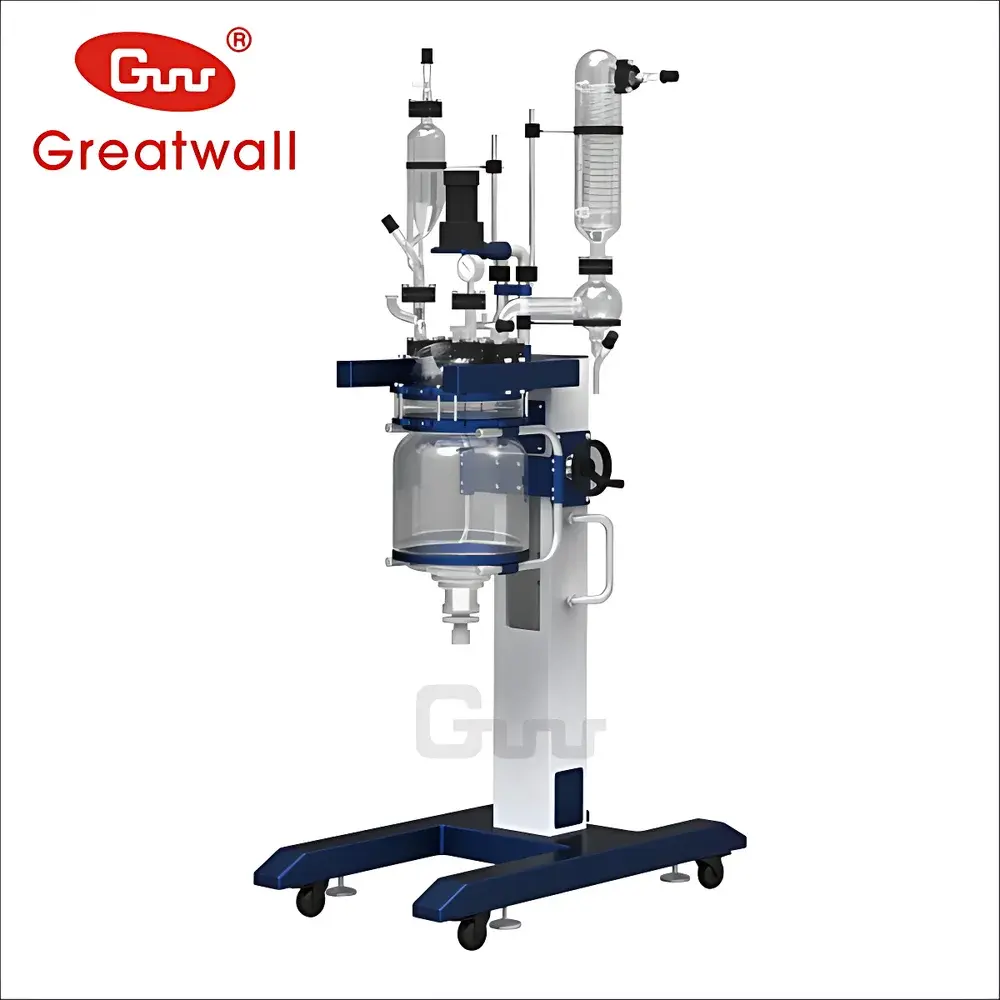
Great Wall GR-20L Adjustable Height & Rotatable Double-Jacketed Glass Reactor
| Brand | The Great Wall |
|---|---|
| Origin | Henan, China |
| Manufacturer Type | Direct Manufacturer |
| Country of Origin | China |
| Model | GR-20L (Adjustable Height & Rotatable) |
| Price Range | USD 2,800 – 7,000 |
| Usable Volume | 20 L |
| Vessel Material | Borosilicate Glass 3.3 |
| Operating Pressure | Atmospheric or Vacuum (Max. Vacuum: 0.098 MPa) |
| Jacket Volume | 6 L |
| Jacket Heat Transfer Area | 0.32 m² |
| Condenser Heat Transfer Area | 0.3 m² |
| Temperature Range | −80 °C to +200 °C |
| Thermal Shock Resistance | ΔT ≤ 90 °C |
| Motor Power | 90 W |
| Speed Range | 50–500 rpm |
| Speed Control | Frequency Inverter |
| Stirring Seal | Dual Mechanical Seal (PTFE-coated Stainless Steel Shaft & Bearings) |
| Bottom Discharge Valve | PTFE-lined, Zero-Dead-Volume Design |
| Base Construction | Parallel Steel Frame with Locking Casters |
| Overall Dimensions (L×W×H) | 660 × 535 × 1950 mm |
Overview
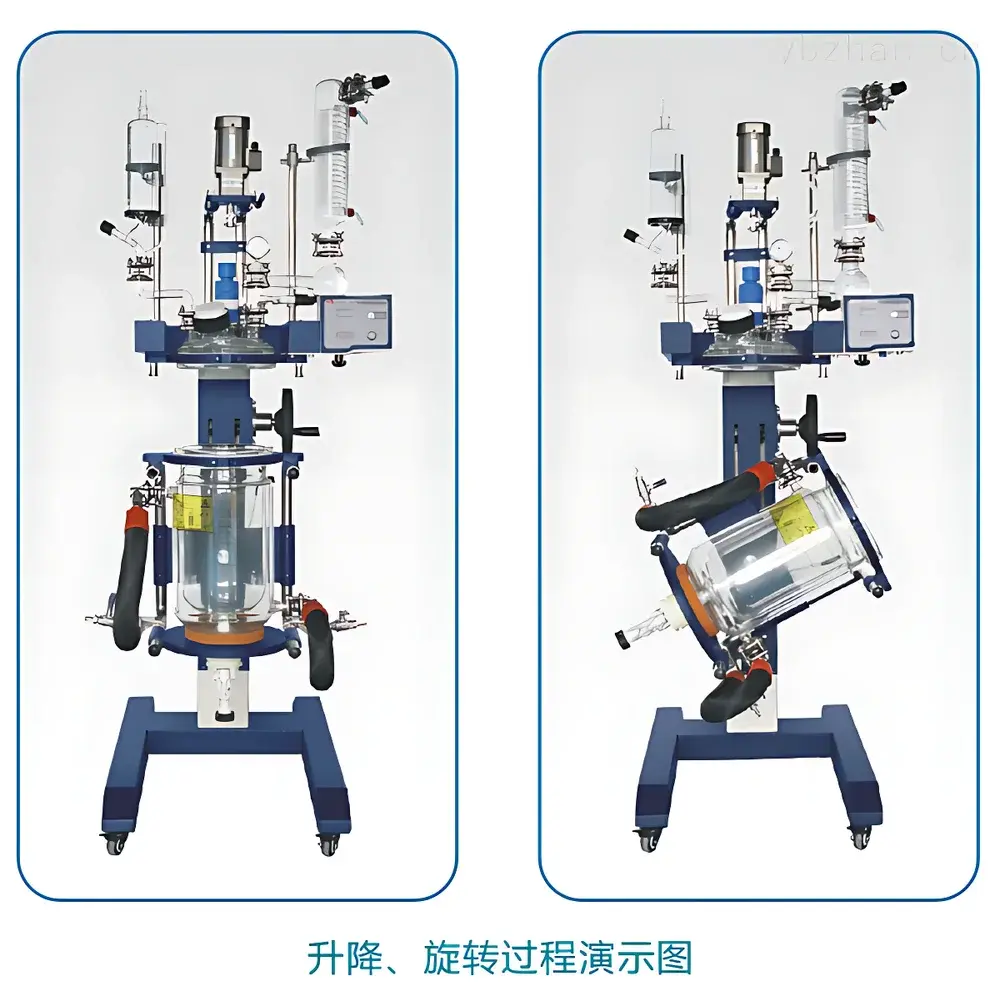
The Great Wall GR-20L Adjustable Height & Rotatable Double-Jacketed Glass Reactor is an engineered solution for controlled chemical synthesis, crystallization, and multi-step reaction processes in research laboratories and pilot-scale development environments. Designed around the principles of mechanical accessibility, thermal management, and chemical inertness, this reactor integrates a borosilicate glass 3.3 vessel with a double-jacketed configuration for precise temperature control via external heating/cooling circulators. Its defining operational features—manual vertical lift (enabling safe loading/unloading of viscous media or large crystals) and 0–120° rotational capability (facilitating thorough cleaning and residue-free drainage)—address critical workflow constraints common in pharmaceutical process development, fine chemical synthesis, and academic reaction optimization. The system operates under atmospheric pressure or high vacuum (up to 0.098 MPa absolute), supporting solvent reflux, reduced-pressure distillation, and moisture-sensitive reactions without reliance on vacuum grease—a direct result of its precision-machined flange-sealing interface.
Key Features
- Manually adjustable vertical lift mechanism with ergonomic handwheel operation, enabling safe access to the reaction vessel for solid charging, crystal harvesting, or maintenance.
- 0–120° continuous rotation capability of the entire reactor body, ensuring complete internal surface exposure during cleaning and minimizing residual carryover between batches.
- Flange-based sealing architecture eliminates the need for vacuum grease, delivering consistent vacuum integrity up to 0.098 MPa and reducing contamination risk in GMP-aligned workflows.
- Zero-dead-volume bottom discharge valve with PTFE-lined stainless steel construction ensures quantitative material transfer and prevents cross-contamination between sequential reactions.
- Six standardized ground-glass and flanged ports (including 50 mm stirrer port, 24/40/50 standard taper joints, and 80 mm solid feed port) support modular integration of condensers, dropping funnels, temperature probes, pH electrodes, and gas inlets.
- Stirring system features dual mechanical seals, PTFE-coated stainless steel shaft and impeller, and variable-speed inverter control (50–500 rpm) for reproducible mixing across viscosity ranges.
- Structural base employs parallel steel framing with locking casters, providing vibration-damped stability during operation while allowing full-system mobility within laboratory spaces.
Sample Compatibility & Compliance
The GR-20L is chemically compatible with a broad spectrum of organic solvents, aqueous reagents, acids (e.g., HCl, H₂SO₄ ≤ 30%), and bases (e.g., NaOH ≤ 20%) due to its borosilicate glass 3.3 wetted surfaces and PTFE-sealed components. It meets ISO 3585 specifications for laboratory glassware and conforms to ASTM E438 Type I, Class A requirements for chemical resistance. While not certified for hazardous area use (ATEX/IECEx), its design supports GLP-compliant documentation practices when integrated with validated data acquisition systems. Vacuum performance aligns with ISO 2859-1 sampling plans for leak integrity verification; users performing regulated pharmaceutical synthesis may implement supplementary audit trails using third-party SCADA-compatible software per FDA 21 CFR Part 11 guidelines.
Software & Data Management
The reactor is natively compatible with Great Wall’s ZN Intelligent Biochemical Reaction System—a modular controller offering real-time digital display of stirring speed, torque (as proxy for viscosity), temperature (via Pt100 sensor), and pH (with optional probe). The system supports multi-segment programmable protocols for automated addition, temperature ramping, and speed profiling. When connected via RS485 or Ethernet to a host PC, it enables time-stamped data logging, curve plotting (temperature vs. time, torque vs. rpm), and export to CSV or Excel formats. All logged parameters are timestamped with millisecond resolution and support user-defined metadata tagging—critical for traceability in method validation studies under ICH Q5, Q7, or USP analytical instrument qualification frameworks.
Applications
- Controlled crystallization of active pharmaceutical ingredients (APIs) under vacuum-assisted solvent evaporation.
- Multi-step Grignard, Suzuki, or hydrogenation reactions requiring sequential reagent addition and strict exclusion of moisture/oxygen.
- Enzymatic hydrolysis and biocatalytic transformations where temperature uniformity and shear-sensitive mixing are essential.
- Polymerization kinetics studies (e.g., step-growth polycondensation) with real-time torque monitoring to infer molecular weight evolution.
- Process safety evaluation (e.g., RC1 calorimetry surrogate) via controlled exotherm induction under jacketed thermal regulation.
- Educational demonstration of reaction engineering concepts including mass transfer limitations, heat balance, and residence time distribution.
FAQ
Can the GR-20L be used under positive pressure?
No. This model is rated for atmospheric or vacuum operation only (max. vacuum: 0.098 MPa). Positive pressure applications require reinforced stainless steel reactors with ASME Section VIII certification.
Is the glass vessel resistant to thermal shock during rapid cooling?
Yes—borosilicate glass 3.3 exhibits a maximum thermal gradient tolerance of 90 °C, permitting controlled quenching from 200 °C to ambient using chilled glycol circulation, provided jacket temperature differentials remain within specification.
What maintenance is required for the lifting and rotating mechanisms?
The manual lift system uses sealed ball-bearing guides and requires no lubrication; the rotation hinge incorporates corrosion-resistant stainless steel bushings inspected annually for play or wear.
Are replacement parts such as glass vessels or PTFE valves available separately?
Yes. Great Wall supplies OEM-certified spare vessels (Part No. GR-20L-VESSEL-B33), bottom discharge valves (GR-20L-VALVE-PTFE), and standardized ground-glass joints (24/40, 50/50) with traceable batch documentation.
Does the system comply with CE or UL safety directives?
The GR-20L meets CE marking requirements for low-voltage equipment (2014/35/EU) and electromagnetic compatibility (2014/30/EU); UL listing is not held, but electrical components conform to IEC 61000-6-2/6-4 standards.



