
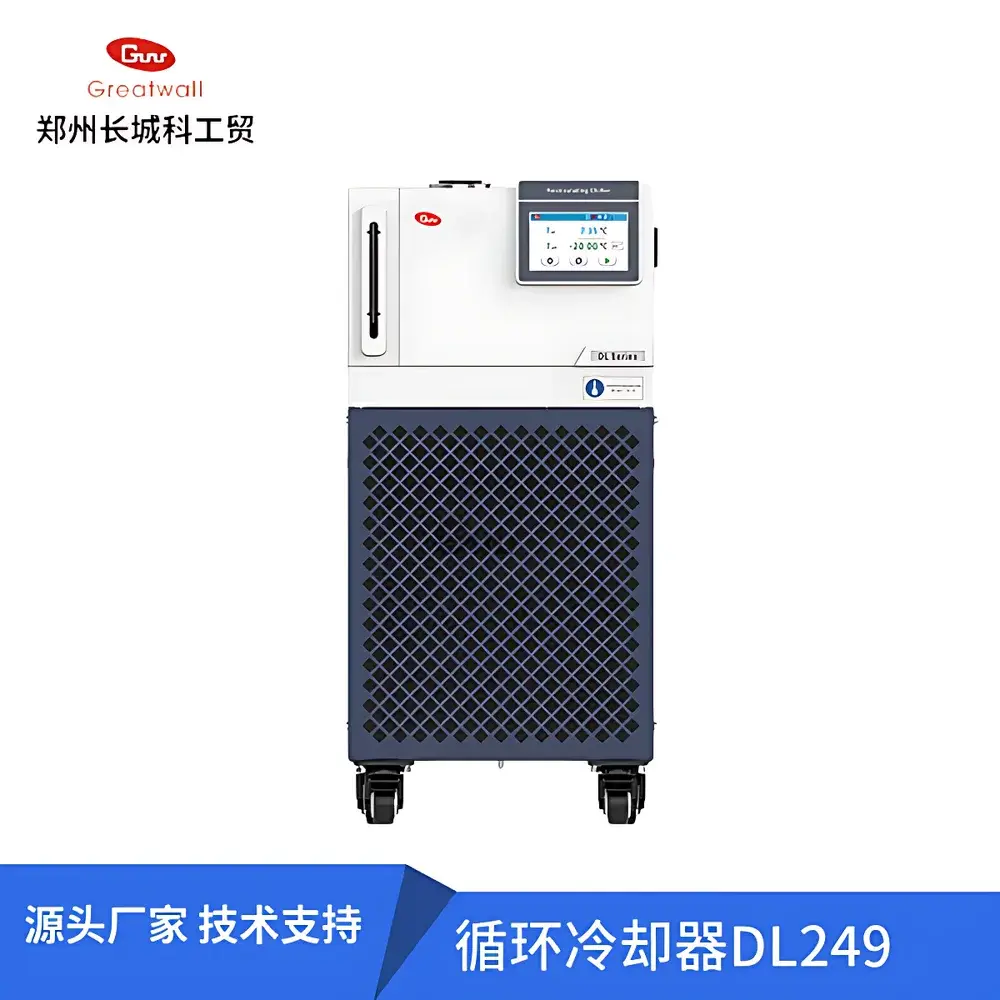
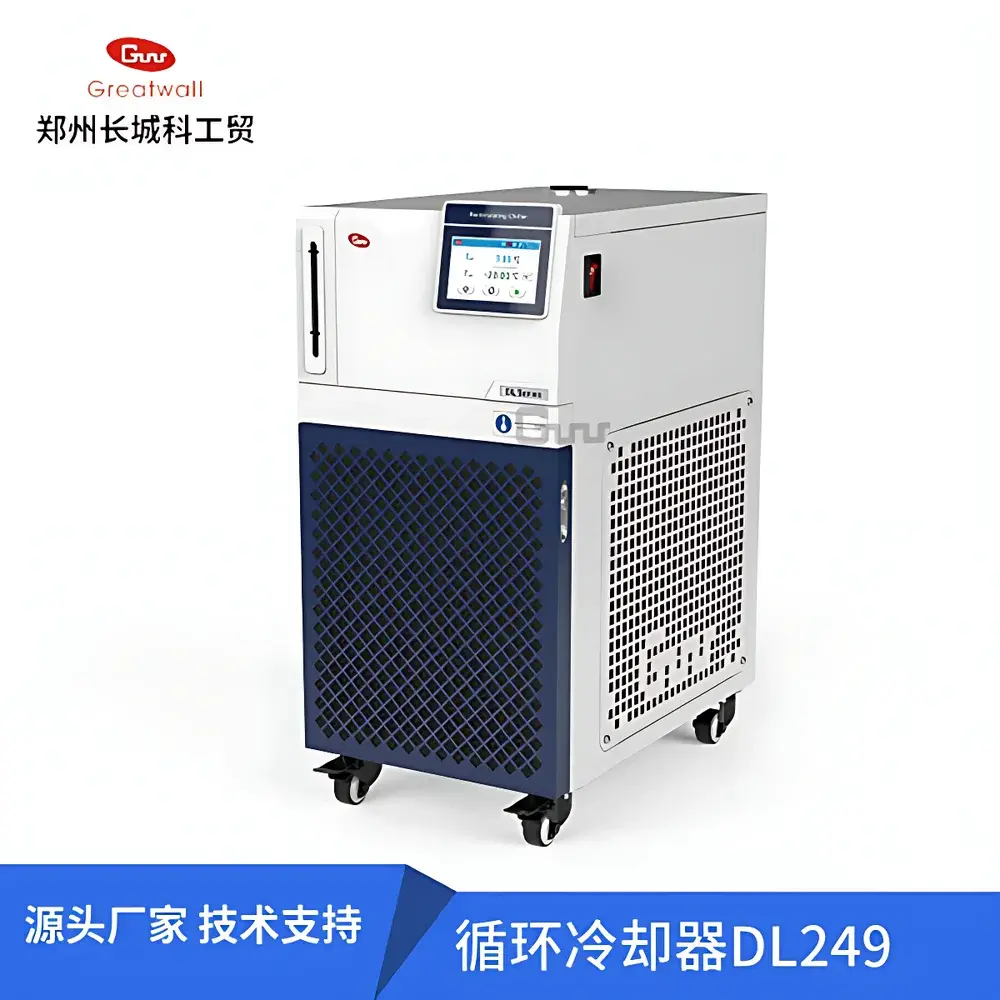
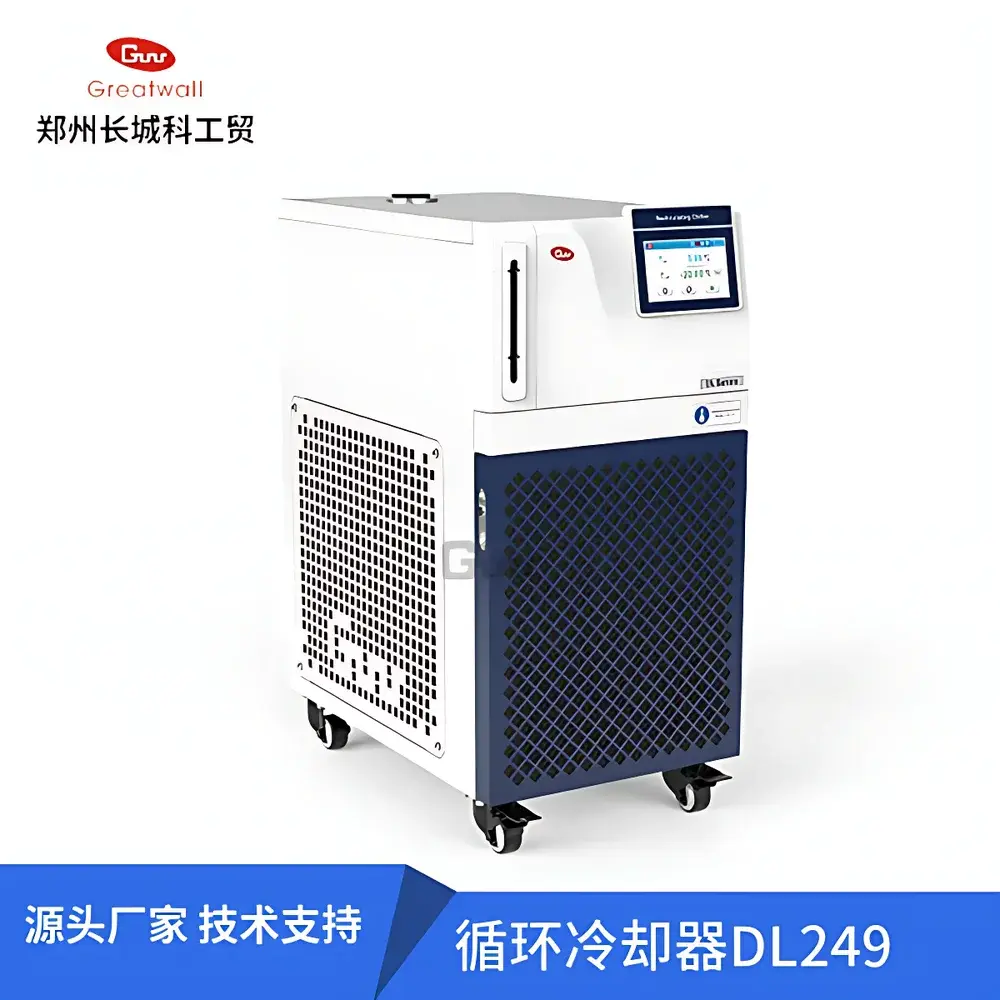
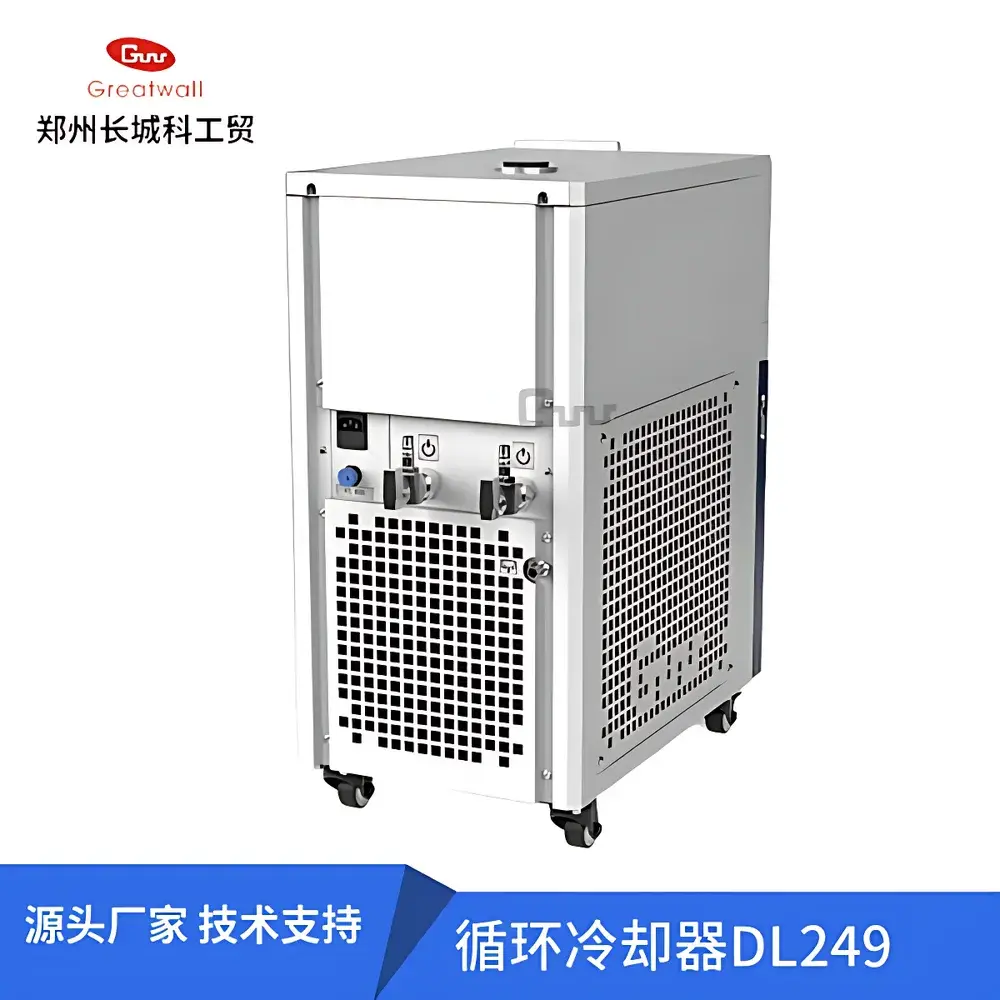
The Great Wall DL249 Circulating Chiller
| Brand | The Great Wall |
|---|---|
| Origin | Henan, China |
| Manufacturer Type | Direct Manufacturer |
| Equipment Type | Integrated Circulating Chiller |
| Cooling Method | Air-Cooled |
| Temperature Control Range | −20 °C to +40 °C |
| Refrigeration Capacity | 900 W at 0 °C |
| Maximum Circulation Pressure | 1.2 bar |
| Maximum Flow Rate | 23 L/min |
| Power Supply | 220–240 V~, 50 Hz |
| Temperature Stability | ±0.5 °C (PID-controlled, Pt100 sensor) |
| Refrigerant | R404A |
| Reservoir Volume | 9 L |
| Reservoir & Evaporator Material | 06Cr19Ni10 (AISI 304 stainless steel) |
| Pump Type | Brushless DC (BLDC) |
| Tubing Material | Silicone Rubber (Φ13×Φ9 mm) |
| Communication Interface | RS-485, Modbus RTU protocol |
| Protection Features | Delayed startup, overheat, overcurrent, high-pressure cutoff |
| IP Rating | IP20 |
| Pollution Degree | Class 2 |
| Dimensions (W×D×H) | 300×480×630 mm |
| Net Weight | 38 kg |
Overview
The Great Wall DL249 Circulating Chiller is an integrated, air-cooled thermal management system engineered for precise and stable temperature control of external laboratory equipment—including rotary evaporators, spectrophotometers, NMR probes, laser sources, and reaction calorimeters. It operates on a closed-loop refrigeration cycle utilizing a hermetically sealed reciprocating compressor, microchannel condenser, and a dual-stage throttling system comprising both an electronic expansion valve (EEV) and capillary tube. This architecture ensures high thermodynamic efficiency, low acoustic emissions (<58 dB(A)), and consistent performance across ambient conditions ranging from 5 °C to 35 °C. The chiller maintains setpoint stability within ±0.5 °C under steady-state load conditions, validated using traceable Pt100 resistance temperature detectors calibrated per IEC 60751 Class B. Its compact footprint (0.091 m³) and modular internal layout facilitate integration into constrained benchtop environments without compromising service accessibility or thermal dissipation integrity.
Key Features
- Hermetically sealed piston-type compressor with low-vibration mounting and extended service life (>20,000 operating hours)
- Microchannel aluminum condenser offering 22% higher heat transfer coefficient vs. conventional finned-tube designs, reducing unit weight by 18%
- Dual-mode refrigerant metering: EEV enables dynamic superheat control during transient loads; capillary backup ensures fail-safe operation during communication loss
- Stainless steel (06Cr19Ni10) reservoir and evaporator coil—welded seamless tubing minimizes leakage risk and eliminates freeze-induced cracking via submerged immersion design
- Brushless DC circulation pump delivering up to 23 L/min at 1.2 bar max pressure, with adjustable flow rate and built-in dry-run protection
- 4.3-inch capacitive touchscreen HMI supporting real-time monitoring, PID parameter tuning, temperature offset calibration, and event logging
- RS-485 interface compliant with Modbus RTU protocol (addressable range: 1–247), enabling integration into centralized lab automation systems and SCADA platforms
- Comprehensive safety suite: compressor delay start (3 min), high-pressure cutoff (≥2.8 MPa), overtemperature lockout (>65 °C), and ground-fault current interruption
Sample Compatibility & Compliance
The DL249 is compatible with water, water-glycol mixtures (up to 40% v/v), and other non-corrosive heat transfer fluids meeting ASTM D1384 specifications. Its fluid-contact materials—06Cr19Ni10 stainless steel, silicone rubber tubing (FDA-compliant per 21 CFR 177.2600), and PPE/PK/PA pump housing—ensure chemical resistance against common organic solvents and buffer solutions. The unit complies with IEC 61000-6-3 (EMC emission limits), IEC 61000-6-2 (immunity), and IEC 61010-1:2010 (safety requirements for electrical equipment for measurement, control, and laboratory use). While not certified for hazardous locations, its IP20 enclosure meets standard indoor laboratory environmental classifications per IEC 60529. Documentation supports GLP/GMP-aligned validation protocols including IQ/OQ/PQ execution templates.
Software & Data Management
No proprietary software is required for basic operation; all configuration and monitoring occur via the onboard HMI. For automated data acquisition, the Modbus RTU interface permits bidirectional communication with third-party platforms such as LabVIEW, MATLAB, or custom Python-based controllers using standard serial-to-Modbus libraries (e.g., pymodbus). Register mapping includes real-time temperature (holding register 40001), setpoint (40002), flow status (40003), fault codes (40004–40007), and cumulative runtime (40010–40011). Event logs are retained in non-volatile memory for ≥10,000 entries and support timestamped export via USB (optional adapter). Audit trail functionality satisfies FDA 21 CFR Part 11 requirements when deployed with validated host software implementing electronic signatures and user access controls.
Applications
- Condenser cooling for rotary evaporation under vacuum (maintaining bath temperatures between −10 °C and +15 °C)
- Thermal stabilization of high-power UV-Vis and FTIR light sources to minimize wavelength drift
- Heat sink for exothermic catalytic reactions monitored via in-situ IR or Raman spectroscopy
- Temperature regulation of electrophoresis power supplies and gel documentation systems
- Supporting cryo-microscopy sample stages requiring sub-zero ambient conditioning
- Process validation studies requiring documented thermal profiles per ISO 17025 clause 5.4.2
FAQ
What is the minimum ambient temperature at which the DL249 can operate reliably?
The unit is rated for continuous operation at ambient temperatures between 5 °C and 35 °C. Below 5 °C, compressor oil viscosity increases significantly, risking inadequate lubrication and potential mechanical failure.
Can the chiller be used with ethylene glycol solutions?
Yes—up to 40% (v/v) aqueous ethylene glycol is supported. Higher concentrations reduce specific heat capacity and increase viscosity, potentially limiting flow rate and thermal response time.
Is remote monitoring possible without additional hardware?
Basic telemetry (temperature, status, alarms) is accessible via RS-485; however, a USB-to-RS485 converter and compatible terminal software are required for PC-based readout.
Does the unit include validation documentation for GxP environments?
Factory-supplied documentation includes calibration certificates for the Pt100 sensor and pressure transducer, electrical safety test reports, and material compliance statements. Full IQ/OQ/PQ protocols must be executed by the end user or qualified third party.
What maintenance intervals are recommended?
Compressor oil inspection every 24 months; condenser coil cleaning every 6 months in dusty environments; refrigerant leak check annually; and full system performance verification every 12 months per manufacturer’s service manual.



