
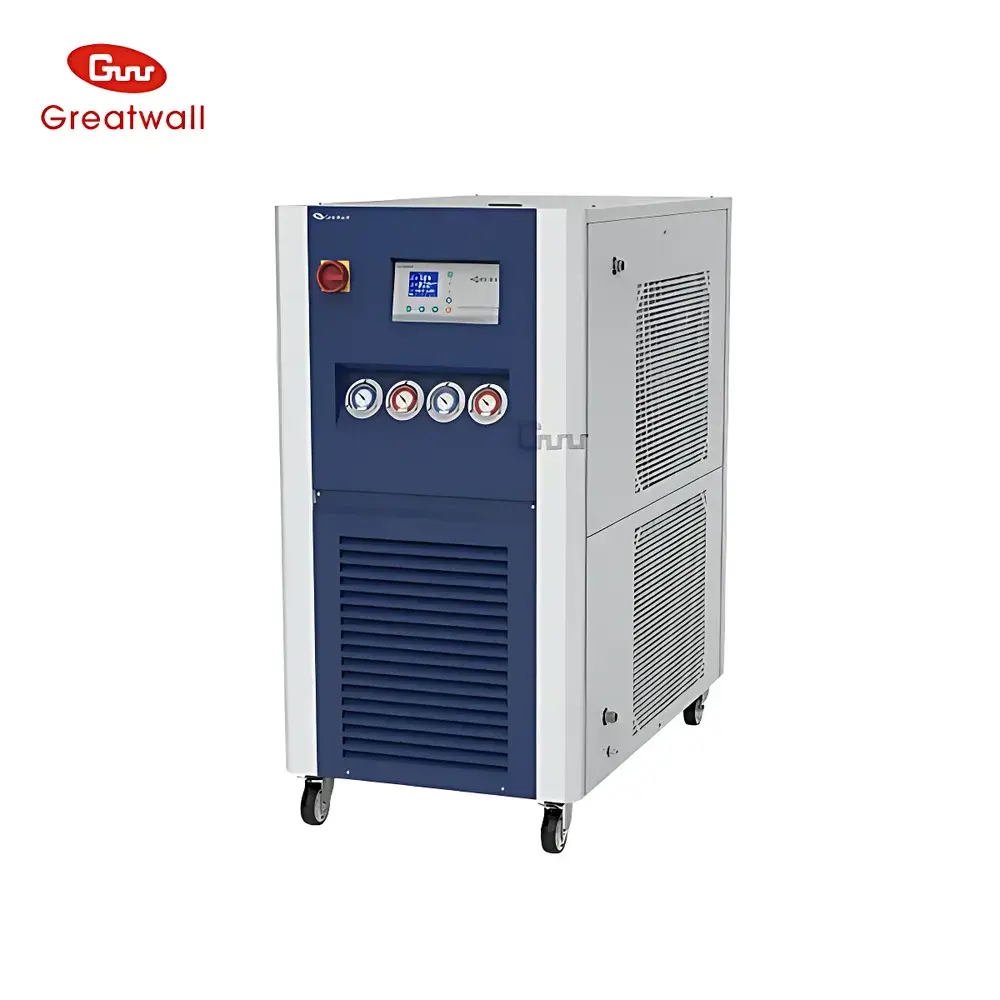
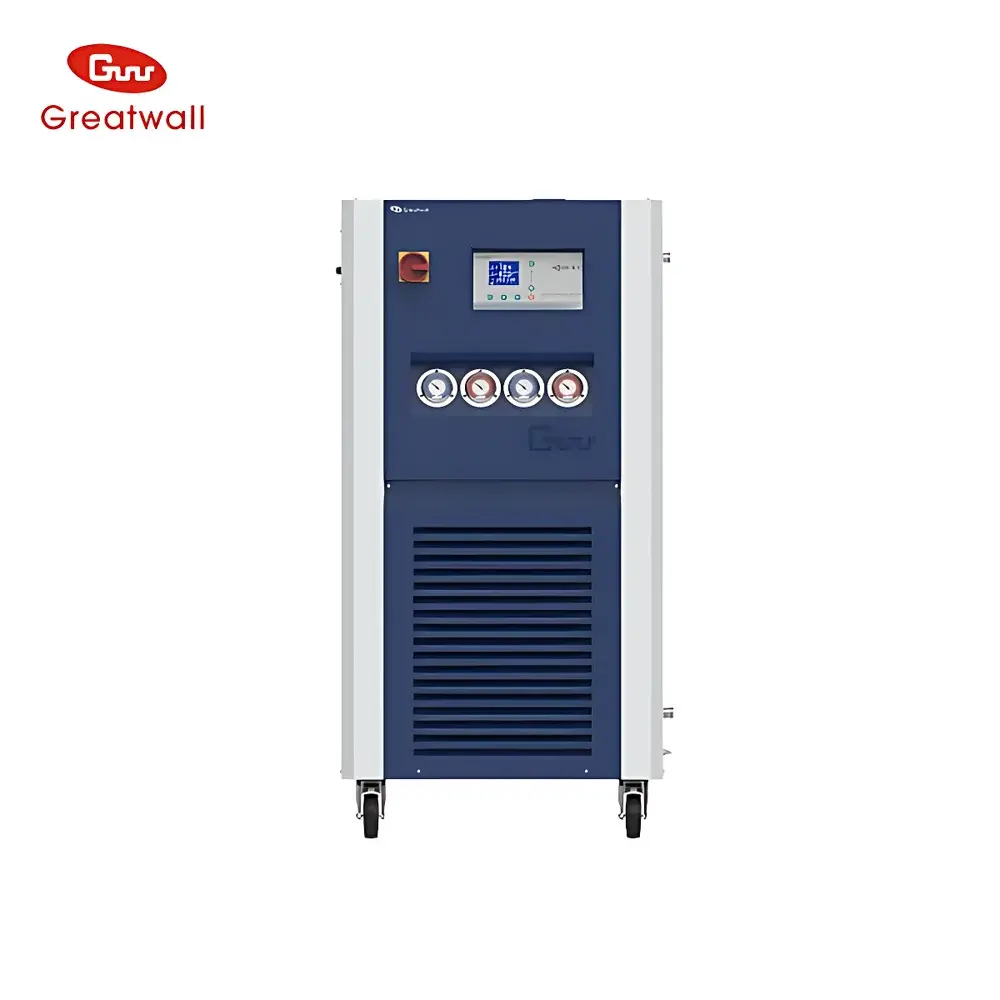
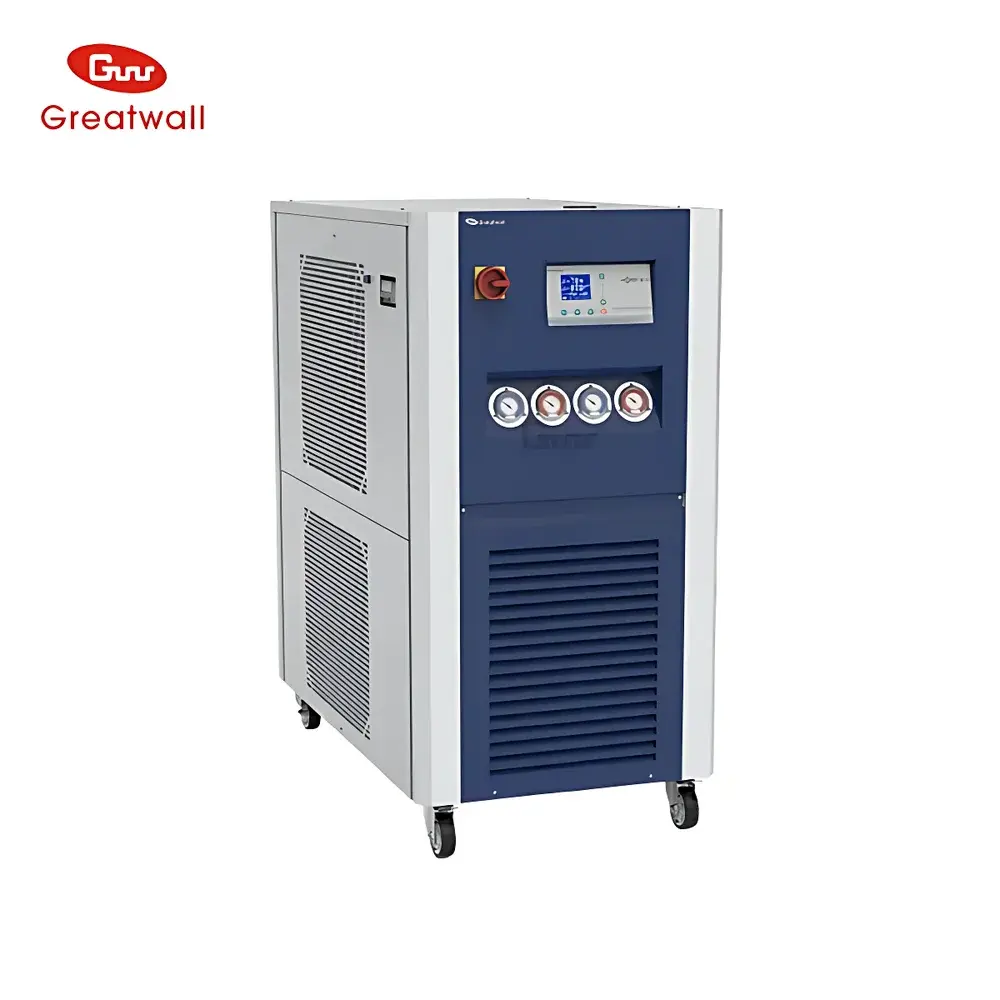
The Great Wall LT-50-80 Ultra-Low Temperature Circulating Chiller
| Brand | The Great Wall |
|---|---|
| Model | LT-50-80 |
| Temperature Range | −80 °C to −40 °C |
| Temperature Stability | ±2 °C |
| Refrigerant | R404A/R23 |
| Cooling Capacity | 5000 W at −40 °C, 3000 W at −60 °C, 1000 W at −80 °C |
| Reservoir Volume | 10 L |
| Pump Flow Rate | 30 L/min |
| Pressure | 1 bar |
| Power Supply | 3-phase, 380 V, 50 Hz |
| Rated Power | 9800 W |
| Rated Current | 17.5 A |
| Reservoir Material | SUS304 stainless steel |
| Dimensions (W×D×H) | 710 × 1230 × 1380 mm |
| Net Weight | 350 kg |
| Ambient Operating Conditions | 5–35 °C, ≤70% RH |
Overview
The Great Wall LT-50-80 Ultra-Low Temperature Circulating Chiller is an engineered solution for precise, stable thermal management in demanding laboratory and pilot-scale applications requiring sustained operation between −80 °C and −40 °C. Designed around a dual-refrigerant cascade compression system (R404A primary stage + R23 secondary stage), it delivers high-efficiency heat extraction under low-temperature load conditions typical of cryogenic reaction control, polymerization kinetics studies, low-temperature material characterization, and pharmaceutical crystallization processes. Its fully sealed, closed-loop architecture minimizes vapor loss and moisture ingress—critical for maintaining thermal fluid integrity over extended operational cycles. Unlike open-bath chillers or dry-ice-based alternatives, the LT-50-80 provides continuous, programmable temperature delivery with reproducible setpoint accuracy (±2 °C) across its full operating range, enabling compliance with controlled-temperature process requirements outlined in ICH Q5C, USP , and ISO 17025-accredited calibration protocols.
Key Features
- Two-stage cascade refrigeration system optimized for ultra-low temperature performance, utilizing environmentally compliant refrigerants R404A and R23 in accordance with EU F-Gas Regulation (EU) No 517/2014 phase-down schedules.
- Stainless steel (SUS304) reservoir and internal wetted components ensure chemical compatibility with common heat transfer fluids—including silicone oils, ethylene glycol/water mixtures, and specialized low-temperature synthetic fluids—while resisting corrosion and thermal degradation.
- Integrated safety architecture includes high/low pressure cutouts, compressor thermal overload protection, phase sequence monitoring, delayed startup logic to prevent inrush current damage, and automatic overfill drainage to safeguard against fluid expansion during cooldown.
- High-capacity circulation pump (280 W, 30 L/min flow rate, 1 bar max pressure) supports external systems with substantial thermal mass, including jacketed reactors up to 100 L volume and multi-zone environmental chambers.
- Digital Pt100 temperature sensing with 0.1 °C resolution and real-time display ensures traceable, GLP-compliant temperature monitoring; sensor output is accessible via analog 4–20 mA signal for integration into DCS or SCADA environments.
Sample Compatibility & Compliance
The LT-50-80 is compatible with a broad spectrum of externally connected equipment, including glass and stainless steel jacketed reactors, calorimeters, spectroscopic cryostats, and materials testing rigs requiring sub-ambient thermal conditioning. Its closed-loop design eliminates direct atmospheric exposure of the heat transfer medium—reducing oxidation, water absorption, and viscosity drift that compromise long-term stability in low-temperature applications. The unit meets CE marking requirements for machinery (2006/42/EC) and electromagnetic compatibility (2014/30/EU), and its electrical safety complies with IEC 61000-6-2 and IEC 61000-6-4 standards. While not inherently 21 CFR Part 11 compliant, its analog sensor outputs and mechanical interlocks support validation pathways for GMP environments when integrated with qualified data acquisition systems.
Software & Data Management
The LT-50-80 operates as a standalone thermal controller with no embedded software stack or network interface. All operational parameters—including setpoint, actual temperature, pump status, and alarm history—are displayed locally on a high-contrast digital interface. For automated process logging or remote supervision, optional analog output signals (4–20 mA for temperature, relay contacts for fault conditions) enable connection to third-party PLCs, PID controllers, or validated LabVIEW- or DeltaV-based data historians. Users deploying this chiller in regulated settings are advised to implement external audit-trail-enabled recording per ALCOA+ principles, particularly when supporting critical quality attributes (CQAs) in API synthesis or bioprocess development workflows.
Applications
- Temperature-controlled synthesis of organometallic compounds and air-sensitive catalysts requiring −70 °C to −80 °C reaction environments.
- Cryogenic testing of elastomers, composites, and battery electrolytes per ASTM D746, ISO 974, and IEC 62660-2 thermal cycling specifications.
- Stabilization of NMR probe cooling circuits and laser diode mounts where thermal drift must remain below ±0.5 °C over 24-hour acquisitions.
- Simulated process cooling profiles in continuous manufacturing platforms, aligned with FDA’s Process Validation Guidance (2011) Stage 2 commissioning requirements.
- Low-temperature preservation of biological reference standards during analytical method transfer studies conducted under ISO/IEC 17025 Clause 7.2.2.
FAQ
What is the minimum ambient temperature required for stable operation at −80 °C?
The unit requires ambient conditions between 5 °C and 35 °C. At rated capacity (1000 W at −80 °C), optimal performance is achieved at ≤25 °C ambient with ≤60% relative humidity.
Can the LT-50-80 be used with flammable heat transfer fluids?
No. Only non-flammable, thermally stable fluids certified for −80 °C service—such as Dow Corning DC-704 or Shell Therminol VP-1—are recommended. Fluid selection must comply with local fire codes and facility EH&S policies.
Is remote start/stop or setpoint adjustment possible?
Not natively. Remote control requires external relay interfacing or integration via the 4–20 mA temperature output and dry-contact alarm terminals.
Does the chiller include a built-in filtration system for the heat transfer fluid?
No. A 5-µm inline particulate filter is recommended upstream of the chiller inlet when circulating reclaimed or aged fluids to prevent pump cavitation and valve fouling.
What maintenance intervals are recommended for the cascade refrigeration system?
Compressor oil analysis and refrigerant purity verification should be performed annually; condenser coil cleaning every six months in dusty environments; and full system leak check per ISO 5149-2 prior to any refrigerant top-up.



