
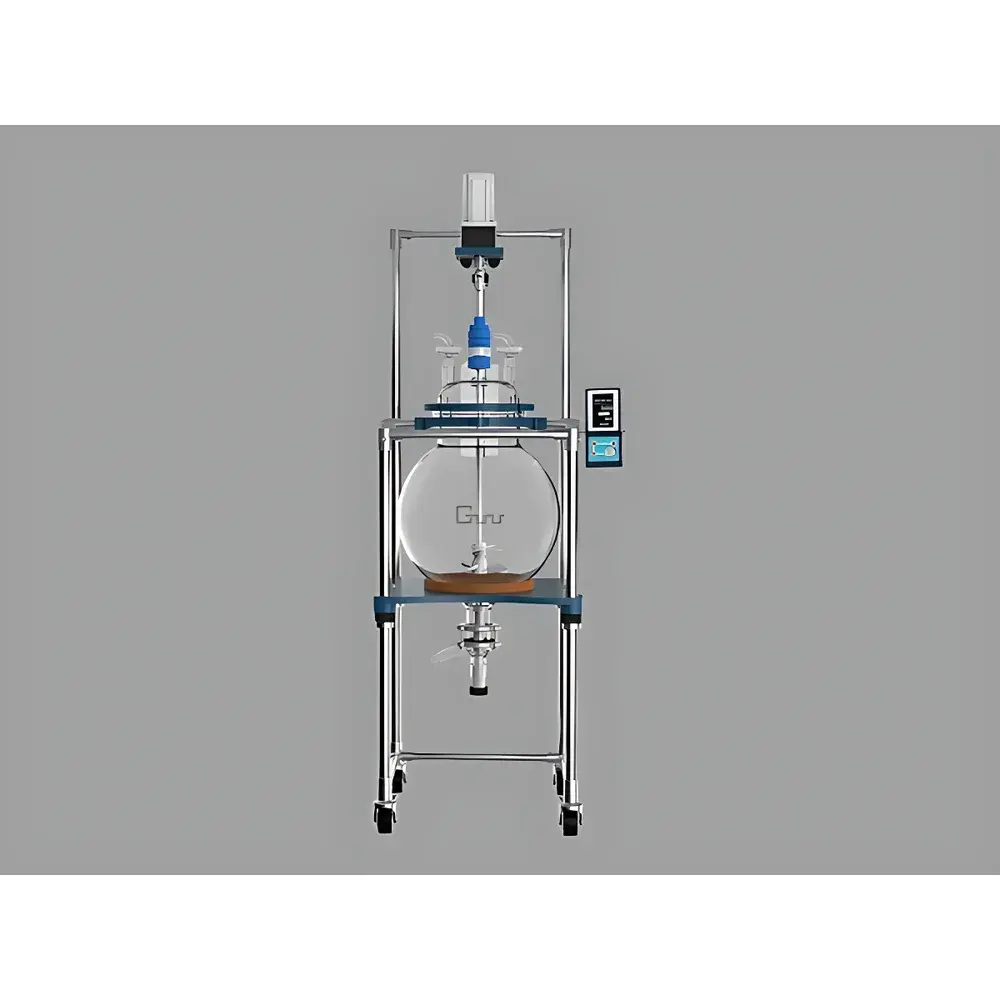
GFY-10L Separatory Funnel System (Glass, Medium-Pressure, Benchtop Extraction Unit)
| Brand | The Great Wall |
|---|---|
| Origin | Henan, China |
| Manufacturer Type | Direct Producer |
| Country of Origin | China |
| Model | GFY-10L |
| Capacity | 10 L |
| Vessel Material | High-Borosilicate Glass (DIN/ISO 3585 compliant) |
| Operating Pressure Range | Medium-pressure (up to 0.4 MPa gauge) |
| Ultimate Vacuum | ≤ –0.098 MPa (absolute, equivalent to ~2 mbar) |
| Valve Type | PTFE/FKM rotary stopcock with precision flow control |
| Stirring | Variable-speed overhead mechanical stirrer (0–200 rpm, torque-regulated) |
| Application Class | Pilot-scale liquid–liquid extraction |
| Compliance | Designed per GB/T 21673–2008 (Laboratory Glassware — Specifications for Separatory Funnels), compatible with ISO 17025-accredited lab workflows |
Overview
The GFY-10L Separatory Funnel System is a purpose-engineered benchtop liquid–liquid extraction apparatus designed for reproducible, scalable partitioning of immiscible phases under controlled pressure and vacuum conditions. Unlike standard gravity-fed funnels, this system integrates a sealed high-borosilicate glass vessel, variable-speed mechanical agitation, and a calibrated PTFE/FKM rotary stopcock—enabling dynamic phase dispersion, equilibration, and selective phase separation in a single, closed-loop configuration. Its operational envelope spans ambient to medium-pressure environments (up to 0.4 MPa gauge) and deep vacuum (≤ –0.098 MPa absolute), supporting extraction protocols requiring inert atmosphere handling, solvent recovery, or volatile solute retention. The unit is explicitly intended for pilot-scale process development—not analytical-scale separations—and bridges the gap between laboratory flask-based extractions and industrial continuous extractors.
Key Features
- High-borosilicate glass construction (≥ 3.3 expansion coefficient, hydrolytic class HGB 1 per ISO 719) ensures chemical resistance to organic solvents, dilute acids/bases, and thermal shock up to ΔT = 120 °C.
- Integrated variable-speed overhead stirrer (0–200 rpm, ±2 rpm repeatability) provides controlled shear input during mixing phase, optimizing interfacial area and mass transfer kinetics without emulsion over-stabilization.
- PTFE/FKM dual-material rotary stopcock delivers leak-tight sealing across temperature (–20 °C to +150 °C) and pressure ranges, with graduated flow modulation for precise phase discharge—critical for sequential fraction collection or interface-sampling protocols.
- Vacuum-compatible design includes ground-glass joints (ISO K 29/32), reinforced clamping flanges, and pressure-rated sight ports—validated for sustained operation at ≤2 mbar absolute pressure per EN 15090:2012 (vacuum equipment safety requirements).
- Modular mounting frame accommodates optional accessories: digital pressure/vacuum transducers (0–1 MPa range, ±0.25% FS), PT100 temperature probe ports, and inert gas purge inlets (Swagelok SS-4-SS-4).
Sample Compatibility & Compliance
The GFY-10L supports biphasic systems involving water/organic (e.g., H₂O/ethyl acetate, H₂O/dichloromethane), organic/organic (e.g., hexane/toluene), and ionic liquid–aqueous phases. It excludes highly exothermic or polymerizing systems, supercritical fluids, or slurries containing >5 wt% suspended solids. All wetted surfaces comply with USP (plastic components) and ISO 10993–1 (biocompatibility screening basis). The system meets structural requirements for GLP-compliant extraction documentation per OECD Test Guideline 105 (Water Solubility) and supports audit-ready operation when paired with validated electronic logbooks (see Software section).
Software & Data Management
While the GFY-10L operates as a standalone hardware platform, it interfaces via 4–20 mA analog outputs (optional) with third-party SCADA or LIMS systems (e.g., LabVantage, Thermo Fisher SampleManager). Pressure, vacuum, and stirrer RPM signals can be logged at 1 Hz resolution. When integrated with a validated data acquisition module meeting FDA 21 CFR Part 11 criteria—including electronic signatures, audit trails, and role-based access control—the system satisfies GMP Annex 11 and EU GMP Chapter 4 traceability mandates for pharmaceutical intermediate purification workflows.
Applications
- Pilot-scale optimization of solvent selection and phase ratio in API purification (e.g., post-hydrolysis workup of β-lactam antibiotics).
- Recovery and concentration of natural product extracts (e.g., curcuminoids from turmeric oleoresin using ethyl acetate/water partitioning).
- Removal of catalyst residues (e.g., Pd/C leachates) from cross-coupling reaction mixtures prior to crystallization.
- Radiochemical separation of ⁹⁹Mo/⁹⁹mTc generator eluates under nitrogen blanket.
- Teaching laboratories demonstrating mass transfer coefficients (KLa), distribution ratios (D), and stage efficiency in multi-stage countercurrent extraction theory.
FAQ
Is the GFY-10L suitable for acidic or alkaline aqueous phases?
Yes—high-borosilicate glass resists corrosion from pH 1–12 solutions at temperatures ≤80 °C; prolonged exposure to hot concentrated NaOH (>30 wt%) or HF-containing media is not recommended.
Can the system be sterilized by autoclaving?
No—glass vessel and PTFE/FKM components are not rated for saturated steam cycles; validated dry-heat sterilization (160 °C, 2 h) is permissible per ISO 17665–1.
What vacuum pump specifications are required to achieve ≤2 mbar?
A two-stage oil-sealed rotary vane pump with ultimate vacuum ≤0.5 mbar and pumping speed ≥12 m³/h is recommended; use of a cold trap is mandatory for solvent-laden vapors.
Does the stirrer motor include torque overload protection?
Yes—integrated current-limiting circuitry halts rotation if torque exceeds 1.2 N·m, preventing shaft deformation during high-viscosity emulsion formation.
Are replacement stopcocks and glass parts available as spares?
Yes—standardized ISO K 29/32 ground-glass stopcocks (PTFE/FKM), 10 L vessel bodies, and clamp assemblies are stocked and supplied with calibration certificates (traceable to NIM, China).



