
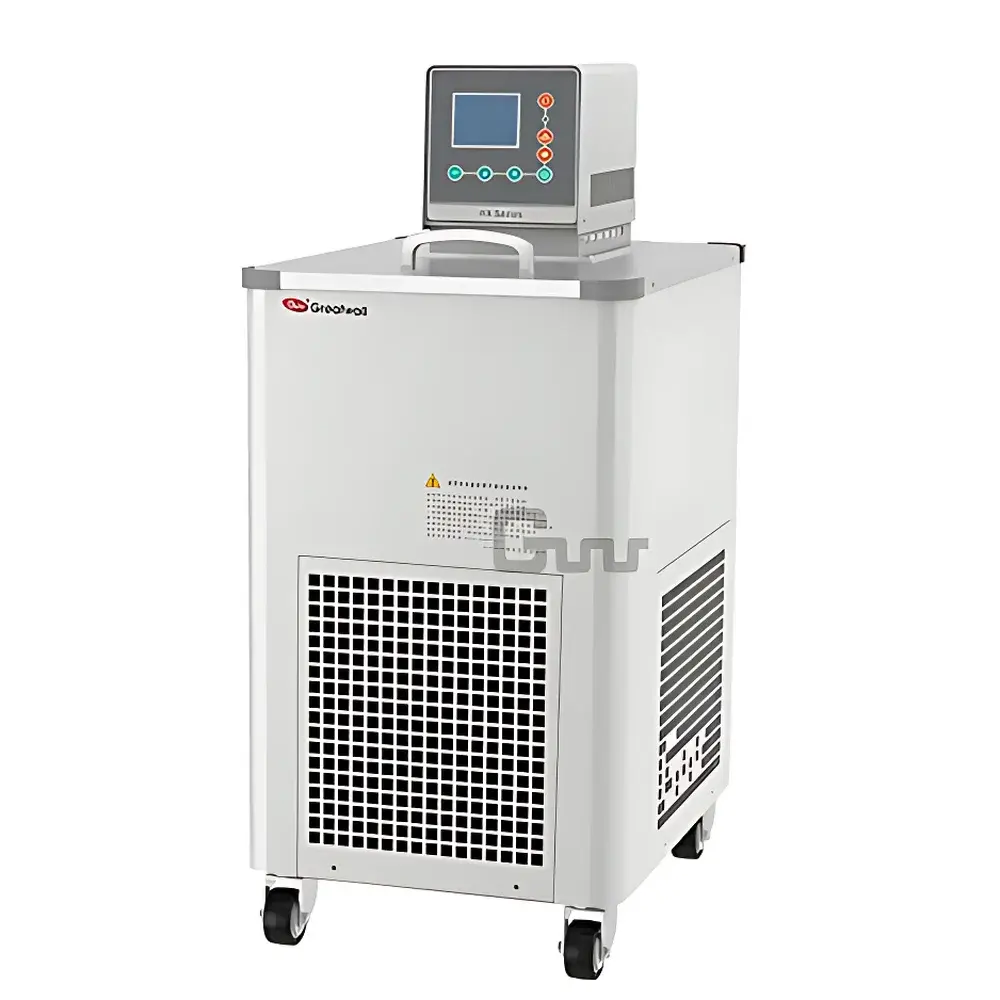
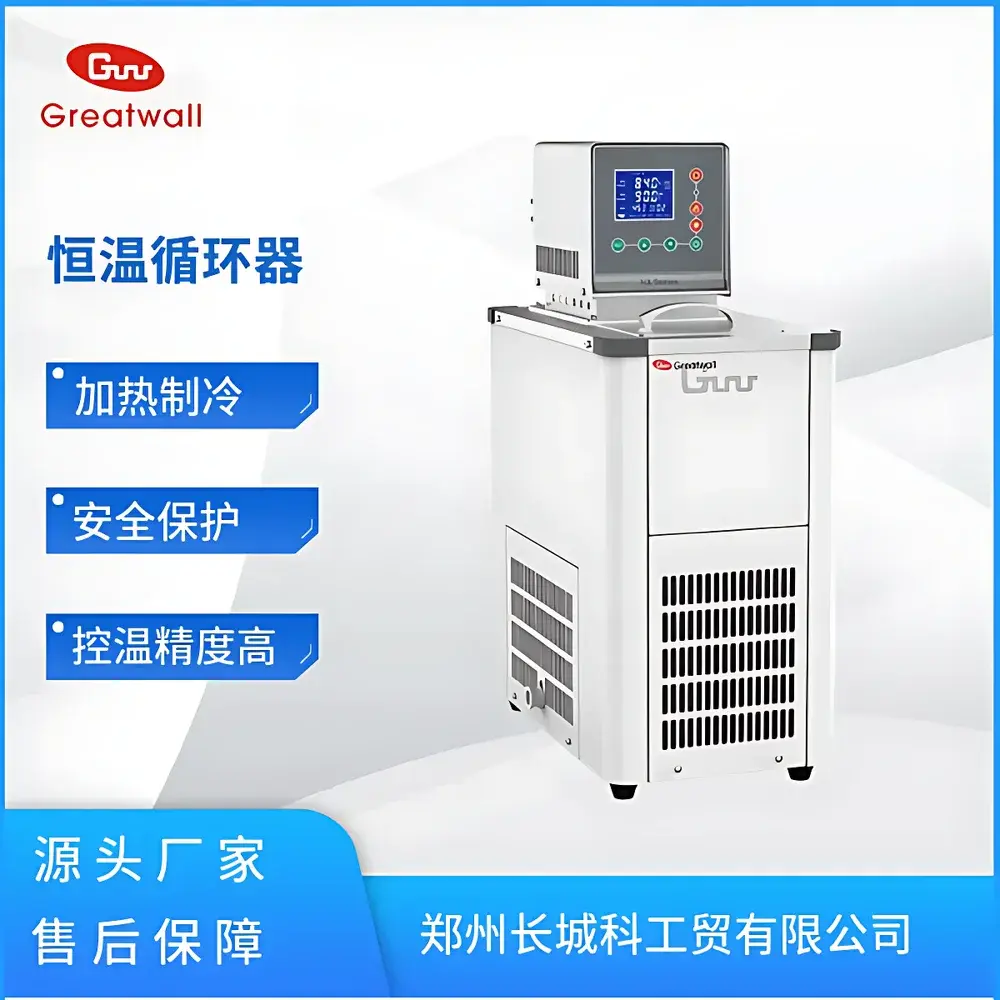
Great Wall HX-1005 Benchtop Circulating Chiller/Heater
| [Brand | The Great Wall |
|---|---|
| Origin | Henan, China |
| Manufacturer Type | Direct Manufacturer |
| Instrument Type | Vertical |
| Temperature Range | −5 to 99 °C |
| Temperature Stability | ±0.05 °C (display resolution) |
| Display Resolution | 0.01 °C |
| Bath Volume | 5 L |
| Bath Opening | 141 W × 120 D mm |
| Bath Depth | 145 mm |
| External Dimensions | 270 W × 490 D × 650 H mm |
| Net Weight | 32 kg |
| Circulation Pump Flow Rate | up to 10 L/min |
| Max Pump Pressure | 0.2 bar |
| Heating Power | 1.1 kW |
| Total Power Consumption | 1.5 kW |
| Refrigerant | R134a |
| Communication Interface | RS-485 (Modbus RTU protocol) |
| Bath Material | 06Cr19Ni10 (AISI 304 stainless steel) |
| Enclosure Material | Powder-coated cold-rolled steel |
| IP Rating | IP20 |
| Pollution Degree | 2 |
| Operating Ambient | 5–35 °C, ≤70% RH |
| Power Supply | 220–240 V~, 50 Hz] |
Overview
The Great Wall HX-1005 is a compact, vertically oriented circulating chiller/heater engineered for precise thermal control in laboratory-scale applications. It operates on a closed-loop thermoregulation principle—using a dual-mode refrigeration and resistive heating system—to maintain stable bath temperatures across a wide operational range of −5 °C to 99 °C. Its core function is to supply accurately regulated coolant or heat-transfer fluid to external devices (e.g., electrophoresis units, electron probe microanalyzers, spectrophotometer jackets, or reaction blocks) via an integrated circulation pump. The unit employs PID-based temperature control logic with real-time feedback from a high-stability Pt100 sensor embedded in the stainless-steel bath, enabling reproducible thermal setpoints with a stability of ±0.05 °C (display resolution) and 0.01 °C digital readout precision. Designed for integration into multi-instrument workflows, it complies with fundamental safety and electromagnetic compatibility requirements for laboratory equipment under IEC 61010-1.
Key Features
- Stainless-steel bath (06Cr19Ni10 / AISI 304) ensures long-term chemical resistance against common organic solvents, aqueous buffers, and glycol-based heat-transfer fluids.
- Dual-impeller circulation pump delivers up to 10 L/min flow rate and 0.2 bar pressure head, supporting both low-resistance internal recirculation and moderate-pressure external loops.
- Intelligent thermal management includes delayed startup, overcurrent protection, overload cutoff, and compressor thermal safeguarding—meeting Class II insulation and basic functional safety expectations per IEC 61010.
- Front-accessible, tool-free removable air grille enables routine cleaning of the condenser coil without disassembly.
- Side- and rear-mounted drain valves facilitate safe, spill-free replacement of heat-transfer media—critical when switching between water, ethanol/water mixtures, or silicone oils.
- RS-485 interface with standard Modbus RTU protocol allows seamless integration into centralized lab monitoring systems or SCADA platforms for remote parameter setting, status polling, and event logging.
- Compact footprint (270 W × 490 D × 650 H mm) and lightweight construction (32 kg) optimize space utilization in crowded analytical labs or fume hood peripheries.
Sample Compatibility & Compliance
The HX-1005 is compatible with standard laboratory heat-transfer fluids including deionized water, 30–50% ethylene glycol/water blends, and low-viscosity silicone oils (up to 100 cSt). Its bath geometry (141 W × 120 D × 145 H mm) accommodates immersion probes, jacketed reactors up to 2 L volume, and standard electrophoresis tanks. While not certified to ISO/IEC 17025 or GLP-specific validation protocols out-of-the-box, its hardware architecture—including traceable temperature sensing, deterministic PID response, and audit-ready communication logs—supports user-defined IQ/OQ/PQ qualification in regulated environments (e.g., pharmaceutical QC labs operating under USP or FDA 21 CFR Part 11-compliant data governance frameworks).
Software & Data Management
The device does not include proprietary PC software but exposes all controllable parameters (setpoint, actual temperature, pump status, alarm flags) via Modbus RTU registers over RS-485. This enables interoperability with third-party lab automation suites such as LabVIEW, MATLAB Data Acquisition Toolbox, or enterprise LIMS platforms using standard Modbus TCP-to-RTU gateways. All communication events—including setpoint changes and fault triggers—are timestamped at firmware level, satisfying minimum ALCOA+ (Attributable, Legible, Contemporaneous, Original, Accurate) data integrity expectations for non-GxP auxiliary equipment. Firmware updates are performed via physical USB interface (optional adapter), with version history retained in non-volatile memory.
Applications
- Temperature stabilization of electrophoresis systems during DNA/RNA separation to prevent band distortion from Joule heating.
- Thermal conditioning of electron probe microanalyzers (EPMA) and scanning electron microscope (SEM) sample stages to minimize thermal drift during quantitative elemental mapping.
- Controlled cooling of rotary evaporator condensers in solvent recovery workflows, particularly for low-boiling-point fractions (e.g., diethyl ether, pentane).
- Calibration support for thermocouple and RTD reference standards in metrology labs requiring traceable thermal baths within ±0.1 °C uncertainty budgets.
- Process simulation in pilot-scale bioreactor development, where consistent jacket temperature profiles replicate upstream/downstream thermal conditions.
FAQ
What heat-transfer fluids are recommended for operation below 0 °C?
For sub-zero operation, a mixture of deionized water and propylene glycol (e.g., 30:70 v/v) is recommended to avoid freezing while maintaining thermal conductivity and pump compatibility.
Can the HX-1005 be used in a cleanroom environment?
Its IP20 rating and powder-coated enclosure meet general laboratory requirements but do not satisfy ISO Class 5–7 cleanroom particulate or outgassing specifications; supplemental HEPA filtration of exhaust air is advised.
Is the temperature sensor calibrated traceably to NIST standards?
The built-in Pt100 sensor is factory-calibrated; full traceable calibration certificates (with uncertainty statements) are available upon request as an optional service.
Does the unit support external temperature feedback control (e.g., from a reactor jacket sensor)?
No—the HX-1005 operates in bath-temperature control mode only; external feedback loops require a programmable logic controller or external PID controller interfaced via analog I/O (not included).
What maintenance intervals are recommended for optimal longevity?
Condenser cleaning every 3 months in dusty environments; refrigerant pressure and pump seal inspection annually; full system performance verification every 24 months per manufacturer’s technical bulletin TB-HX-2023-01.



