
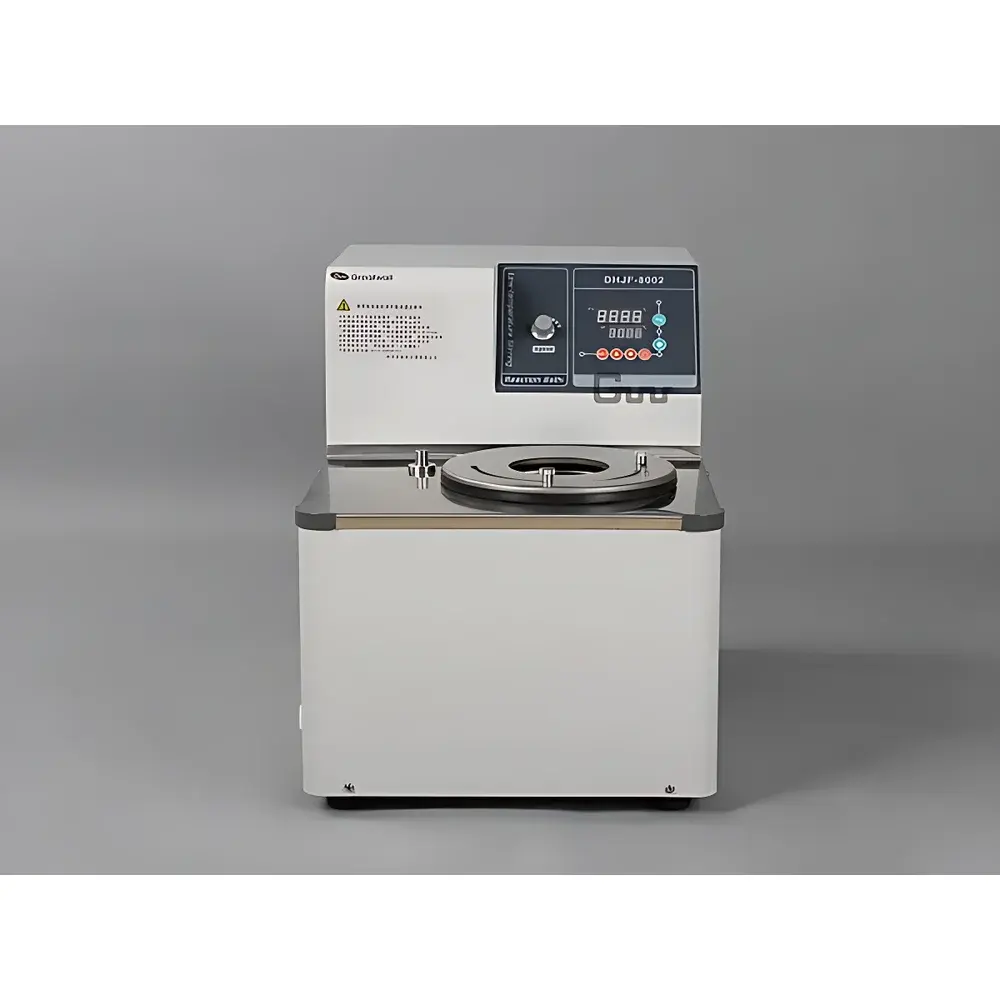
Zhengzhou Great Wall DHJF-8002 Low-Temperature Circulating Bath
| Brand | The Great Wall |
|---|---|
| Origin | Henan, China |
| Manufacturer Type | Direct Manufacturer |
| Country of Origin | China |
| Model | DHJF-8002 |
| Price | Upon Request |
| Temperature Range | −80 °C to +10 °C |
| Temperature Stability | ±2 °C |
| Reservoir Volume | 2 L |
| Reservoir Dimensions | Φ160 mm × 105 mm (H) |
| Opening Diameter | Φ140 mm |
| Max Flask Capacity | 500 mL |
| Refrigeration Capacity | 200 W at −40 °C / 120 W at −60 °C / 60 W at −80 °C |
| Refrigerants | R404A & R23 |
| Power Supply | 220–240 V~, 50 Hz |
| Total Power Consumption | 1024 W |
| Cabinet Material | Cold-Rolled Steel with Electrostatic Powder Coating |
| External Dimensions (W×D×H) | 410 × 610 × 495 mm |
| Net Weight | 68 kg |
| Ambient Operating Temperature | 5–25 °C |
| Safety Protections | Compressor Delay Start, Leakage Current Protection, Overcurrent Protection, Overtemperature Protection |
Overview
The Zhengzhou Great Wall DHJF-8002 Low-Temperature Circulating Bath is a precision-engineered thermal management system designed for laboratory-scale low-temperature reaction control, cryogenic sample conditioning, and temperature-stable bath applications. It operates on a dual-stage cascade refrigeration principle—employing two independent refrigeration circuits (R404A for the high-temperature stage and R23 for the ultra-low-temperature stage)—to achieve stable operation down to −80 °C without liquid nitrogen or external coolant loops. This architecture enables reliable, continuous cooling under variable thermal loads while maintaining ±2 °C temperature stability across its full operating range (−80 °C to +10 °C). The unit is optimized for integration with glass reactors, jacketed vessels, and analytical instrumentation requiring precise, vibration-minimized thermal environments. Its compact footprint (410 × 610 × 495 mm), air-cooled condenser design, and sealed scroll-type compressors eliminate dependency on chilled water infrastructure—making it suitable for standard laboratory electrical and ventilation conditions.
Key Features
- Cascade Refrigeration Architecture: Dual-refrigerant system (R404A/R23) enables deep cooling to −80 °C with improved thermodynamic efficiency and reduced compressor cycling versus single-stage alternatives.
- High-Efficiency Heat Exchangers: Finned-tube air-cooled condenser with oxygen-free copper spiral tubing; proprietary expansion joint technology ensures long-term mechanical integrity and simplified maintenance.
- Integrated Immersion Evaporator: Coil-type evaporator mounted directly inside the 2 L stainless-steel reservoir—designed to withstand localized freezing of heat-transfer fluids without structural compromise or refrigerant leakage.
- Digital PID Controller: Full-text Chinese LCD interface with real-time temperature display, programmable setpoint ramping, and user-configurable alarm thresholds for overtemperature, low-level, and fault conditions.
- Comprehensive Electrical Protection: Built-in safeguards include compressor time-delay start, ground-fault circuit interruption (GFCI), overcurrent tripping, and thermal cutoffs on both compressor windings and reservoir walls.
- Lab-Scale Ergonomics: Φ140 mm open-top reservoir accommodates standard 500 mL jacketed flasks; powder-coated cold-rolled steel chassis provides corrosion resistance and static discharge mitigation.
Sample Compatibility & Compliance
The DHJF-8002 is compatible with common low-temperature heat-transfer media including ethanol, methanol, ethylene glycol/water mixtures, and silicone oils rated for operation below −80 °C. Its reservoir geometry and internal flow path are engineered to minimize dead volume and promote uniform thermal distribution—critical for reproducible kinetic studies and exothermic reaction quenching. All refrigerants comply with China’s GB/T 7778–2017 standard for refrigerant classification and environmental safety. While not certified to UL/CSA or CE for standalone medical or industrial process use, the unit meets general laboratory equipment requirements per GB 4793.1–2007 (Safety Requirements for Electrical Equipment for Measurement, Control, and Laboratory Use). Documentation supports GLP-compliant recordkeeping when paired with validated external data loggers.
Software & Data Management
The DHJF-8002 operates as a standalone instrument with no embedded network interface or proprietary software suite. Temperature setpoints, real-time readings, and alarm status are accessible exclusively via the front-panel LCD. For traceable data acquisition, users may integrate third-party USB or RS-485 temperature loggers (e.g., Omega OM-DAQPRO-5300 or Testo 176 T4) using the optional analog output signal (0–5 V DC proportional to bath temperature). All operational parameters—including compressor runtime, fault codes, and thermal history—are retained in non-volatile memory for post-event diagnostics. Audit trails and electronic signatures fall outside native capability; compliance with FDA 21 CFR Part 11 requires external validation of connected logging systems and procedural controls.
Applications
- Low-temperature synthesis of organometallic compounds and Grignard reagents
- Cryogenic stabilization of enzymatic assays and protein crystallization trials
- Calibration of thermocouples, RTDs, and infrared sensors at sub-zero reference points
- Condenser cooling for rotary evaporation of high-boiling solvents under reduced pressure
- Thermal preconditioning of polymer samples prior to DSC or DMA analysis
- Controlled-rate freezing of biological specimens in pre-analytical workflows
FAQ
What is the minimum ambient temperature required for stable −80 °C operation?
The unit requires an ambient environment between 5 °C and 25 °C. Operation below 5 °C may impair oil return in the low-stage compressor; above 25 °C significantly reduces refrigeration capacity and increases compressor duty cycle.
Can the DHJF-8002 be used with flammable solvents such as diethyl ether?
No. The reservoir and circulation system are not intrinsically safe or explosion-proof. Only non-flammable, low-vapor-pressure heat-transfer fluids compliant with IEC 60079-0 should be used in hazardous area applications.
Is remote monitoring or control possible via Ethernet or Wi-Fi?
No. The controller lacks network connectivity. Remote readout requires external analog-to-digital conversion hardware and custom scripting.
Does the unit support external temperature feedback from a probe immersed in the reaction vessel?
No. The system regulates based solely on internal reservoir sensor feedback. External PID cascade control is not supported natively.
What maintenance intervals are recommended for long-term reliability?
Compressor oil inspection every 24 months; condenser coil cleaning every 6 months in dusty environments; refrigerant leak verification annually using halogen leak detector or pressure decay test.



