
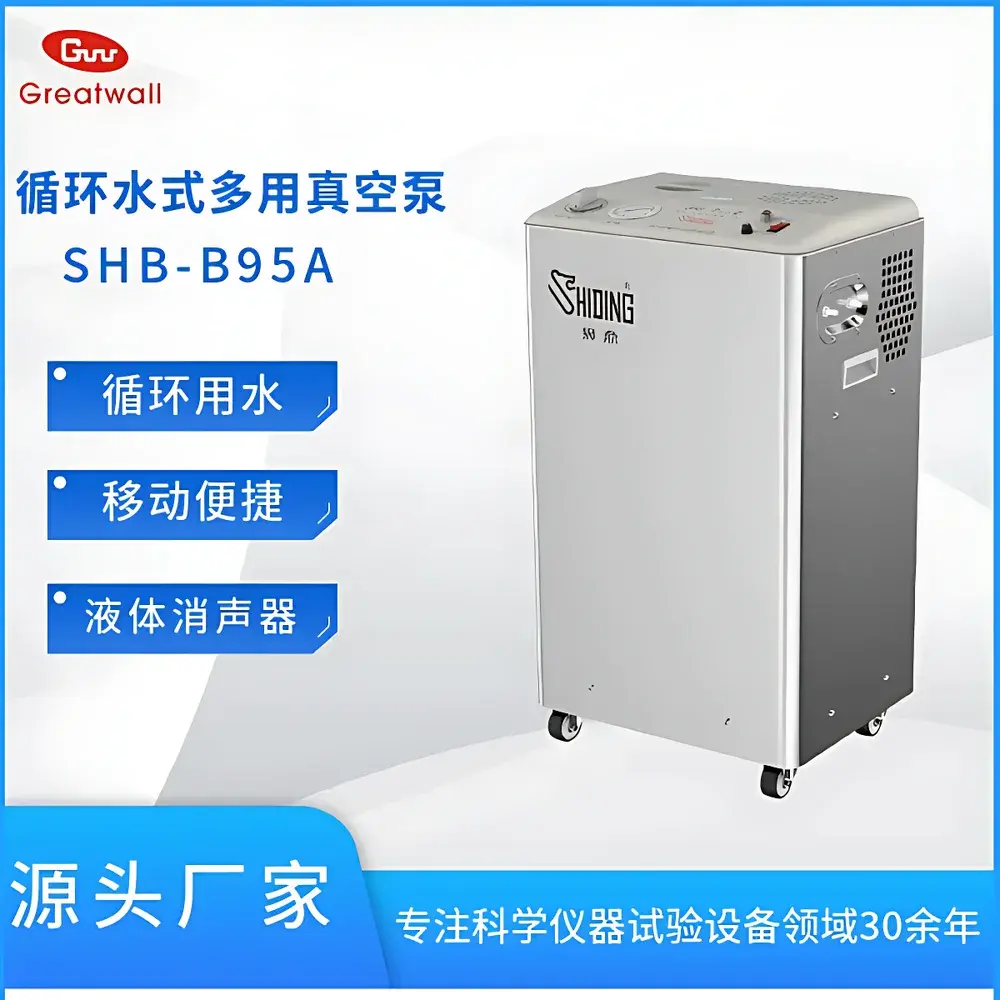
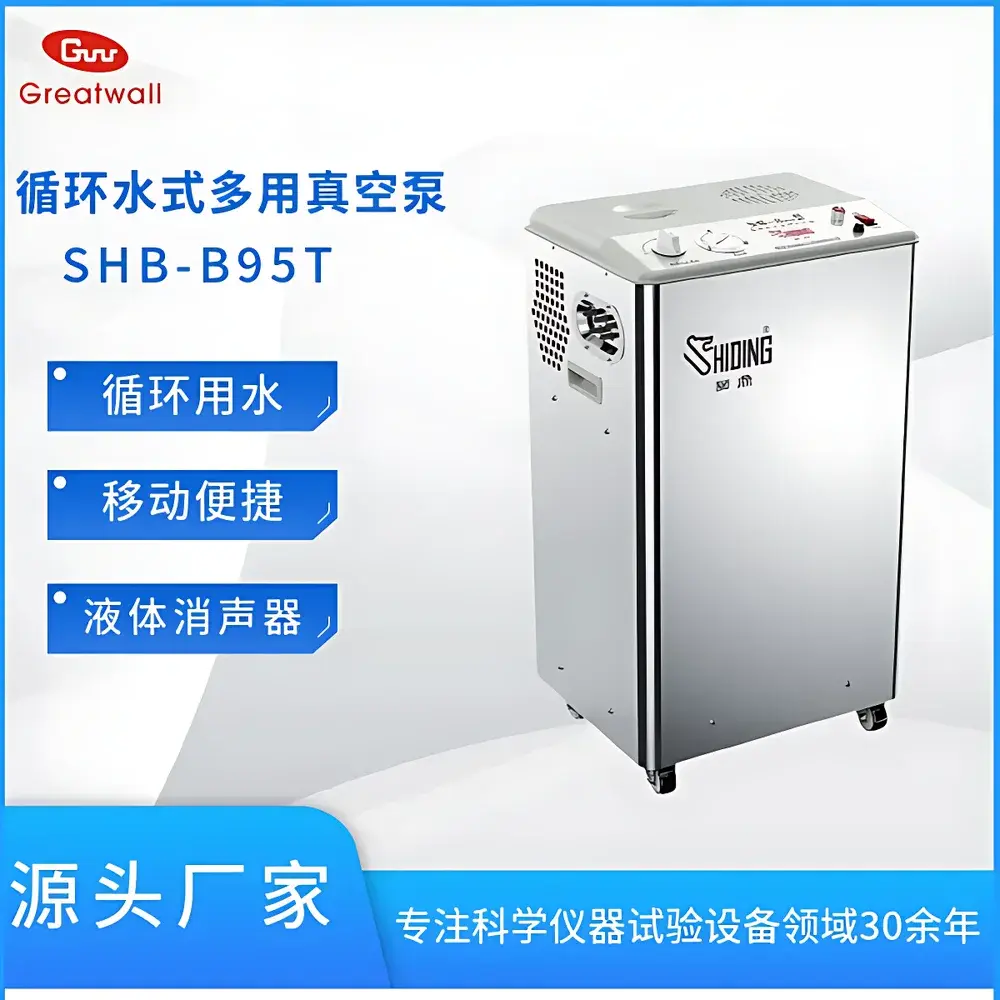
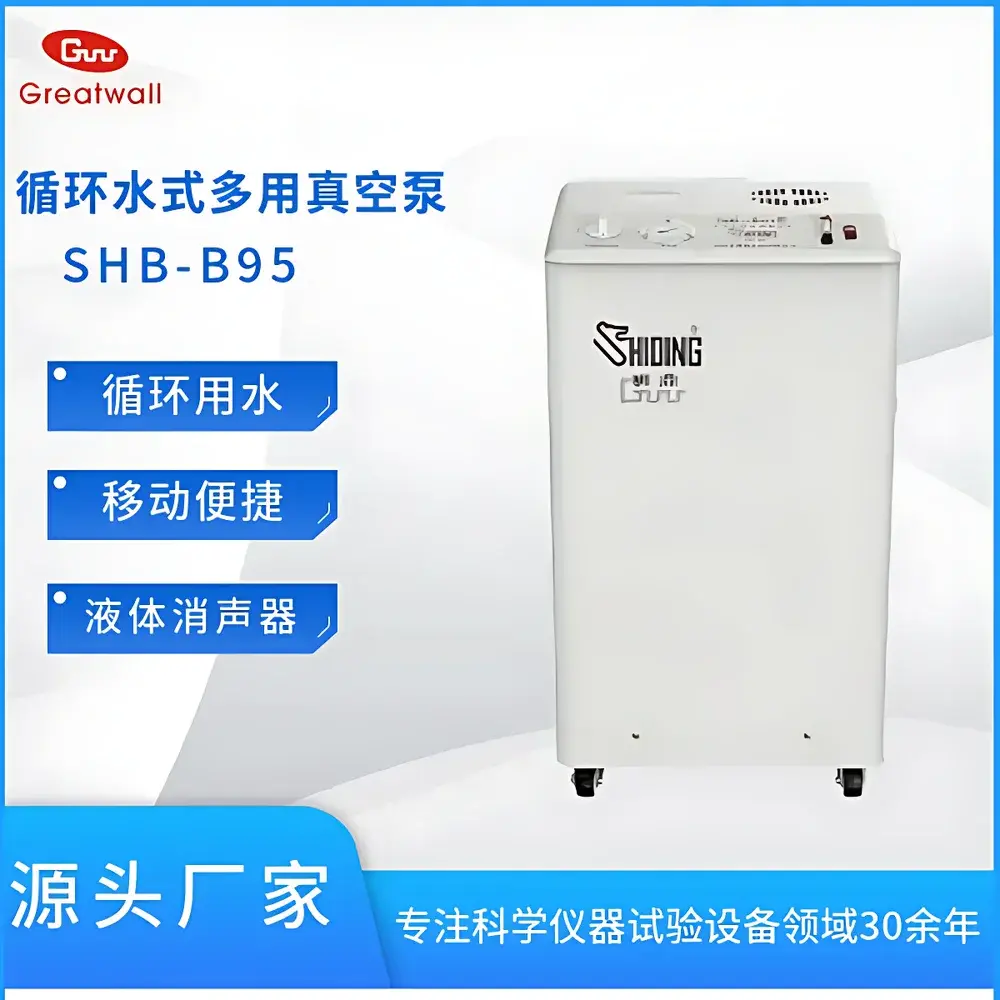
The Great Wall SHB-B95 Circulating Water Vacuum Pump
| Brand | The Great Wall |
|---|---|
| Origin | Henan, China |
| Manufacturer Type | Direct Manufacturer |
| Country of Origin | China |
| Model | SHB-B95 |
| Instrument Type | Circulating Water Vacuum Pump |
| Product Type | Oil-Free Vacuum Pump |
| Single-Head Air Extraction Rate | 10 L/min |
| External Dimensions | 450 W × 350 D × 820 H mm |
| Weight | 36 kg |
| Power Rating | 550 W |
| Supply Voltage | 220–240 V, 50 Hz |
| Ultimate Pressure | 0.098 MPa (20 mbar) |
| Number of Vacuum Ports | 5 |
| Water Tank Capacity | 57 L |
| Operating Ambient Temperature | 5–35 °C |
| Relative Humidity Limit | ≤70% |
| Ingress Protection Rating | IP20 |
Overview
The Great Wall SHB-B95 Circulating Water Vacuum Pump is an oil-free, water-sealed vacuum system engineered for stable, corrosion-resistant operation in chemistry, biochemistry, and pharmaceutical laboratories. It operates on the principle of water-ring vacuum generation—where rotating water within a cylindrical chamber forms a dynamic seal and imparts momentum to entrained gas molecules, enabling continuous evacuation without lubricants or hydrocarbon contamination. Unlike mechanical or diaphragm pumps, this design eliminates oil vapor backstreaming, making it ideal for solvent-sensitive applications such as rotary evaporation, vacuum filtration, and vacuum drying. Its five independently controllable suction ports allow simultaneous connection of multiple apparatuses—e.g., parallel rotovaps or multi-neck reaction flasks—while maintaining consistent vacuum levels across all outlets. The pump’s sealed motor assembly, fluororubber-shaft seals, and stainless-steel drive shaft ensure long-term integrity when exposed to mildly acidic, alkaline, or organic vapors.
Key Features
- Five independent vacuum ports with individual control valves—enabling flexible configuration for single or concurrent use.
- Motor shaft constructed from AISI 304 stainless steel; shaft-to-housing sealing achieved via high-temperature fluororubber gaskets to prevent ingress of corrosive vapors into the motor housing.
- Integrated check valve in internal gas pathways to prevent liquid backflow during sudden pressure equalization or pump shutdown.
- Modular construction with interchangeable wetted components: SHB-B95 variants offer configurable materials—including 304 stainless steel pump body and impeller, copper or PTFE-coated ejectors and nozzles, PP or PTFE-lined vacuum nipples, and PE or stainless-steel enclosures—to match chemical compatibility requirements.
- Large-capacity 57 L polyethylene water reservoir with thermal mass sufficient to sustain stable operating temperature under continuous load at ambient conditions up to 35 °C.
- Equipped with heavy-duty casters for ergonomic repositioning within lab spaces; robust cold-rolled steel or optional 304 stainless-steel enclosure with electrostatic powder coating ensures structural durability and cleanability.
Sample Compatibility & Compliance
The SHB-B95 is compatible with aqueous, alcoholic, and moderately polar solvent systems commonly used in extraction, concentration, and purification workflows. Its water-mediated vacuum generation avoids cross-contamination risks associated with oil-lubricated systems—supporting compliance with GLP documentation standards where trace hydrocarbon interference must be excluded. While not certified to ISO 8573 (compressed air purity) or FDA 21 CFR Part 11 by default, its design facilitates integration into validated laboratory processes through audit-ready operational logs (when paired with external data acquisition), consistent performance verification per ASTM D2873 (vacuum system performance testing), and adherence to IEC 61000-6-3 EMC emission limits. All electrical components meet CE safety directives (EN 60335-1), and the IP20-rated enclosure complies with standard indoor laboratory environmental classifications.
Software & Data Management
The SHB-B95 operates as a standalone analog device with no embedded microcontroller or digital interface. Vacuum level monitoring is performed visually via a single analog pressure gauge calibrated to -0.1 to 0 MPa (0–100 kPa absolute). For process validation and traceability, users may integrate third-party digital pressure transducers (e.g., Keller PA-23Y or Druck DPI 141) with USB/RS485 output and log data using LabVIEW, MATLAB, or ELN-compatible platforms. When deployed in regulated environments, manual log entries—recording date/time, water replacement intervals, observed vacuum stability, and maintenance actions—satisfy basic GxP record-keeping expectations. Optional water temperature sensors (PT100) can be installed externally to correlate thermal drift with vacuum decay trends.
Applications
- Routine vacuum support for rotary evaporators (up to 5 L capacity) in synthetic organic chemistry labs.
- Vacuum-assisted gravity and pressure filtration of precipitates or crystalline products in QC/QA settings.
- Evacuation of desiccators and vacuum ovens during moisture content analysis (per USP & Ph. Eur. methods).
- Gas-phase purging and inert atmosphere preparation prior to air-sensitive reactions.
- Low-vacuum aspiration in tissue culture hoods and microbiological containment workstations.
- Integration into custom-built distillation or extraction rigs requiring chemically resistant, non-oil-based vacuum sources.
FAQ
What is the recommended water replacement frequency for optimal vacuum performance?
Water should be replaced daily under continuous operation or after each 8-hour shift in high-throughput labs. Evaporation and dissolved CO₂ accumulation degrade ultimate vacuum; conductivity monitoring (>500 µS/cm) signals need for full reservoir exchange.
Can the SHB-B95 be operated in a fume hood or enclosed cabinet?
Yes—provided ambient temperature remains between 5–35 °C and relative humidity stays ≤70%. Ensure adequate ventilation around the unit to dissipate heat from the 550 W motor and prevent condensation inside the water tank.
Is the pump suitable for vacuum drying of hygroscopic compounds?
It achieves 20 mbar ultimate pressure—sufficient for most low-temperature drying protocols—but prolonged exposure to highly deliquescent samples may elevate water vapor load; supplemental desiccant traps are advised for extended runs.
How does ambient temperature affect ultimate vacuum pressure?
Water vapor pressure rises exponentially with temperature: at 30 °C, saturated vapor pressure reaches ~4.2 kPa (~42 mbar), limiting achievable vacuum. Maintaining reservoir temperature below 25 °C via chilled water recirculation or ambient cooling improves performance marginally.
What maintenance procedures ensure long service life?
Monthly inspection of fluororubber seals for cracking, quarterly cleaning of nozzle orifices with dilute citric acid solution, annual verification of motor insulation resistance (>2 MΩ), and biannual calibration of the analog vacuum gauge against a NIST-traceable reference.



