
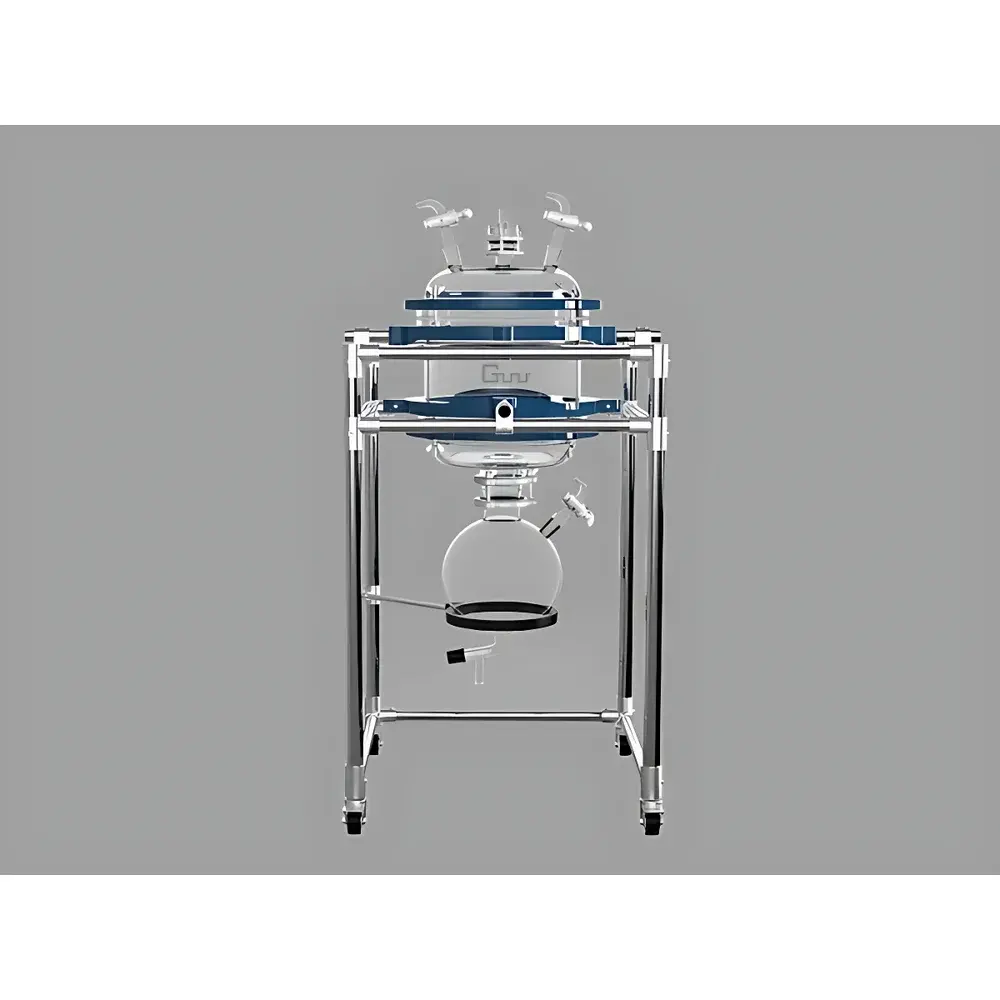
The Great Wall CZLL-20 Benchtop Vacuum Filtration Unit
| Brand | The Great Wall |
|---|---|
| Origin | Henan, China |
| Manufacturer Type | Direct Manufacturer |
| Country of Origin | China |
| Model | CZLL-20 |
| Capacity | 30 L |
| Construction Material | Borosilicate Glass (Reaction Vessel), Stainless Steel (Frame) |
| Operating Pressure Range | Medium Vacuum |
| Ultimate Vacuum | 0.098 MPa (98 kPa absolute) |
| Vessel Volume Class | Medium-Scale |
| Filter Plate Options | Interchangeable Standard Sizes (e.g., Ø100 mm, Ø150 mm, Ø200 mm) |
| Filtration Visibility | Full Visual Process Monitoring Through Glass Body |
| Compliance | Designed for GLP-aligned laboratory workflows |
| Service Support | 1-Year Limited Warranty (excludes glass components), Lifetime Technical Support and Repair Services |
Overview
The Great Wall CZLL-20 Benchtop Vacuum Filtration Unit is an engineered solution for medium-scale solid–liquid separation in synthetic chemistry, pharmaceutical process development, and materials science laboratories. It operates on the principle of pressure differential-driven filtration: a vacuum source (e.g., diaphragm or water aspirator pump) creates negative pressure beneath a porous filter plate mounted within a borosilicate glass filtration flask, inducing rapid and controlled flow of liquid phase through the filter medium while retaining solid particulates. Unlike centrifugal or gravity-based methods, vacuum-assisted filtration delivers consistent throughput, reduced processing time, and improved cake integrity—particularly critical during crystallization workups, catalyst recovery, precipitate isolation, and polymer purification steps. Its modular architecture supports both batch and semi-continuous operation modes, making it suitable for lab-scale optimization as well as pilot-stage process transfer.
Key Features
- Borosilicate glass (3.3-grade) filtration vessel with calibrated volume markings and chemical resistance to strong acids, bases, and organic solvents—ensuring long-term dimensional stability and optical clarity for real-time observation of filtration dynamics.
- Stainless steel (AISI 304) support frame with powder-coated finish, providing structural rigidity, corrosion resistance, and ergonomic height adjustment for compatibility with standard lab benches and fume hoods.
- Interchangeable filter plates (standard diameters: 100 mm, 150 mm, 200 mm) made from sintered stainless steel or PTFE-coated ceramic—each secured via quick-release clamping mechanism for tool-free installation and removal.
- Integrated vacuum port with ISO-KF25 or NPT 1/4″ connection, compatible with common vacuum regulators and pressure gauges for precise control of applied vacuum level (adjustable down to 0.098 MPa absolute).
- Sealing system utilizing high-temperature silicone gaskets and reinforced ground-glass joints (ISO 29761-compliant) to maintain vacuum integrity under prolonged operation and thermal cycling.
Sample Compatibility & Compliance
The CZLL-20 accommodates heterogeneous mixtures across diverse chemical classes—including inorganic precipitates (e.g., metal hydroxides, carbonates), organic crystals (API intermediates, chiral resolutions), polymeric slurries, and biopolymer suspensions. Its inert glass–stainless steel interface prevents catalytic side reactions or metal leaching, supporting USP , EP 2.2.42, and ASTM D2989-compliant particulate analysis workflows. While not certified for GMP production environments, the unit is routinely deployed in GLP-regulated R&D labs where traceability, reproducibility, and equipment qualification (IQ/OQ) are required. Documentation packages—including material certificates of conformance (CoC), joint tolerance reports, and vacuum leak test records—are available upon request to support internal validation protocols.
Software & Data Management
The CZLL-20 is a standalone mechanical system without embedded electronics or digital interfaces. However, it integrates seamlessly into digitally enabled lab infrastructures: vacuum pressure can be monitored externally using calibrated digital manometers (e.g., MKS Baratron series), and filtration duration, filtrate mass, and cake weight are logged manually or via connected balance systems (e.g., Mettler Toledo XSR series) into ELN platforms such as LabArchives or Benchling. All mechanical components conform to ISO 9001:2015 manufacturing standards; design documentation supports risk-based assessment per ICH Q9 and facilitates inclusion in equipment master files (EMF) for regulatory submissions.
Applications
- Isolation of crystalline active pharmaceutical ingredients (APIs) following antisolvent precipitation or cooling crystallization.
- Recovery of heterogeneous catalysts (e.g., Pd/C, Raney Ni) in multi-step organic synthesis sequences.
- Purification of metal–organic frameworks (MOFs) and covalent organic frameworks (COFs) from reaction mother liquors.
- Removal of silica gel or celite from column chromatography eluates prior to solvent evaporation.
- Pre-concentration of nanoparticle dispersions (e.g., Ag, Fe₃O₄) for subsequent characterization by TEM or DLS.
- Waste stream conditioning in green chemistry workflows—enabling solvent recycling and solid residue minimization.
FAQ
What is the maximum operating temperature for the glass vessel?
The borosilicate glass body is rated for continuous use up to 150 °C and short-term exposure to 200 °C under ambient pressure; vacuum operation reduces permissible thermal load—consult the thermal stress derating curve in Section 4.2 of the operator manual.
Can the unit be used with aggressive solvents like HF or hot concentrated H₂SO₄?
No. Although borosilicate glass resists most common reagents, hydrofluoric acid and molten alkalis cause irreversible etching; use fused quartz alternatives for such applications.
Is the filter plate assembly autoclavable?
Stainless steel plates may be autoclaved at 121 °C/15 psi for 20 minutes; PTFE-coated variants require steam sterilization only below 110 °C to preserve coating integrity.
Does the system include a vacuum pump?
No. The CZLL-20 requires an external vacuum source; recommended minimum pumping speed is 12 L/min at 0.098 MPa for optimal 30 L batch performance.
How is calibration performed for quantitative filtration studies?
Calibration involves gravimetric verification of filtrate volume using NIST-traceable volumetric flasks and certified reference weights; full procedure is detailed in Appendix B of the Installation Qualification (IQ) template provided with shipment.



