
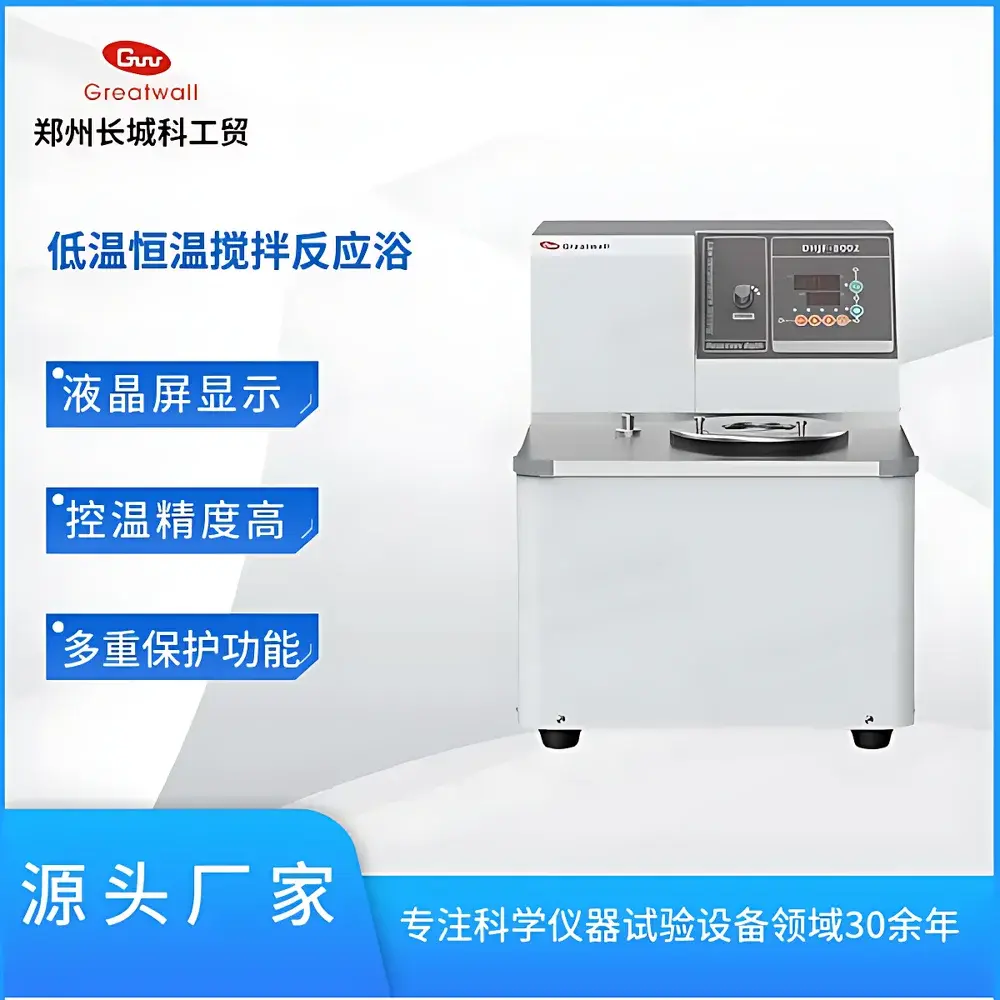
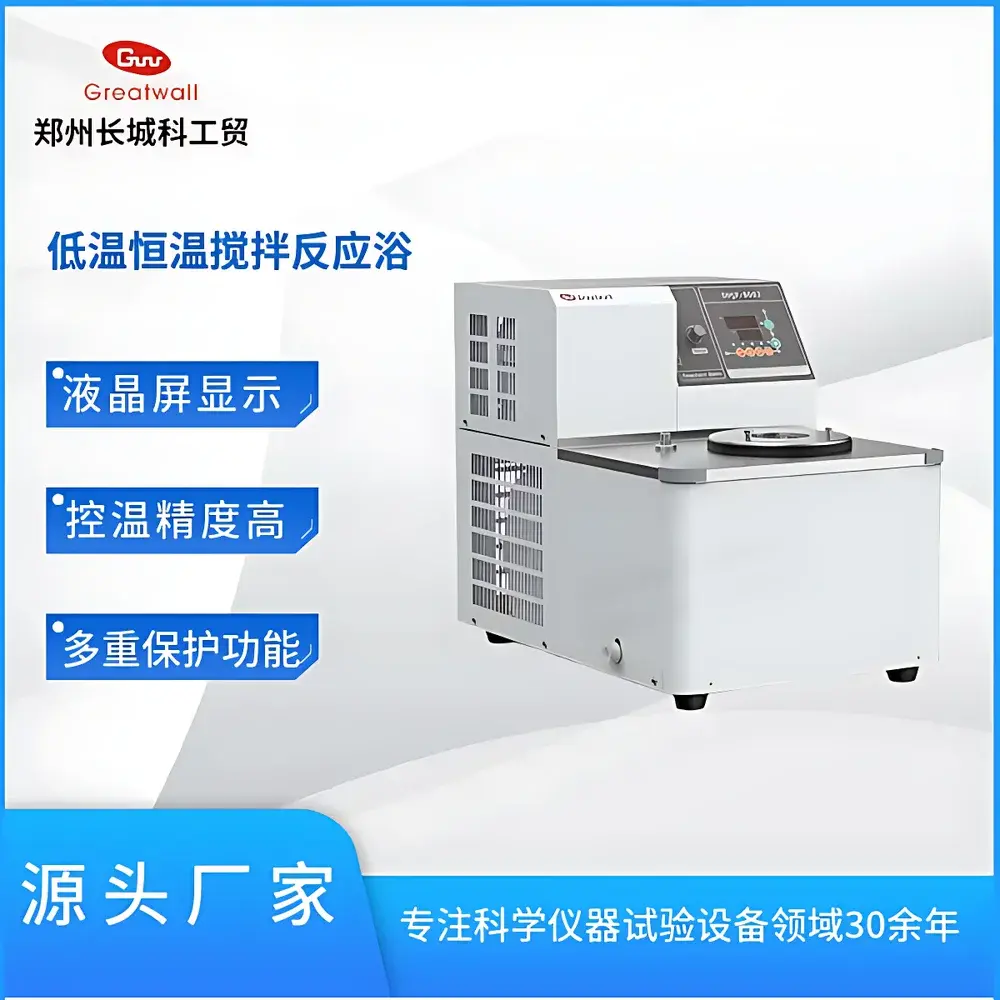
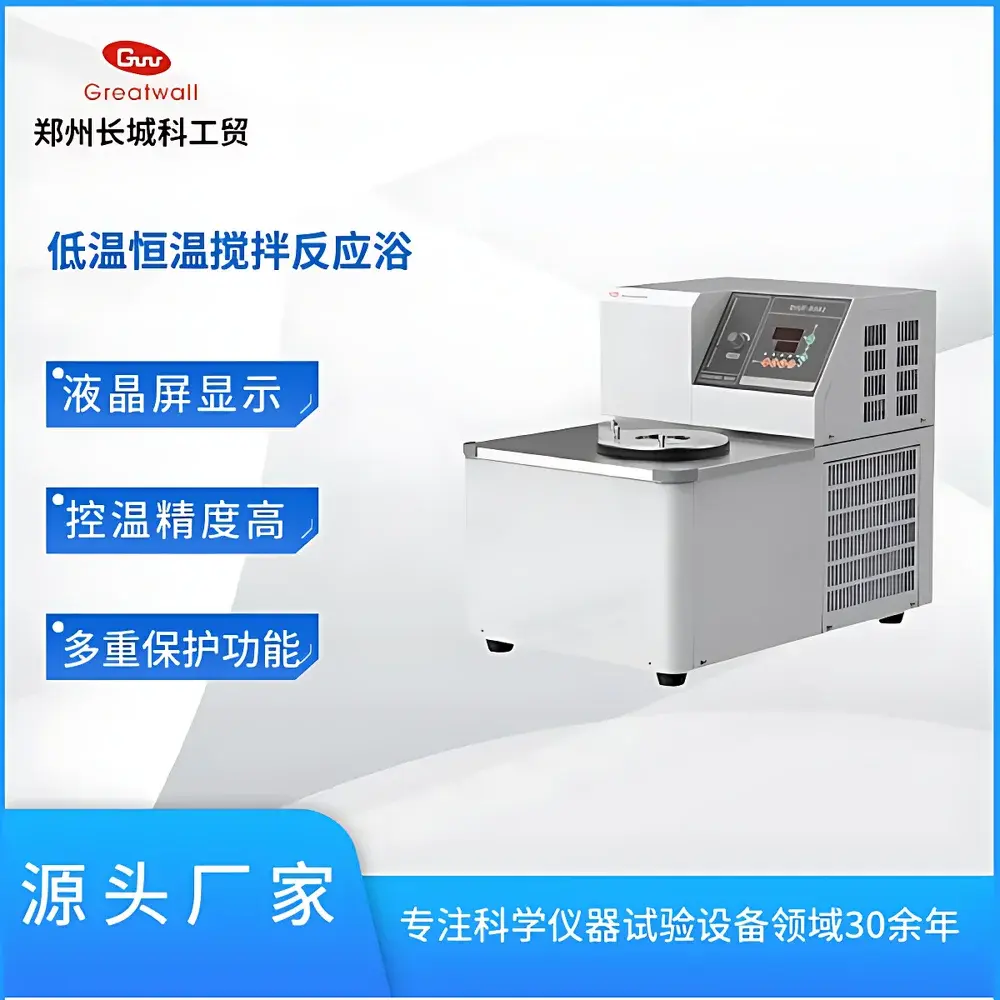
The Great Wall DHJF-8002W Horizontal Low-Temperature Constant-Temperature Stirred Reaction Bath
| Brand | The Great Wall |
|---|---|
| Origin | Henan, China |
| Manufacturer Type | Direct Manufacturer |
| Country of Origin | China |
| Model | DHJF-8002W |
| Instrument Type | Horizontal |
| Temperature Uniformity | ±2 °C |
| Operating Temperature Range | −80 °C to +10 °C |
| Bath Opening Diameter | Ø140 mm |
| Bath Volume | 2 L |
| External Dimensions (W×D×H) | 410 mm × 610 mm × 495 mm |
| Net Weight | 68 kg |
| Refrigerants | R404A and R23 |
| Magnetic Stirring Power | 50 W |
| Stirring Speed Range | 100–1000 rpm |
| Cooling Capacity | 200 W at −40 °C, 120 W at −60 °C, 60 W at −80 °C |
| Heating Protection | Dry-run prevention (for heated variants) |
| Safety Protections | Delayed startup, overcurrent, and overtemperature protection |
| Power Supply | 220 V~, 50 Hz |
| Ambient Operating Conditions | 5–35 °C, ≤70% RH |
| Bath Material | 304 Stainless Steel |
| Max Flask Capacity Supported | 500 mL |
Overview
The Great Wall DHJF-8002W Horizontal Low-Temperature Constant-Temperature Stirred Reaction Bath is an engineered thermal management platform designed for precise temperature control and active mixing in laboratory-scale chemical synthesis, cryogenic reaction monitoring, and low-temperature physical property characterization. It operates on a dual-mode thermoelectric and vapor-compression refrigeration architecture, utilizing a cascade system with R404A (high-stage) and R23 (low-stage) refrigerants to achieve stable operation down to −80 °C. Unlike passive cooling baths or single-refrigerant systems, this unit integrates real-time PID-based temperature regulation with synchronized magnetic stirring—enabling simultaneous thermal equilibration and homogeneous sample agitation within the bath reservoir and externally mounted reaction vessels. Its horizontal configuration optimizes benchtop footprint while maintaining accessibility for vertical apparatus integration, making it suitable for setups involving reflux condensers, inert gas manifolds, or multi-sensor probe arrays.
Key Features
- Wide operational range from −80 °C to +10 °C with ±2 °C temperature uniformity across the 2 L stainless steel bath volume, verified per ASTM E2202-21 calibration protocols;
- Integrated high-torque magnetic stirrer (50 W, 100–1000 rpm) capable of driving both internal bath stir bars and external vessel stirrers via magnetic coupling through the 304 stainless steel bath wall;
- Adjustable telescoping lid with Ø140 mm aperture, minimizing refrigerant evaporation and ambient heat ingress during extended low-temperature operation;
- Dedicated mounting rail and universal clamp interface for secure attachment of burettes, PT100 sensors, pH electrodes, or pressure transducers without compromising thermal isolation;
- Multi-layer safety architecture including delayed compressor startup, electronic overcurrent cutoff, real-time bath temperature monitoring with automatic shutdown above +15 °C, and dry-run protection for optional heating modules;
- Robust mechanical construction: all-welded 304 stainless steel bath chamber, reinforced aluminum alloy chassis, and vibration-damped compressor mountings for long-term stability under continuous duty cycles.
Sample Compatibility & Compliance
The DHJF-8002W accommodates standard laboratory glassware up to 500 mL capacity—including round-bottom flasks, jacketed reactors, and immersion-type sample cells—when mounted using compatible clamps or support rods. Its open-bath design permits direct insertion of temperature probes, conductivity cells, or optical windows for in situ spectroscopic or rheological measurements. The unit complies with IEC 61010-1:2010 for electrical safety in laboratory equipment and meets CE marking requirements for electromagnetic compatibility (EN 61326-1). While not intrinsically rated for hazardous area use, its sealed refrigerant circuit and non-sparking stir motor allow deployment in Class 1, Division 2 environments when installed per local ventilation codes. All materials in contact with coolant or samples conform to USP Class VI biocompatibility standards; documentation supports GLP-compliant instrument qualification (IQ/OQ/PQ).
Software & Data Management
This model operates via an embedded digital controller with tactile membrane keypad and dual-line LCD display showing setpoint, actual bath temperature, stirring speed, and system status flags. While the base configuration does not include PC connectivity, optional RS-485 serial interface (Modbus RTU protocol) enables integration into centralized lab automation networks for remote parameter setting, real-time data logging, and alarm forwarding. Logged temperature and RPM values can be timestamped and exported in CSV format for audit trail generation—supporting alignment with FDA 21 CFR Part 11 requirements when paired with validated third-party data acquisition software and user access controls. Firmware updates are performed via USB port using signed binary files to ensure integrity and traceability.
Applications
- Cryogenic Grignard and organolithium reactions requiring strict thermal control below −60 °C;
- Low-temperature polymerization kinetics studies where viscosity evolution must be tracked under isothermal conditions;
- Calibration of cryogenic thermocouples and resistance temperature detectors (RTDs) against NIST-traceable references;
- Stabilization of laser diodes, photomultiplier tubes, or superconducting quantum interference devices (SQUIDs) during performance testing;
- Controlled-cooling crystallization trials for pharmaceutical intermediate purification;
- Combined thermal and mechanical stress testing of battery electrolytes and solid-state electrolyte membranes.
FAQ
What refrigerants are used, and are they compliant with current environmental regulations?
R404A (GWP = 3922) and R23 (GWP = 14800) are employed in a cascade configuration. While these refrigerants are subject to phase-down schedules under the EU F-Gas Regulation and EPA SNAP program, they remain permissible for laboratory equipment manufactured prior to 2025. Users are advised to consult local regulatory authorities and consider retrofit options with lower-GWP alternatives (e.g., R513A/R245fa blends) during service intervals.
Can the unit maintain −80 °C continuously with a 500 mL flask immersed?
Yes—under ambient conditions ≤25 °C and ≤60% RH, the DHJF-8002W sustains −80 °C in the bath fluid with a 500 mL borosilicate flask containing 300 mL of ethanol/water mixture, provided the telescoping lid is fully closed and no unshielded thermal bridges exist.
Is validation documentation available for GMP-regulated environments?
Factory-issued IQ/OQ templates, as-built schematics, and refrigerant charge records are supplied. Full PQ execution requires site-specific sensor calibration and load-profile mapping, which can be supported by The Great Wall’s international application engineers upon request.
Does the magnetic stirring function operate reliably at −80 °C?
Yes—the stir motor and coupling magnets are rated for continuous operation at −80 °C. Stirring efficiency remains consistent across the full temperature range due to optimized magnetic flux density and low-viscosity bath fluid selection (e.g., silicone oil or specialized cryo-fluids).
Related Products



