
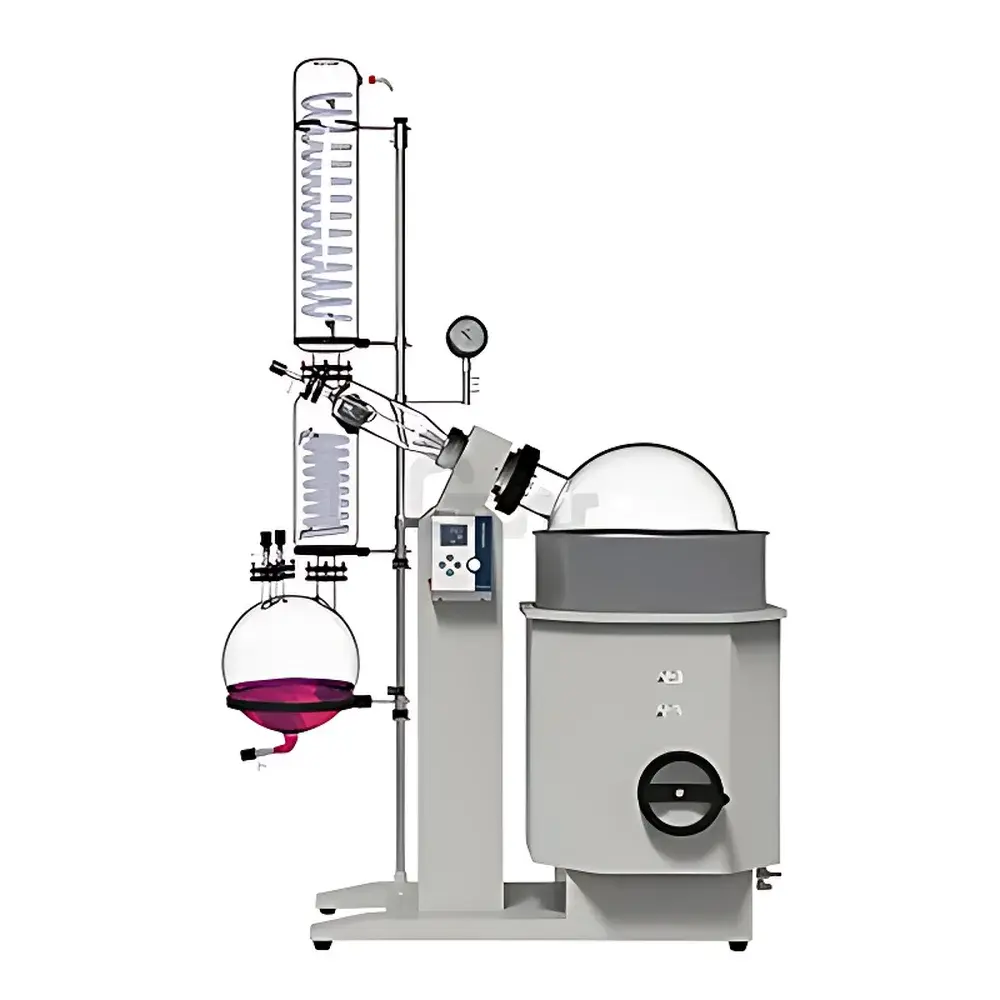
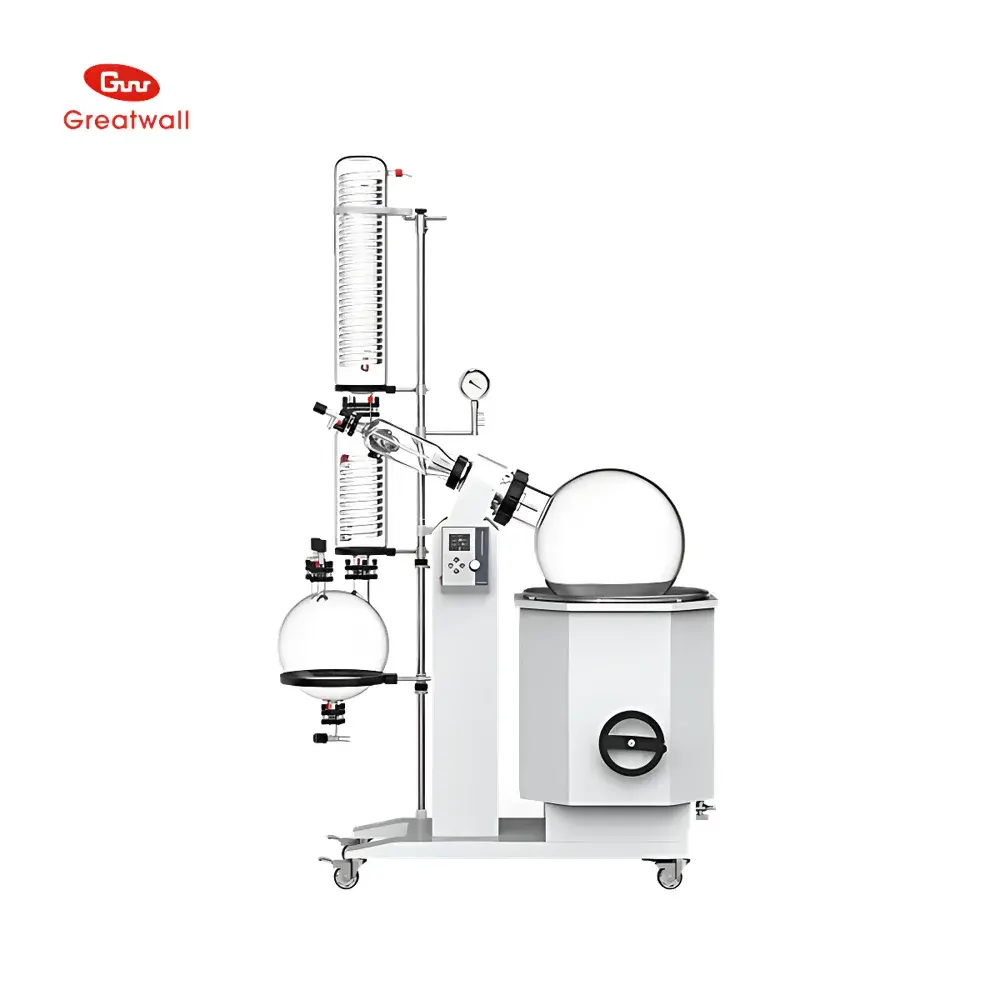
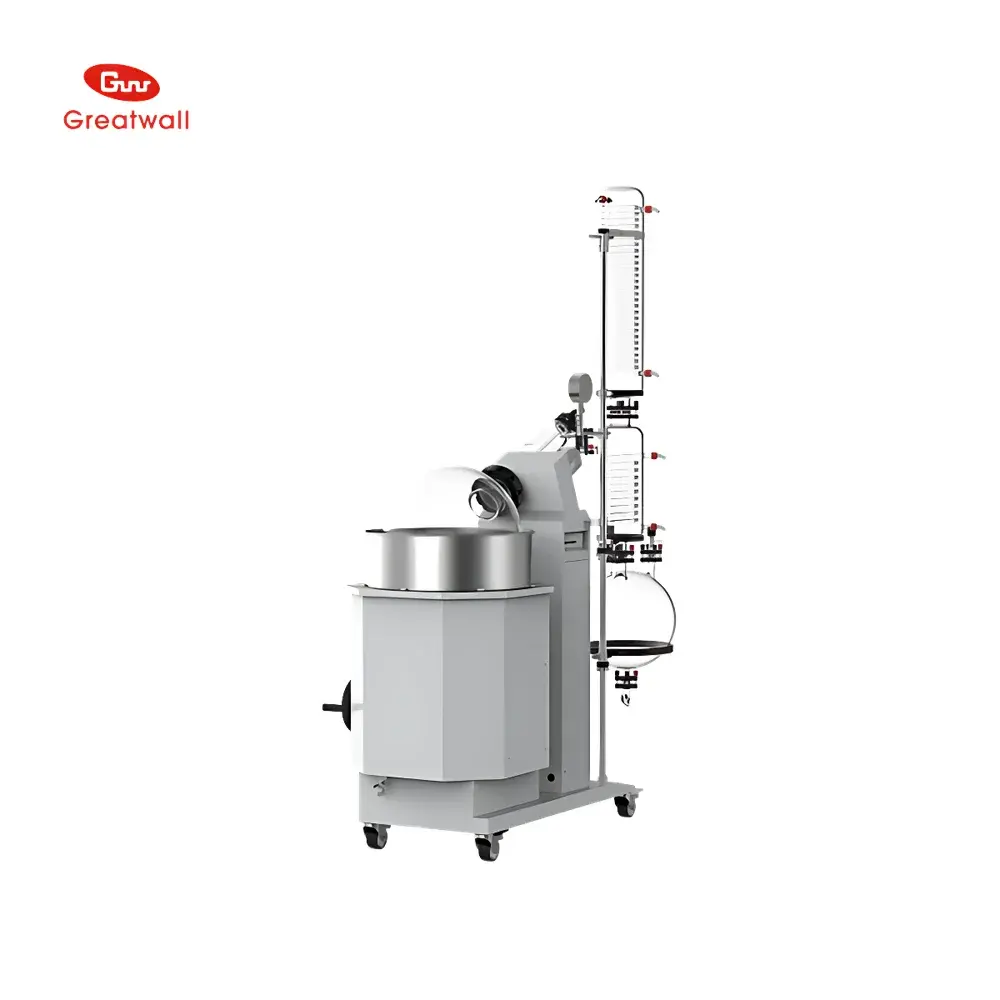
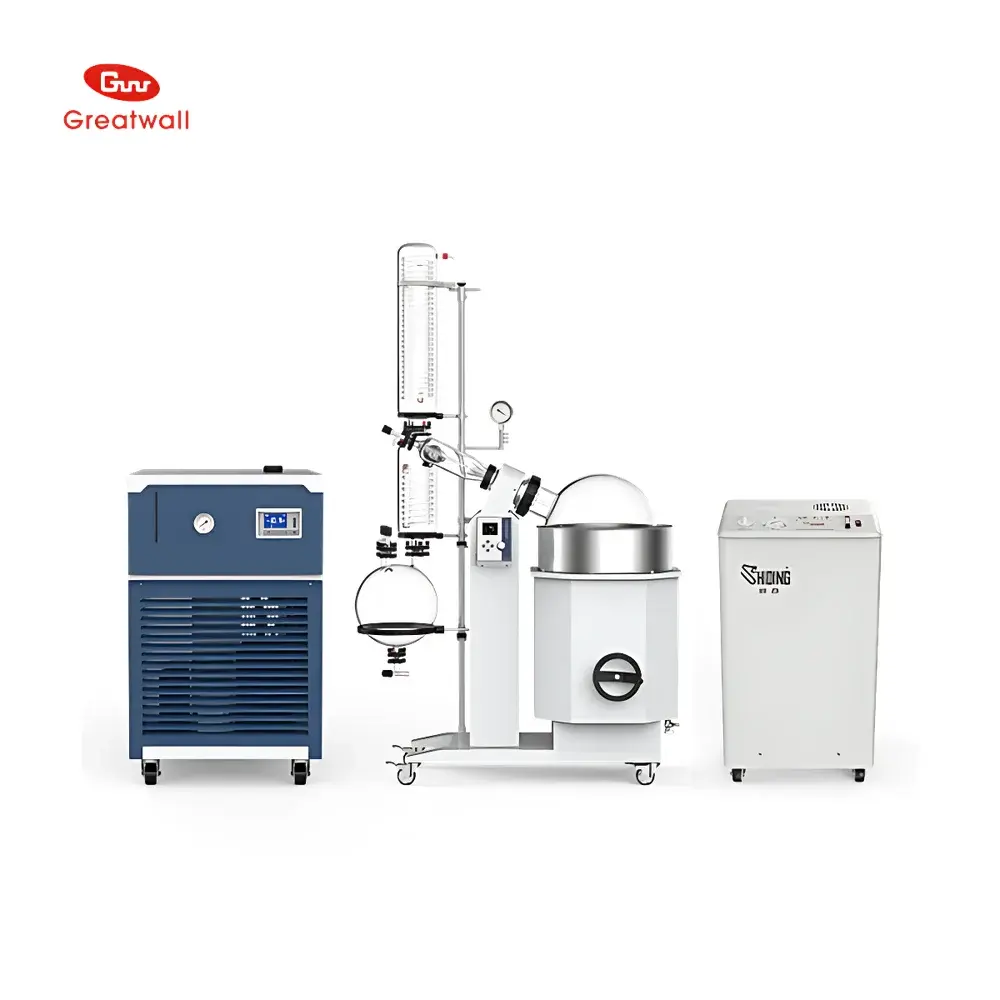
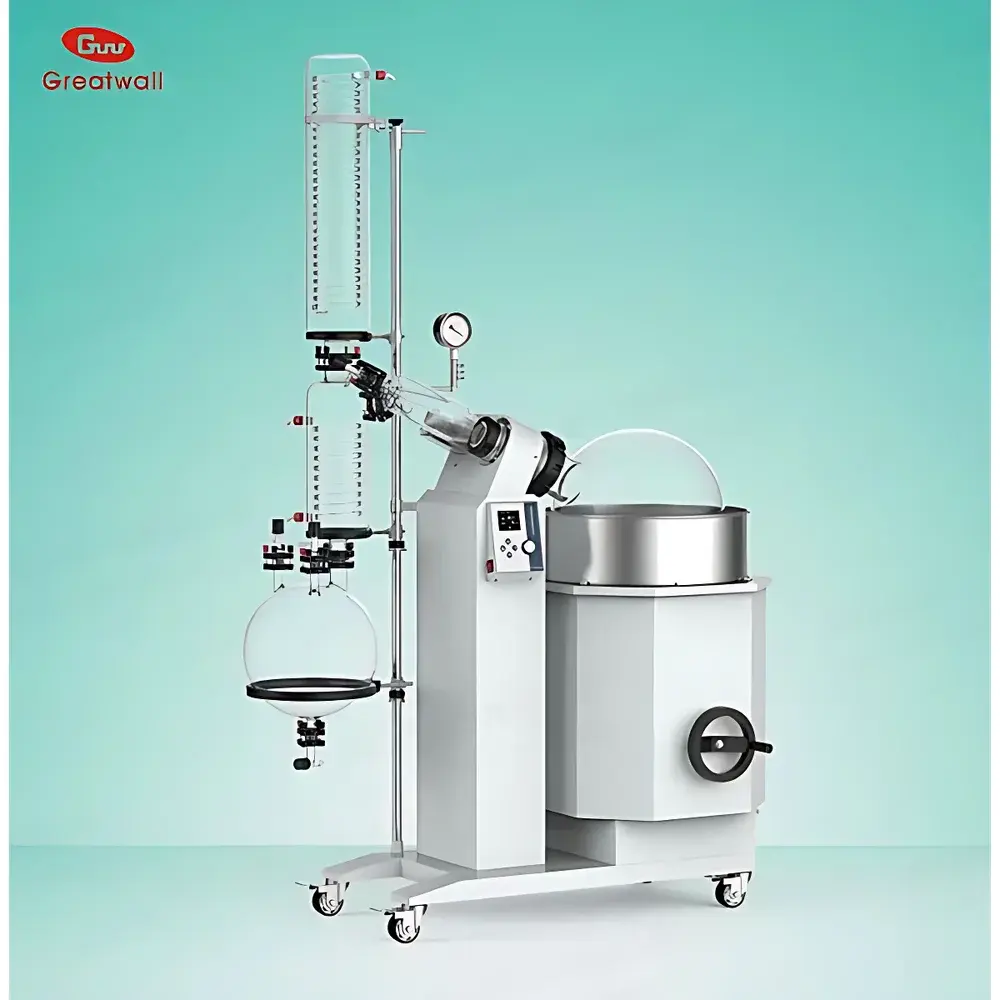
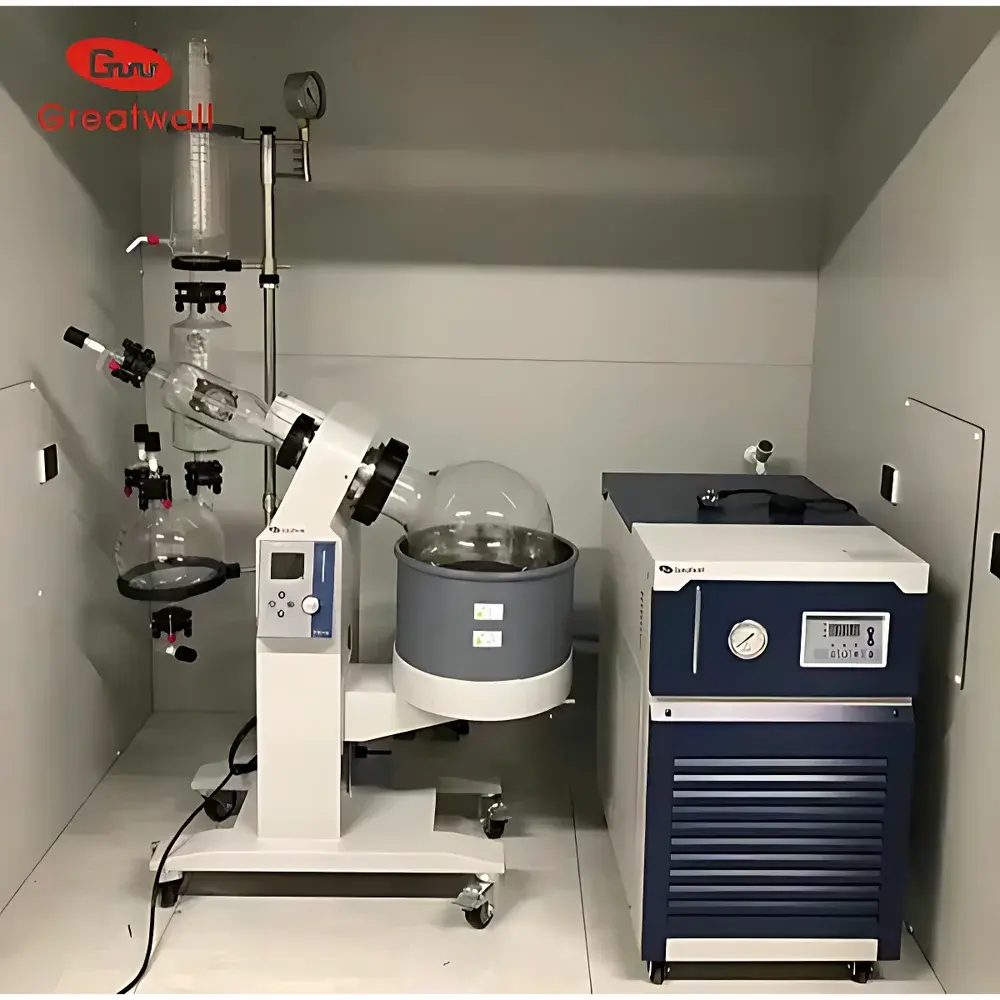
Great Wall R-1050 Large-Scale Pilot Rotary Evaporator
| [Brand | Great Wall |
|---|---|
| Origin | Henan, China |
| Manufacturer Type | Direct Manufacturer |
| Country of Origin | China |
| Model | R-1050 |
| Rotating Flask Capacity | 50 L |
| Rotation Speed Range | 20–110 rpm |
| Bath Temperature Range | +5 °C to 95 °C (above ambient) |
| Temperature Control Accuracy | ±1.5 °C (nominal) |
| Condensing Area | Main Condenser ≈ 1.15 m², Auxiliary Condenser ≈ 0.4 m² |
| Power Supply | 3-phase, 380 V, 50 Hz |
| Total Power Consumption | 6300 W |
| Protection Class | IP20 |
| Pollution Degree | 2 |
| Max. Evaporation Rate (Water) | 9 L/h |
| Sealing Leakage Rate | ≤ 0.03 kPa/min |
| Bath Material | 06Cr19Ni10 (AISI 304 stainless steel) |
| Glass Material | DIN 7080 / ISO 3585 borosilicate glass 3.3 |
| Sealing System | Dual PTFE + fluororubber gaskets |
| Quick-Release Flange Connections | Yes |
| Motor Type | DC stepless speed control |
| Heating Element Power | 6000 W |
| Bath Dimensions | Φ550 mm × 320 mm |
| Overall Dimensions (with glassware) | 1345 W × 770 D × 2230 H mm |
| Net Weight (with glass) | 140 kg] |
Overview
The Great Wall R-1050 Large-Scale Pilot Rotary Evaporator is an engineered solution for laboratory-scale process development, pilot production, and intermediate-volume purification workflows. Designed around the principle of vacuum-assisted thin-film evaporation under controlled rotational shear and thermal input, the R-1050 enables efficient solvent removal from heat-sensitive compounds—including active pharmaceutical ingredients (APIs), natural extracts, polymer solutions, and food-grade concentrates—while preserving molecular integrity. Its 50 L rotating flask provides substantial surface-area-to-volume ratio, facilitating rapid mass transfer under reduced pressure (typically 1–100 mbar). The system operates with a precisely regulated water bath (±1.5 °C accuracy) and variable-speed rotation (20–110 rpm), allowing optimization of film thickness, residence time, and thermal load across diverse feedstock viscosities and boiling point profiles.
Key Features
- Borosilicate glass 3.3 (DIN 7080 / ISO 3585) construction for all wetted components—including 50 L rotating flask (Φ125 mm standard taper), 20 L collection flask, and triple-reflux condenser—ensuring high chemical resistance, thermal shock tolerance, and optical clarity for real-time process observation.
- Dual-stage condensation system: primary condenser (≈1.15 m²) coupled with auxiliary condenser (≈0.4 m²), enabling >95% solvent recovery efficiency even during high-throughput evaporation of low-boiling or volatile solvents (e.g., ethyl acetate, dichloromethane, methanol).
- PTFE-fluororubber dual-seal design at all critical joints (flask, condenser, vapor duct) ensures long-term vacuum integrity with leakage rate ≤0.03 kPa/min—meeting ASTM E2910-13 requirements for vacuum stability in GMP-aligned pilot systems.
- Electric + manual motorized bath lift mechanism (stroke: ≥120 mm) allows precise immersion depth control and safe flask detachment without disassembly; integrated braking casters (IP20-rated) support stable positioning and reconfiguration within ISO Class 7 or Class 8 cleanroom-adjacent lab environments.
- DC brushless motor with digital speed control delivers smooth, vibration-minimized rotation across full 20–110 rpm range; electronic feedback loop maintains setpoint stability within ±1 rpm under variable load conditions.
- PTFE-lined discharge valve and quick-connect法兰 (ISO-KF 60 & ISO-KF 125) enable solvent-free collection bottle exchange during continuous operation—critical for multi-step fractionation or sequential batch processing.
Sample Compatibility & Compliance
The R-1050 accommodates viscous, foaming, and particulate-laden feeds common in biopharmaceutical downstream processing (e.g., crude fermentation broths, protein precipitates) and fine chemical synthesis (e.g., Grignard intermediates, metal-catalyzed reaction mixtures). All fluid-contact surfaces comply with USP Class VI and FDA 21 CFR 177.1550 for PTFE components, while borosilicate glass meets ISO 3585 specifications for extractables testing. The system supports integration into GLP/GMP documentation frameworks via external data loggers (RS485/Modbus RTU interface optional); temperature and rotation data can be timestamped and archived per ALCOA+ principles when paired with validated third-party software. Bath temperature control utilizes PT100 (3-wire) sensors traceable to NIST standards, satisfying calibration requirements under ISO/IEC 17025-accredited labs.
Software & Data Management
While the R-1050 operates as a standalone instrument with local LCD interface (simultaneous digital display of bath temperature and rotation speed), it is fully compatible with external supervisory control systems. Analog outputs (4–20 mA) for temperature and speed are available upon request, enabling connection to PLC-based process historians or LIMS platforms. For audit-trail compliance, users may integrate the unit with validated data acquisition software that records operational parameters—including vacuum level (via optional Pirani gauge), bath temperature ramp profiles, and runtime duration—with electronic signatures and user-level access controls aligned with FDA 21 CFR Part 11 Annex 11 expectations.
Applications
- Pharmaceutical: Solvent removal from API crystallization slurries; concentration of sterile-filtered peptide solutions prior to lyophilization; recovery of chiral solvents in asymmetric synthesis.
- Food & Nutraceuticals: Gentle concentration of heat-labile anthocyanins, carotenoids, and omega-3 oils under oxygen-limited vacuum; decolorization and deodorization of botanical extracts.
- Materials Science: Removal of residual monomers from acrylic or silicone prepolymers; solvent exchange in nanoparticle dispersion preparation.
- Academic Research: Scalable evaporation trials supporting Technology Readiness Level (TRL) 4–5 transition; kinetic studies of evaporation dynamics under variable film thickness and shear rate.
FAQ
What vacuum level is recommended for optimal performance with the R-1050?
For most organic solvents, a working vacuum range of 10–50 mbar is advised; lower pressures (≤5 mbar) may be used for high-boiling-point solvents (e.g., glycerol, PEG), but require careful monitoring of bath temperature to avoid bumping.
Can the R-1050 be operated under inert gas (e.g., nitrogen) purging?
Yes—the vapor duct includes a dedicated inert gas inlet port (1/4″ NPT), allowing continuous blanketing during evaporation to prevent oxidation of air-sensitive compounds.
Is the 50 L rotating flask certified for autoclaving?
No. Borosilicate glass 3.3 components are not designed for steam sterilization cycles; cleaning is performed via validated solvent rinses and ultrasonic baths per SOP-PU-027.
What maintenance intervals are recommended for the DC motor and sealing system?
Motor brush inspection every 2,000 operating hours; fluororubber gaskets should be replaced annually or after 500 vacuum cycles, whichever occurs first, to maintain leak-tight performance.
Does the R-1050 meet CE or UL safety certification requirements?
The unit complies with IEC 61010-1:2010 for laboratory electrical equipment and carries CCC certification for domestic use; CE marking is available upon request with EU Representative designation and full EC Declaration of Conformity.



