
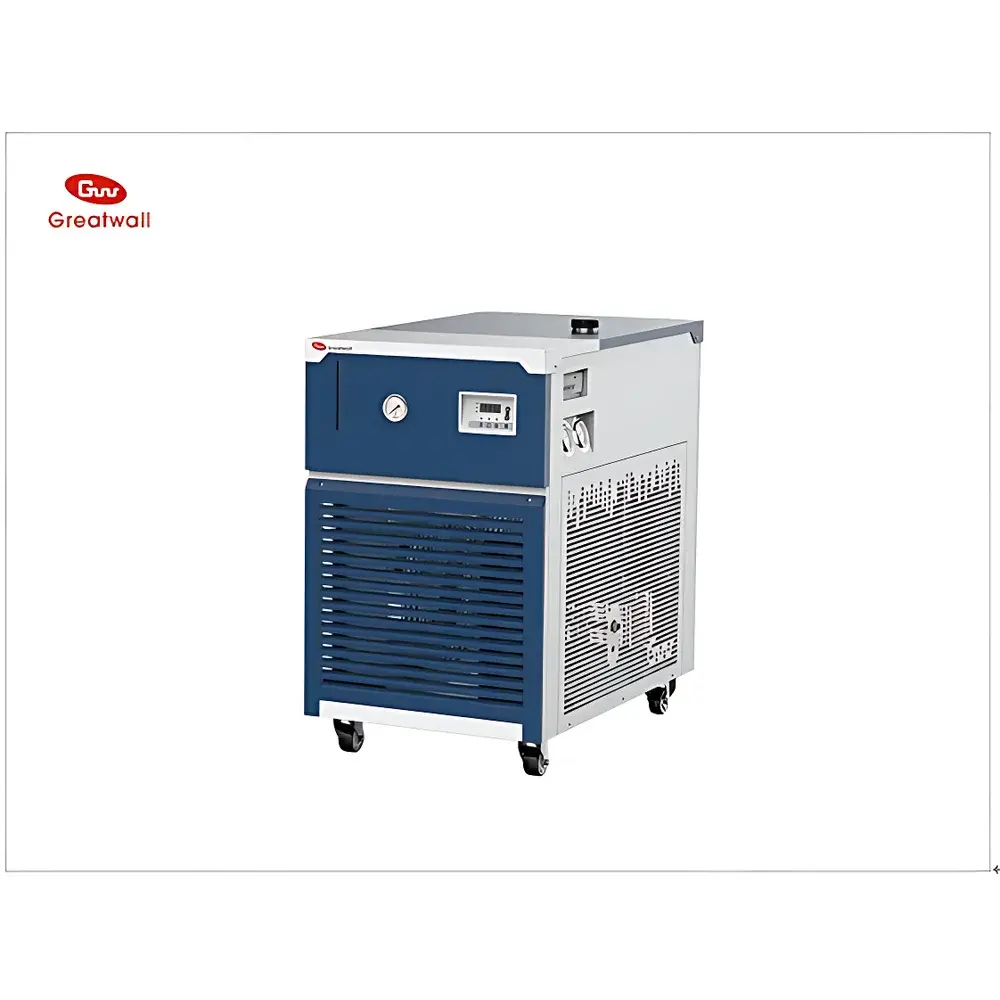
DL10-1000G Circulating Chiller by The Great Wall
| Key | Brand: The Great Wall |
|---|---|
| Origin | Henan, China |
| Manufacturer Type | Direct Manufacturer |
| Country of Origin | China |
| Model | DL10-1000G Circulating Chiller |
| Pricing | Upon Request |
Overview
The DL10-1000G Circulating Chiller is an engineered thermal management solution designed for precision temperature control in laboratory environments requiring stable, low-temperature cooling capacity. Operating on a closed-loop vapor-compression refrigeration cycle, the unit delivers consistent chilled fluid—typically ethylene glycol/water or silicone oil mixtures—to external instruments via a regulated circulation pump. Its core function is to absorb and reject heat from sensitive analytical or process equipment, enabling operation within defined thermal windows critical for reproducible experimental outcomes. Unlike open-bath chillers, this system maintains fluid integrity through full enclosure, minimizing evaporation loss and hygroscopic degradation—a key requirement for long-duration applications such as NMR spectrometer cooling, ICP-MS plasma stabilization, or controlled bioreactor fermentation.
Key Features
- Adjustable circulation pump pressure: Enables fine-tuned flow delivery to match varying hydraulic resistance across instrument interfaces (e.g., narrow-bore tubing in atomic absorption systems or high-backpressure vacuum coating chambers).
- Hermetically sealed refrigerant circuit with high-pressure safety cutoff: Prevents compressor damage under abnormal load conditions; complies with IEC 61000-6-2 electromagnetic immunity standards.
- Comprehensive electrical protection suite: Includes delayed compressor startup (to avoid inrush current tripping), thermal overload relay, and overcurrent circuit interruption per UL 61010-1 requirements.
- Real-time fluid level monitoring via integrated capacitive sensor: Provides visual indication and automatic shutdown if level falls below minimum operational threshold—critical for preventing dry-run pump failure.
- Stainless steel reservoir and corrosion-resistant internal piping: Ensures compatibility with common heat-transfer fluids and resists chemical attack from trace solvents or acidic condensates.
Sample Compatibility & Compliance
The DL10-1000G supports integration with a broad range of instrumentation requiring external coolant supply at temperatures ranging from –10 °C to +35 °C (ambient-dependent). It is routinely deployed with atomic absorption spectrometers (AAS), inductively coupled plasma optical emission spectrometers (ICP-OES) and mass spectrometers (ICP-MS), nuclear magnetic resonance (NMR) consoles, scanning/transmission electron microscopes (SEM/TEM), physical vapor deposition (PVD) systems, and benchtop bioreactors. The unit meets CE marking requirements for electromagnetic compatibility (EMC) and low-voltage directive (LVD) compliance. While not certified to ISO/IEC 17025 or GLP-specific validation protocols out-of-the-box, its design facilitates IQ/OQ documentation for laboratory quality systems adhering to ISO/IEC 17025:2017 or FDA 21 CFR Part 11–aligned workflows when paired with third-party calibration and audit trails.
Software & Data Management
This chiller operates via an embedded microcontroller-based interface with dual-line LCD display showing setpoint temperature, actual bath temperature, pump pressure (in bar), and reservoir level (% full). No proprietary PC software is bundled; however, analog 0–10 V or 4–20 mA output signals are available for integration into centralized building management systems (BMS) or laboratory information management systems (LIMS) using standard Modbus RTU protocol (optional RS485 module). All operational events—including fault codes, compressor run time, and alarm history—are stored in non-volatile memory for up to 30 days and can be retrieved via front-panel navigation. Audit-ready logging requires external data acquisition hardware compliant with ALCOA+ principles.
Applications
- Stabilizing plasma torch temperatures in ICP-MS to reduce polyatomic interferences and improve detection limits.
- Maintaining cryogenic probehead temperatures in high-field NMR systems to preserve signal-to-noise ratio and spectral resolution.
- Controlling exothermic reaction kinetics in catalytic hydrogenation or Grignard synthesis setups.
- Providing auxiliary cooling for high-power RF generators in sputtering and evaporation systems.
- Sustaining constant temperature in calorimetric assays where thermal drift directly impacts enthalpy calculations.
FAQ
What is the typical operating temperature range of the DL10-1000G?
The unit achieves a minimum setpoint of –10 °C at 25 °C ambient, with maximum setpoint limited to +35 °C. Actual achievable low temperature depends on heat load, ambient conditions, and selected heat-transfer fluid.
Can this chiller be used with deionized water?
Deionized water is not recommended due to corrosion risk and freezing point limitations; a 30–40% ethylene glycol/water mixture is advised for sub-zero operation and extended service life.
Is remote monitoring supported natively?
Remote monitoring requires optional RS485 communication module and external SCADA or LIMS integration; no built-in Wi-Fi or Ethernet connectivity is provided.
Does the unit include calibration documentation?
Factory calibration certificates for temperature sensor and pressure transducer are available upon request but are not included in standard shipment.
What maintenance intervals are recommended?
Compressor oil inspection every 2,000 hours; refrigerant charge verification every 5 years or after any leak repair; annual cleaning of condenser coils and reservoir filtration.



