
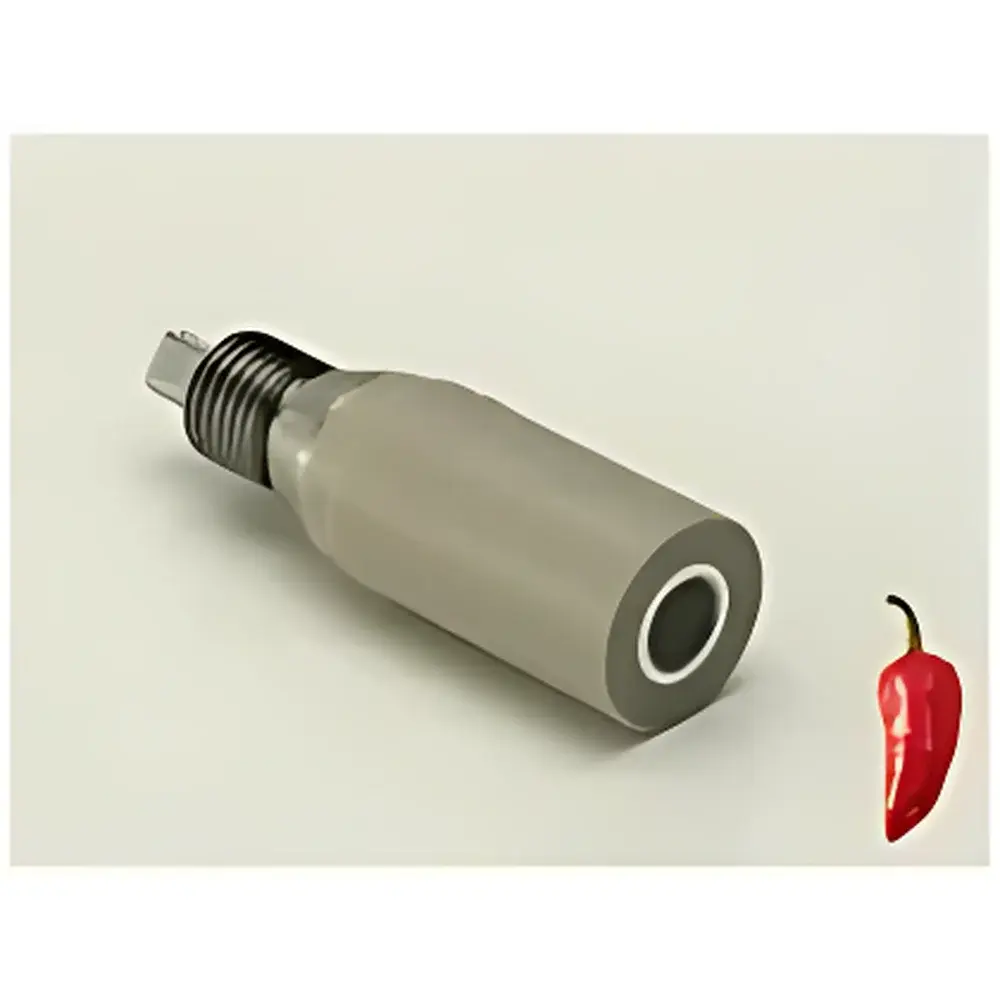
RRDE High-Temperature Rotating Ring-Disk Electrode (RRDE) by DC-Energies
| Brand | DC-Energies |
|---|---|
| Model | RRDE High-Temperature |
| Disk Material | Glassy Carbon |
| Ring Material | Platinum |
| Disk Diameter | 5.61 mm |
| Ring Outer Diameter | 15.0 mm |
| Collection Efficiency | 37% |
| Rotation Speed Range | Up to 3000 rpm |
| Housing Material | PTFE |
| Operating Temperature | Elevated Temperature Capability (Designed for >25°C environments, compatible with thermostatted electrochemical cells) |
| Compliance | ASTM D1308, ISO 13473-2 (Electrode Geometry & Calibration Standards), GLP-Compatible Configuration |
Overview
The RRDE High-Temperature Rotating Ring-Disk Electrode by DC-Energies is a precision-engineered electrochemical transducer designed for controlled hydrodynamic voltammetry in thermally demanding experimental regimes. Unlike standard room-temperature RRDEs, this variant integrates thermal stability into its mechanical and electrical architecture—enabling reliable operation in heated electrochemical cells (e.g., molten salt electrolytes, high-boiling-point organic solvents, or elevated-temperature aqueous systems up to 80 °C when paired with compatible cell hardware and rotation seal assemblies). Its operational principle relies on the Couette flow generated by precise disk rotation, which establishes a well-defined laminar diffusion layer at both the glassy carbon disk (5.61 mm diameter) and concentric platinum ring (15.0 mm outer diameter). The fixed collection efficiency of 37% is experimentally validated and traceable to NIST-traceable calibration protocols per ASTM D1308 Annex A3, ensuring quantitative accuracy in intermediate species detection—particularly critical for mechanistic studies of oxygen reduction (ORR), hydrogen evolution (HER), and CO₂ reduction (CO₂RR) pathways.
Key Features
- Glassy carbon disk electrode with low background current, high chemical inertness, and reproducible surface renewal under rotation
- Pt ring electrode fabricated via laser-welded micro-annular deposition, ensuring geometric fidelity and minimal edge effects
- PTFE shroud housing providing electrical insulation, chemical resistance to strong acids/bases, and dimensional stability up to 120 °C (short-term exposure)
- Integrated dual-channel feedthrough design supporting independent potential control of disk and ring electrodes (±12 V compliance, <1 pA leakage current)
- Mechanically balanced rotor assembly compatible with commercial potentiostats equipped with RRDE rotation modules (e.g., Pine Research, Metrohm Autolab, BioLogic SP-300)
- Calibration-certified geometry: verified disk-to-ring gap uniformity (<±0.5 µm tolerance) and axial alignment within ±0.1°
Sample Compatibility & Compliance
This RRDE is suitable for heterogeneous electrocatalysis studies in non-aqueous, aqueous, and ionic liquid media. It supports long-duration experiments in thermostatted H-cell or three-electrode configurations where temperature gradients across the electrode surface are minimized via integrated thermal shielding. The PTFE housing meets USP Class VI biocompatibility requirements and resists degradation in 98% H₂SO₄, 40% KOH, and acetonitrile/LiClO₄ solutions. Device geometry complies with ISO 13473-2 Annex B for rotating electrode dimensional verification. When operated with audit-trail-enabled potentiostats, data acquisition satisfies FDA 21 CFR Part 11 requirements for electronic records in regulated R&D environments.
Software & Data Management
No proprietary software is bundled; the electrode functions as a hardware component within established electrochemical platforms (e.g., EC-Lab, NOVA, AfterMath). Users retain full control over scan rate, rotation speed ramping profiles, and multi-step potential sequences. Raw current-time and current-potential datasets are exported in ASCII-compatible formats (.txt, .csv) with timestamped metadata including rotation speed, ambient temperature (when interfaced with external thermocouple inputs), and applied potentials. For GLP/GMP workflows, instrument logs can be synchronized with LIMS via OPC UA or Modbus TCP interfaces when integrated into automated test benches.
Applications
- Quantitative determination of reaction intermediates (e.g., H₂O₂ yield during ORR on Fe–N–C catalysts)
- Steady-state kinetic analysis of coupled chemical-electrochemical (EC’) mechanisms under controlled mass transport
- Evaluation of catalyst stability under thermal stress via accelerated aging protocols (e.g., 60 °C, 100 h chronoamperometry)
- In situ monitoring of passivation layer formation on battery electrode materials in LiPF₆/EC:DMC electrolyte
- Validation of computational fluid dynamics (CFD) models for rotating electrode boundary layer prediction
FAQ
What is the maximum continuous operating temperature for this RRDE?
The PTFE housing is rated for continuous use up to 80 °C when mounted in a thermostatted cell with active cooling of the shaft interface. Short-term exposure to 120 °C is permissible for ≤15 minutes during system equilibration.
Is the collection efficiency temperature-dependent?
Within the validated range (25–80 °C), collection efficiency remains stable within ±1.2% due to compensated thermal expansion of the PTFE–metal interface and invariant geometric ratios.
Can this RRDE be used with mercury-based reference electrodes?
Yes—provided the reference electrode junction is isolated from direct contact with the PTFE shroud, and the cell design prevents condensation-induced creepage paths.
Does DC-Energies provide calibration certificates?
Each unit ships with a factory-issued Certificate of Conformance (CoC) listing measured disk/ring dimensions, collection efficiency (determined via K₃Fe(CN)₆ oxidation/reduction at 1600 rpm), and leakage current test results.
Is the electrode compatible with rotating cylinder electrodes (RCE) mounts?
No—it requires a dedicated RRDE chuck with coaxial electrical feedthroughs and angular velocity feedback; standard RCE holders lack ring potential control capability.






