
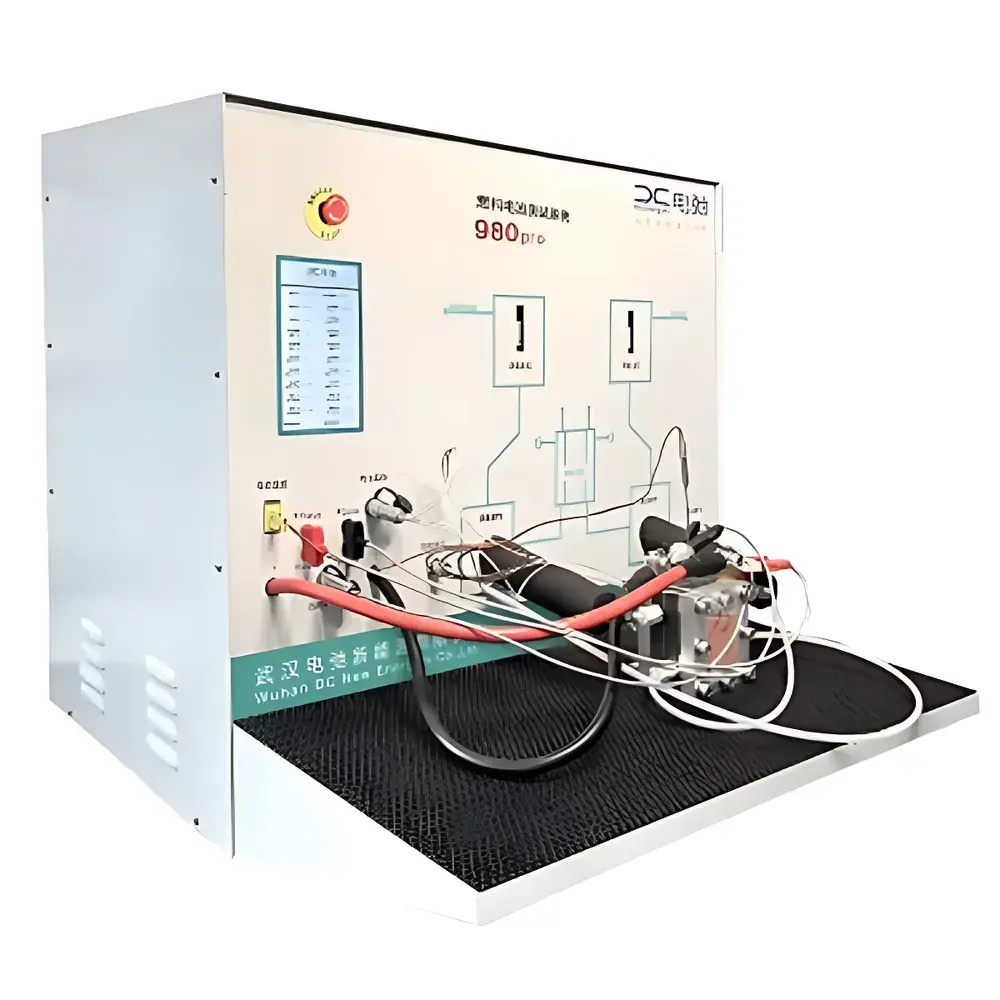
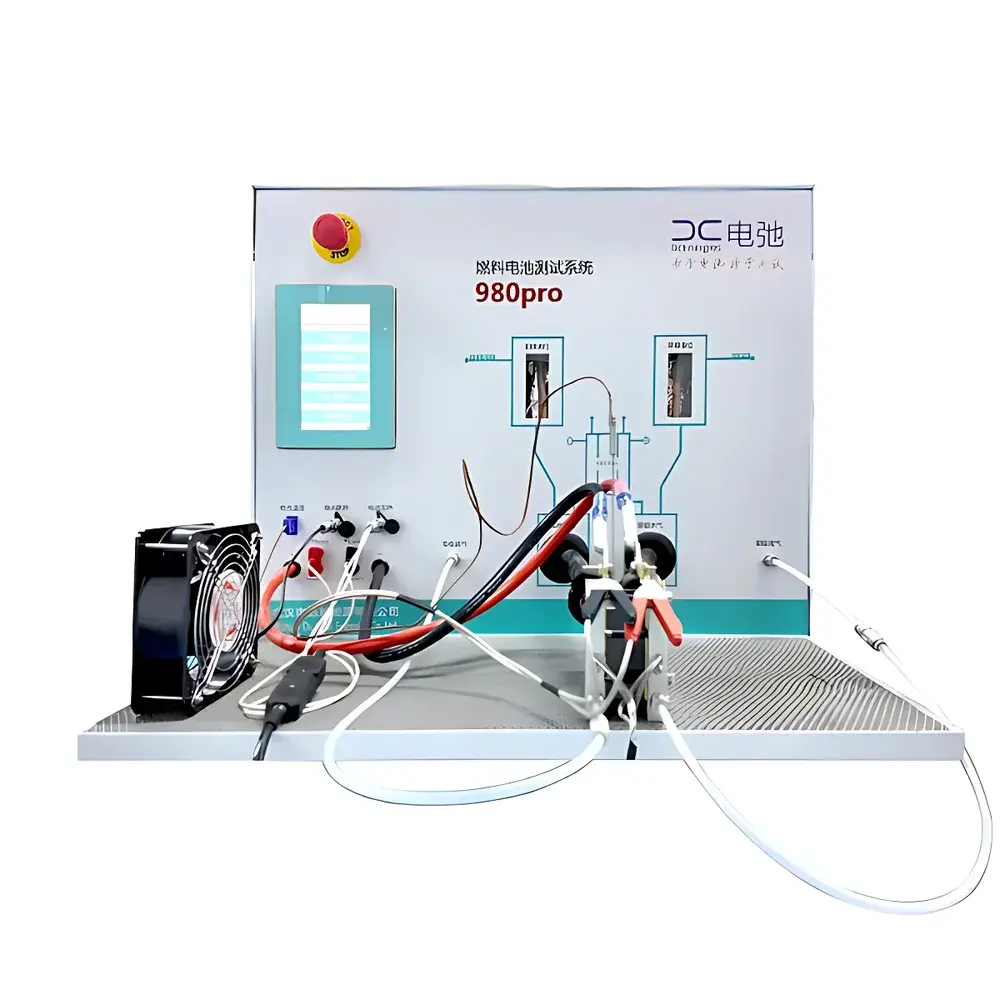
DC980Pro PEM Fuel Cell Testing System (Automated Back-Pressure Control)
| Brand | dc-energies |
|---|---|
| Origin | Hubei, China |
| Manufacturer Type | Authorized Distributor |
| Country of Origin | China |
| Model | DC980Pro Desktop |
| Price | Upon Request |
Overview
The DC980Pro PEM Fuel Cell Testing System (Automated Back-Pressure Control) is a compact, research-grade electrochemical workstation engineered for rigorous characterization and durability evaluation of proton exchange membrane (PEM) fuel cells. Designed and validated by dc-energies (Wuhan DC Energies Co., Ltd.), the system implements a fully integrated hardware–software architecture optimized for controlled gas delivery, precise thermal–humidification management, and high-fidelity electrochemical load cycling. It operates on fundamental principles of galvanostatic, potentiostatic, and power-controlled polarization analysis, enabling quantitative assessment of cell performance under dynamic and steady-state conditions—including startup/shutdown behavior, catalyst poisoning kinetics, mass transport limitations, and long-term voltage decay. With an enclosed footprint under 0.5 m³ and modular subsystems compliant with standard laboratory infrastructure (220 V AC, ambient temperature operation), the DC980Pro is purpose-built for university teaching labs, R&D centers, and early-stage PEM stack development environments where space efficiency, operational safety, and reproducible test protocols are critical.
Key Features
- Automated dual-channel back-pressure control (anode/cathode) with ±0.5% pressure accuracy over 0–1 MPa range
- High-precision mass flow controllers (MFCs): ±(0.4% RD + 0.2% F.S.) repeatability for both anode (up to 5 SLPM) and cathode (up to 10 SLPM) gas streams
- Dual-mode humidification: configurable bubble-type or membrane-based humidification with PID-regulated temperature control (20–90 °C) and real-time liquid-level monitoring with auto-refill/drain
- Integrated thermal management: independent PID loops for cell, anode/cathode humidifiers, and gas-heating tubes; ±1 °C stability in steady state
- Dual-display interface with split-screen visualization: primary screen for real-time voltage/current/power metrics; secondary screen for gas pressure, humidity, temperature, and safety status
- Comprehensive safety architecture: hardware-level H₂ leakage detection (0–40,000 ppm range, alarm threshold configurable), emergency manual stop, multi-tiered interlock logic (e.g., overcurrent, low voltage, communication timeout, dry-humidifier, low inlet pressure)
- Programmable dry/wet mode switching for both anode and cathode channels, executed automatically without manual valve intervention
- Onboard nitrogen purge sequence with programmable duration and flow rate—initiated on shutdown, fault, or user command
- Modular electronic load: supports constant-current (0–240 A), constant-voltage (−3.3 to +10 V), and constant-power modes; 5 Hz data acquisition resolution; 0.05% current accuracy + 0.05% F.S.
- Open-architecture software platform with Python/C++ API support for custom script integration and automated test sequencing
Sample Compatibility & Compliance
The DC980Pro accommodates single-cell PEM fuel cells with active areas ranging from 5 cm² to 200 cm² and supports MEA thicknesses up to 0.8 mm. Its flexible gas delivery design enables testing with H₂/air, H₂/O₂, reformate gas mixtures, and CO-contaminated feeds—facilitating catalyst tolerance studies per ASTM D7586 and ISO 8528-12 protocols. All pressure, temperature, and electrical interfaces conform to IEC 61000-6-3 (EMC) and IEC 61010-1 (safety). The system’s data logging and audit trail functionality—including timestamped parameter changes, operator ID tagging, and event-triggered snapshots—aligns with GLP-compliant documentation requirements. While not pre-certified for FDA 21 CFR Part 11, its software architecture supports optional digital signature modules and role-based access control for regulated environments.
Software & Data Management
The native FuelCellControl™ software provides real-time visualization, multi-parameter trending, and automated test execution via intuitive graphical workflow editors. All raw measurements—including voltage, current, pressure, temperature, flow rates, and humidity—are time-stamped at 200 ms intervals and stored in HDF5 format for interoperability with MATLAB, Python (pandas/h5py), and LabVIEW. Offline analysis tools include polarization curve fitting (Tafel, Ohmic, mass-transport resistance decomposition), degradation rate calculation (mV/kh), and statistical process control (SPC) charting. Audit logs record every configuration change, safety event, and user login, supporting traceability in academic publication or industrial validation reports. Export options include CSV, PDF report generation, and direct SQL database push for LIMS integration.
Applications
- MEA screening and optimization: catalyst layer composition, ionomer distribution, GDL hydrophobicity
- Dynamic load cycling per DOE Fuel Cell Tech Team protocols (e.g., 0–100% step response, ramped current sweeps)
- Start-stop durability testing with open-circuit voltage (OCV) hold and hydrogen/air boundary condition transitions
- CO and SO₂ poisoning kinetics quantification under controlled partial pressures
- Humidification sensitivity mapping: relative humidity vs. ohmic resistance and kinetic overpotential separation
- Thermal stress evaluation via accelerated temperature cycling (25–80 °C) with simultaneous EIS acquisition
- Educational lab exercises: Nernst potential derivation, Tafel analysis, Faradaic efficiency estimation
- Stack subcomponent validation: bipolar plate contact resistance, seal integrity under variable back-pressure
FAQ
What PEM fuel cell configurations does the DC980Pro support?
It is designed for single-cell testing with customizable gas diffusion layers, membrane thicknesses, and catalyst loadings—compatible with standard 5-, 10-, 25-, and 50-cm² active area fixtures.
Does the system meet international calibration traceability standards?
All MFCs and pressure transducers are factory-calibrated against NIST-traceable references; full calibration certificates are provided upon request.
Can the software interface with third-party DAQ systems or PLCs?
Yes—via TCP/IP Modbus TCP or OPC UA protocols; RESTful API endpoints are available for remote command injection and status polling.
Is hydrogen safety certification included with installation?
The system complies with GB/T 29729–2013 (Chinese national standard for hydrogen safety) and includes mandatory ventilation interlock wiring terminals; site-specific explosion-proof certification remains the responsibility of the end-user facility.
What maintenance intervals are recommended for long-term reliability?
Quarterly verification of MFC zero/span, biannual recalibration of thermocouples and pressure sensors, and annual replacement of humidifier water filters and O-rings per maintenance logbook guidance.
Related Products






