
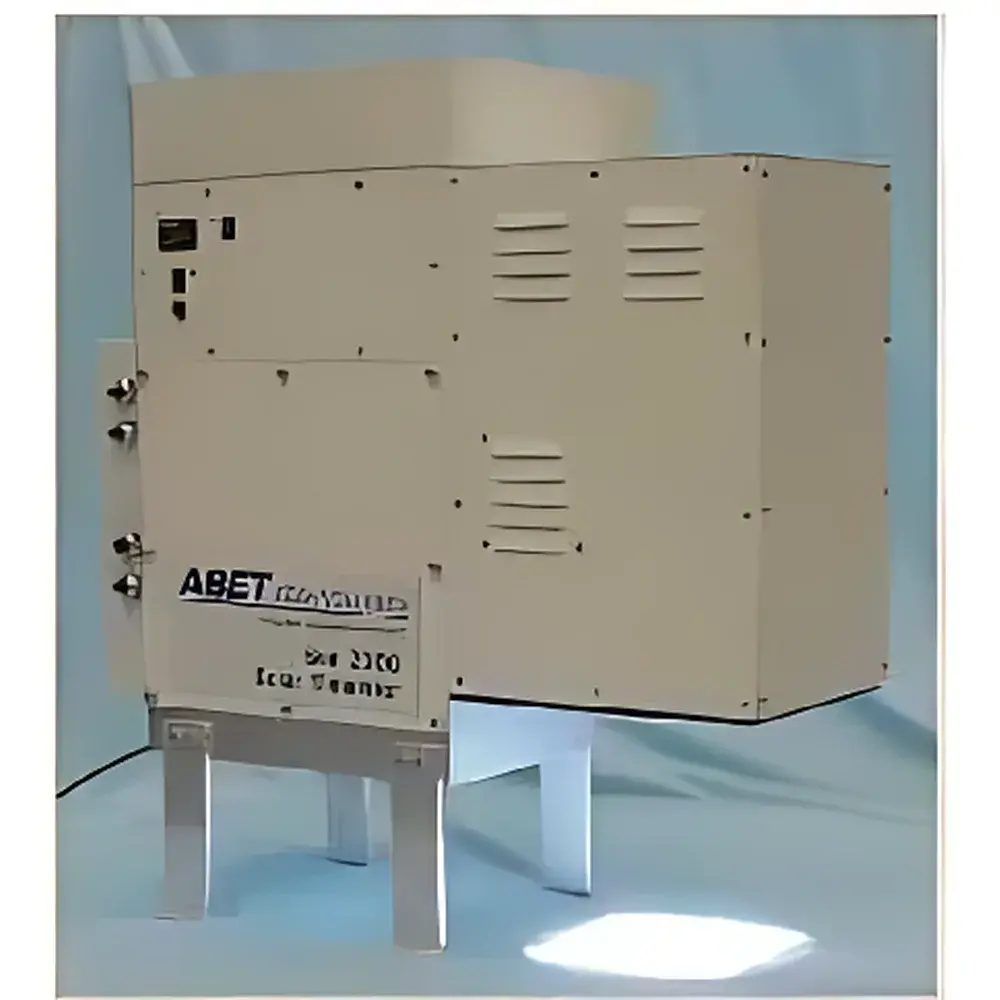
Rayscience Solar Simulator TM3B0(1.5)
| Brand | Rayscience |
|---|---|
| Origin | Germany |
| Category | Class A Solar Simulator |
| Spectral Match | AM0 & AM1.5 |
| Effective Irradiation Area | ≥300 mm (Class 3) |
| Total Irradiance Range | 0.8–1.2 solar constants (AM0) |
| Spatial Uniformity | ≤±2% |
| Temporal Instability | ≤±1% (over 10 s) |
| Light Source | Ozone-free short-arc xenon lamp (150 W) |
| Lamp Lifetime | ≥1500 h |
| Beam Configuration | Collimated (60 mm × 60 mm) and non-collimated (up to 60 cm²) |
| Compliance | IEC 60904-9 Ed. 3 (2020), ASTM E927-22, JIS C 8912 |
Overview
The Rayscience Solar Simulator TM3B0(1.5) is a Class A-certified, laboratory-grade solar simulation system engineered for high-fidelity photovoltaic (PV) device characterization under standardized terrestrial (AM1.5G) and extraterrestrial (AM0) spectral conditions. Based on continuous-output, ozone-free short-arc xenon lamp technology, it delivers spectrally stable irradiance with rigorous adherence to IEC 60904-9 Ed. 3 (2020) and ASTM E927-22 requirements for spectral match, spatial uniformity, and temporal stability. Unlike pulsed xenon systems, its steady-state illumination enables accurate current–voltage (I–V) measurements of PV materials with slow carrier dynamics—including perovskite, organic, dye-sensitized (DSSC), and multi-junction solar cells—without time-response artifacts. The TM3B0(1.5) designation indicates Class 3 (effective irradiation area ≥300 mm), Grade B performance level, and dual-spectrum capability (AM0 and AM1.5), validated via calibrated spectroradiometric traceability to NIST-traceable standards.
Key Features
- Class A spectral match per IEC 60904-9: integrated spectral deviation ≤±25% across six wavelength bands (300–400 nm, 400–500 nm, 500–600 nm, 600–700 nm, 700–800 nm, 800–1100 nm), with full compliance in the 300–1100 nm range required for silicon and emerging PV technologies.
- High spatial uniformity: ≤±2% irradiance variation over the full Class 3 effective irradiation area (≥300 mm feature dimension), verified using calibrated silicon reference cells and motorized XY scanning stages per ASTM E927 Annex A2.
- Exceptional temporal stability: ≤±1% irradiance fluctuation over 10-second intervals, maintained via closed-loop optical feedback control and thermally stabilized power supply with real-time lamp arc monitoring.
- Dual-spectrum flexibility: Integrated AM0 and AM1.5G filter sets—optimized for space-cell qualification (e.g., GaInP/GaAs/Ge triple-junction) and terrestrial PV testing—switched manually or via automated filter wheel (optional).
- Robust thermal management: Active cooling of integrator rod, dichroic filters, and lamp housing ensures <±0.5 °C thermal drift during 8-hour continuous operation, minimizing spectral drift and output degradation.
- Safety-integrated optical enclosure: Interlocked chamber with automatic shutter (200 ms actuation, >1×10⁶ cycles rated), UV-blocking viewport, and lamp-overheat cutoff prevents exposure hazards and preserves optical component integrity.
Sample Compatibility & Compliance
The TM3B0(1.5) supports sample dimensions up to 8″ × 8″ (203 mm × 203 mm) under collimated illumination (60 mm × 60 mm usable beam) and accommodates non-collimated configurations up to 60 cm² for thin-film or flexible PV testing. It is fully compatible with standard PV test fixtures, probe stations, and environmental chambers. All performance metrics are validated per ISO/IEC 17025-accredited calibration protocols, with traceability to PTB (Physikalisch-Technische Bundesanstalt) reference spectroradiometers. The system meets GLP-relevant documentation requirements for audit trails, including lamp hour logging, filter usage history, and irradiance calibration certificates (valid for 12 months). For regulated environments, optional 21 CFR Part 11-compliant software modules support electronic signatures, audit logs, and data integrity controls.
Software & Data Management
The bundled Rayscience SolarSim Control Suite provides instrument-level automation via USB 2.0 and Ethernet interfaces. It enables synchronized control of irradiance intensity (0–150% of 1-sun), shutter timing, filter selection, and integrated I–V sweep acquisition when paired with optional Keithley 2400/2450 source-measure units. Raw spectral data (300–1200 nm, 1 nm resolution) and spatial uniformity maps are exportable in CSV, HDF5, and MATLAB-compatible formats. The software includes built-in IEC 60904-3 spectral weighting functions for EQE and Jsc correction, AM0/AM1.5G reference spectra (SMARTS v2.9.5), and uncertainty propagation tools aligned with GUM (JCGM 100:2008). All measurement sessions generate timestamped, cryptographically signed metadata packages compliant with FAIR data principles.
Applications
- Quantitative efficiency validation of single-junction and tandem solar cells per IEC 60904-1 and IEC 60904-3.
- Accelerated photochemical testing of photocatalysts (e.g., TiO₂, g-C₃N₄) under controlled UV–VIS–NIR irradiance.
- Photostability assessment of organic semiconductors and perovskite thin films under ISOS-L-1 illumination protocols.
- Calibration of reference solar cells and pyranometers against primary standards.
- Biological phototoxicity screening (ISO 10993-10) and cosmetic photostability testing (COLIPA guidelines).
- Spacecraft solar array qualification per ECSS-E-ST-20-07C, including UV-enhanced AM0 spectrum emulation.
FAQ
What spectral standards does the TM3B0(1.5) comply with?
It conforms to IEC 60904-9 Ed. 3 (2020), ASTM E927-22, and JIS C 8912 for Class A classification in spectral match, spatial uniformity, and temporal stability.
Can the system be used for both AM0 and AM1.5G testing without hardware reconfiguration?
Yes—the dual-filter configuration allows rapid switching between AM0 and AM1.5G spectral profiles; filter alignment is factory-verified and documented in the calibration certificate.
Is lamp replacement a user-serviceable procedure?
Lamp replacement requires optical realignment and recalibration; Rayscience recommends certified field service engineers to maintain Class A compliance post-replacement.
Does the system support external triggering for synchronized measurements?
Yes—it provides TTL-compatible trigger I/O for synchronization with oscilloscopes, lock-in amplifiers, or quantum efficiency systems.
What is the recommended recalibration interval?
Annual recalibration is advised, or after 1000 lamp-hours—whichever occurs first—to ensure continued conformance with IEC 60904-9 spectral and uniformity tolerances.





