
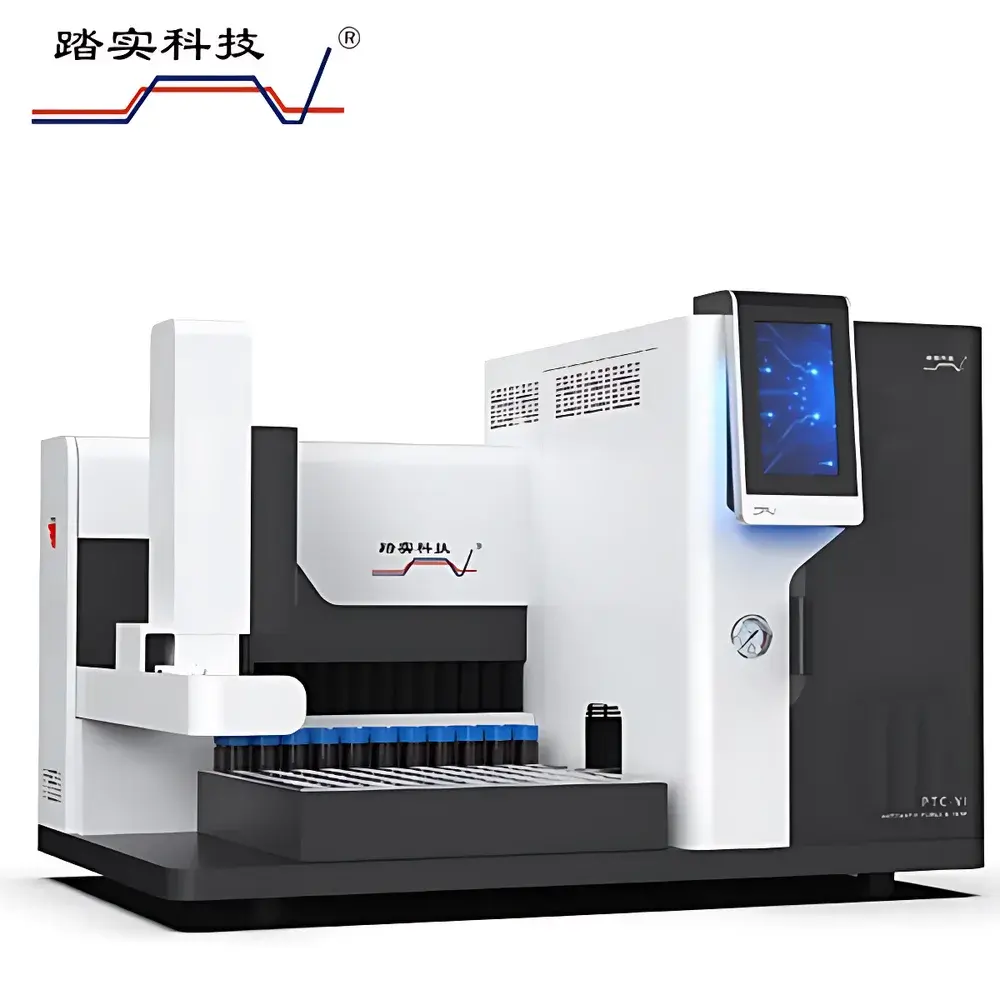
TouchScience PTC-VI Fully Automated Purge and Trap Concentrator
| Brand | TouchScience |
|---|---|
| Origin | Beijing, China |
| Manufacturer Type | Direct Manufacturer |
| Instrument Category | Domestic |
| Model | PTC-VI |
| Pricing | Upon Request |
| Instrument Type | Water & Soil Dual-Mode |
| Sample Tray Capacity | 116 positions |
| Trap Temperature Range | 50–400 °C |
| Sample Heating Temperature Range (Purge Vessel) | Ambient to 90 °C |
Overview
The TouchScience PTC-VI Fully Automated Purge and Trap Concentrator is an engineered solution for the quantitative enrichment and introduction of volatile organic compounds (VOCs) from aqueous and solid matrices into gas chromatography (GC) or gas chromatography–mass spectrometry (GC–MS) systems. Based on the principle of dynamic headspace extraction—where inert gas purges VOCs from a heated sample matrix, followed by cryogenic trapping and rapid thermal desorption—the PTC-VI delivers high reproducibility, low carryover, and method robustness essential for regulatory environmental and food safety laboratories. Designed specifically for compliance with U.S. EPA Method 524.2, ISO 15681-2, and Chinese national standards including HJ 639–2012, HJ 686–2014, and HJ 605–2011, the system supports both water and soil analysis workflows without hardware reconfiguration.
Key Features
- 116-position autosampler with dual-needle architecture (separate water and soil probes) to eliminate cross-contamination between sample types.
- Integrated thermoelectric cooling + forced-air cold trap capable of reaching −30 °C at ambient 20 °C, enabling efficient condensation of C2–C12 VOCs.
- Direct resistive heating of the trap with ramp rates exceeding 3000 °C/min for sharp, focused desorption bands and improved chromatographic resolution.
- Patented water removal technology (Patent No. CN202020125570.4) utilizing selective membrane-assisted dewpoint control and optimized purge gas flow path geometry to reduce water vapor load on downstream GC columns by >95%.
- Automated internal standard addition and gradient calibration curve generation—supports single-point spiking, multi-level calibration, and post-extraction standard addition protocols.
- Full-temperature control of all fluidic pathways: PEEK-lined stainless-steel tubing, heated six-port valves, and heated transfer lines (up to 220 °C) prevent adsorption, condensation, and analyte loss.
- Intelligent foam suppression in purge vessels via real-time pressure feedback and adaptive gas flow modulation—prevents emulsion formation and protects sampling integrity.
- Self-diagnostic leak detection and pressure monitoring subsystem with automated validation prior to each run; full audit trail of temperature setpoints, valve actuation, and purge timing sequences.
- Embedded Linux-based touchscreen interface (no external PC required); stores ≥50 user-defined methods with independent parameter sets for purge time, bake-out duration, trap cool-down, and desorption profile.
Sample Compatibility & Compliance
The PTC-VI accommodates liquid samples (e.g., drinking water, wastewater, leachates) and solid-phase samples (soil, sediment, sludge, food matrices) using standardized 40-mL VOC vials or 10-g soil jars with integrated magnetic stirring. Solid samples are directly mixed with distilled water and heated under controlled agitation during purge. The system meets GLP and GMP documentation requirements through timestamped method execution logs, electronic signatures, and configurable data retention policies. It supports 21 CFR Part 11-compliant software add-ons for audit-ready environments. All wetted materials—including sample needles, purge tubes, and trap frits—are chemically inert (silanized stainless steel, PEEK, and fused silica), minimizing active site adsorption and ensuring trace-level recovery (>92% for benzene, chloroform, and 1,2-dichlorobenzene across 0.05–50 µg/L range).
Software & Data Management
Operation is managed via a 10.1-inch capacitive touchscreen running a deterministic real-time OS. The interface provides live graphical monitoring of trap temperature, purge pressure, valve status, and method progress. Raw method files (.ptc) include embedded metadata (operator ID, instrument serial, calibration date) and support version-controlled backup. Export formats include CSV and XML for LIMS integration. Optional TouchScience Connect software enables remote monitoring, centralized method deployment across multiple instruments, and automated report generation aligned with ISO/IEC 17025 reporting templates.
Applications
The PTC-VI is routinely deployed in accredited environmental testing labs for VOC analysis in compliance with HJ 639–2012 (drinking water), HJ 605–2011 (soil), and HJ 686–2014 (wastewater). In food safety applications, it enables sensitive profiling of off-odor compounds (e.g., geosmin, 2-methylisoborneol, aldehydes) in beverages, dairy products, and packaged foods. Additional use cases include forensic toxicology (ethanol and acetone quantification), pharmaceutical residual solvent testing (ICH Q3C), and industrial hygiene monitoring (workplace air VOC screening when coupled with sorbent tube interfaces).
FAQ
Does the PTC-VI require a dedicated PC for operation?
No—the instrument features an embedded touchscreen controller with onboard method storage and execution; no external computer is needed for routine operation.
Can the system be integrated with third-party GC or GC–MS platforms?
Yes—it provides TTL and RS-232 synchronization signals, plus optional Ethernet-based bidirectional control for Agilent, Thermo Fisher, Shimadzu, and PerkinElmer GC systems.
What maintenance intervals are recommended for the cold trap and desorption heater?
Cold trap cleaning is advised every 200 runs; desorption heater calibration verification is performed automatically during startup self-test and documented in the system log.
Is method validation support available?
TouchScience provides IQ/OQ documentation templates, certified reference material test protocols, and application notes aligned with EPA and HJ standard methods.
How is carryover mitigated between solid and liquid samples?
Dual-needle design, programmable needle wash cycles (methanol/water or hot water), and independent purge gas routing for trap regeneration ensure <0.05% carryover across 116-position batch runs.
Related Products






