
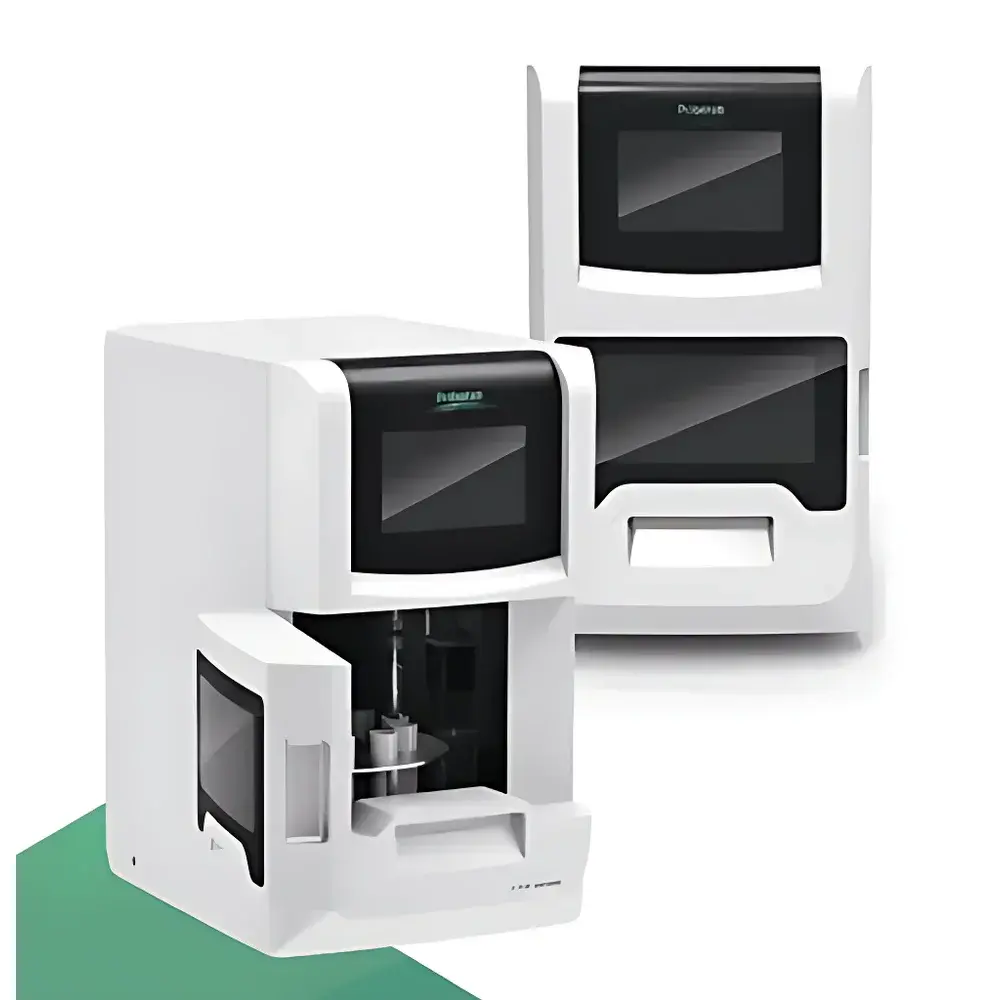
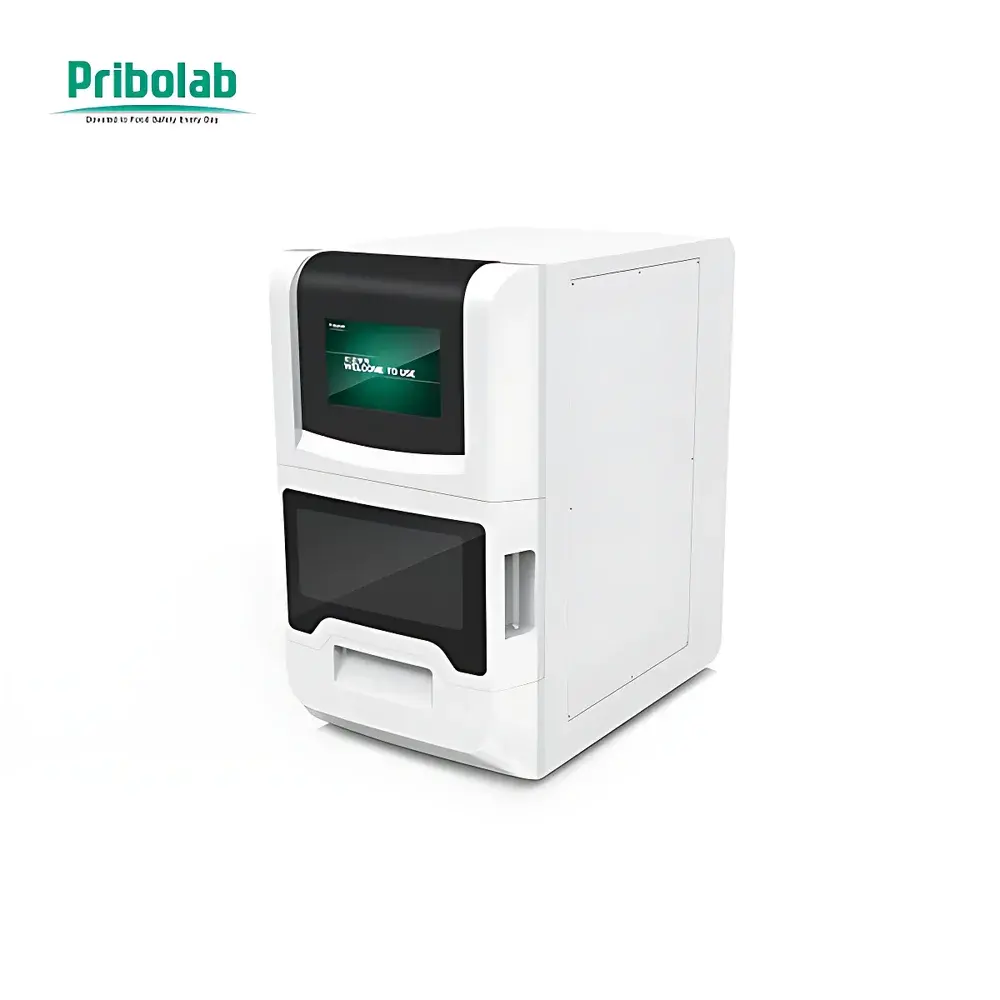
Pribolab® MP2100 Automated Multi-Sample Rotor-Stator Homogenizer
| Brand | Pribolab |
|---|---|
| Origin | Shandong, China |
| Manufacturer Type | Authorized Distributor |
| Country of Origin | China |
| Model | MP2100 |
| Instrument Type | Rotor-Stator Probe Homogenizer |
| Dimensions (W×D×H) | 360 × 600 × 500 mm |
| Sample Volume Range | 10–200 mL |
| Standard Rack | 6-position aluminum anodized rack compatible with 100 mL and 300 mL bottles |
| Motor | Brushless DC (BLDC), 10-speed adjustable, max. 25,000 rpm |
| Positioning Accuracy | < 0.5 mm (absolute), < 0.1 mm (repeatability) |
| Cleaning | Solvent-based + ultrasonic + reverse-rotation blade cleaning |
| Control Interface | Touchscreen with editable, storable protocols |
| Housing | Powder-coated steel chassis with ergonomic 3D-designed front panel |
Overview
The Pribolab® MP2100 Automated Multi-Sample Rotor-Stator Homogenizer is an engineered solution for high-throughput, reproducible sample homogenization in food safety, agricultural testing, veterinary diagnostics, and environmental laboratories. It operates on the principle of rotor-stator shear homogenization—where a rapidly rotating probe (rotor) interacts with a fixed concentric sleeve (stator), generating intense hydrodynamic forces including turbulent flow, cavitation, frictional shear, and centrifugal impact within the narrow clearance gap (typically 0.1–0.5 mm). This mechanism ensures efficient cell lysis, particle size reduction, and matrix disruption across heterogeneous biological, feed, and food matrices—fully compliant with national standard methods requiring mechanical homogenization (e.g., GB 4789.1–2016, GB/T 18869–2002, and AOAC Official Methods™ where applicable). Designed for unattended operation, the MP2100 integrates robotic sample handling, programmable speed and stroke profiles, and automated cleaning—eliminating manual intervention between samples while maintaining inter-sample integrity.
Key Features
- Automated multi-sample processing with intelligent rack recognition: The system detects rack configuration (6-, 10-, or custom positions) and adjusts probe trajectory and dwell time accordingly.
- High-precision robotic arm driven by stepper motor and precision lead screw: Achieves positioning repeatability better than ±0.1 mm and absolute accuracy within ±0.5 mm—critical for consistent probe immersion depth and shear zone engagement.
- Food-grade stainless-steel homogenizing probes with interchangeable tip geometries: Optimized for soft tissues, fibrous feeds, viscous pastes, or particulate suspensions; fully autoclavable and solvent-resistant.
- Brushless DC (BLDC) motor with 10-step speed control (5,000–25,000 rpm): Delivers stable torque at all speeds, minimizing thermal drift and enabling method transfer across viscosity ranges.
- Three-dimensional homogenization mode: Programmable vertical oscillation (±15 mm amplitude) ensures uniform energy distribution throughout the sample volume—particularly essential for viscous or layered matrices.
- Integrated cleaning station with triple-action protocol: Solvent rinse (programmable solvent selection), ultrasonic bath immersion (40 kHz), and reverse-rotation blade agitation to evacuate residual particulates from internal probe channels.
Sample Compatibility & Compliance
The MP2100 accommodates standard laboratory containers—including conical-bottom 100 mL and wide-mouth 300 mL polypropylene or glass bottles—without adapter modification. Its aluminum anodized rack resists corrosion from organic solvents, acidic extracts, and enzymatic buffers. The system supports Good Laboratory Practice (GLP) workflows through audit-trail-enabled touchscreen logging (timestamped method execution, parameter changes, cleaning cycles). While not certified to ISO/IEC 17025 or FDA 21 CFR Part 11 out-of-the-box, its protocol-based operation, user-access-level controls, and non-volatile method storage align with documentation requirements for accredited food testing labs (CNAS-CL01, ISO/IEC 17025:2017 Annex A.3). It meets mechanical performance criteria referenced in GB/T 27404–2008 (Guidelines for Validation of Microbiological Testing Methods) and AOAC 990.12 (Homogenization Efficiency Protocol).
Software & Data Management
The embedded touchscreen interface runs a real-time Linux-based OS with intuitive icon-driven navigation. Users define and store unlimited homogenization methods—including speed ramping profiles, dwell times per sample, vertical stroke parameters, and cleaning sequences. All executed runs are logged with date/time stamps, operator ID (optional PIN login), selected method name, actual RPM, duration, and cleaning status. Export options include CSV via USB port for integration into LIMS or ELN platforms. No cloud connectivity or remote access is implemented—ensuring data sovereignty and network isolation required in regulated environments.
Applications
- Microbiological sample preparation: Homogenization of meat, dairy, produce, and pet food for pathogen enumeration (Salmonella, Listeria, E. coli O157:H7) per ISO 6887-1 and GB 4789.1.
- Feed and grain analysis: Disruption of cereal matrices, oilseed meals, and compound feeds for mycotoxin extraction (aflatoxins, DON, zearalenone) prior to HPLC or LC-MS/MS.
- Veterinary tissue processing: Rapid lysis of liver, kidney, or muscle biopsies for PCR-based pathogen detection or residue analysis.
- Environmental monitoring: Homogenization of soil slurries, compost, or wastewater solids for microbial community profiling or heavy metal leaching studies.
- Method development labs: Platform for optimizing homogenization parameters (speed, time, amplitude) across diverse viscosities and particulate loadings—supporting validation per ICH Q2(R2).
FAQ
What types of sample containers are supported?
Standard 100 mL and 300 mL conical or wide-mouth bottles made of polypropylene, glass, or stainless steel—no adapters required for the 6-position rack.
Is the homogenizer compatible with hazardous solvents?
Yes—the probe shaft, stator sleeve, and rack materials are chemically resistant to common extraction solvents (acetonitrile, methanol, chloroform, hexane) and mild acids/bases (pH 2–12); full compatibility documentation available upon request.
Can cleaning protocols be validated?
Each cleaning cycle is timestamped and logged; users may define blank runs and residue swab tests to establish cleaning verification SOPs aligned with ISO 15189 or GLP Annex 3.
Does the system support IQ/OQ documentation?
Factory-issued IQ/OQ checklists are provided, including mechanical verification (speed calibration, positioning accuracy), electrical safety testing, and software function validation—intended for use by qualified lab personnel or third-party service providers.
What maintenance is required?
Routine maintenance includes monthly inspection of probe tip wear, stator gap alignment, and ultrasonic bath fluid level; annual BLDC motor brush inspection is not applicable (brushless design); no scheduled lubrication required.



