
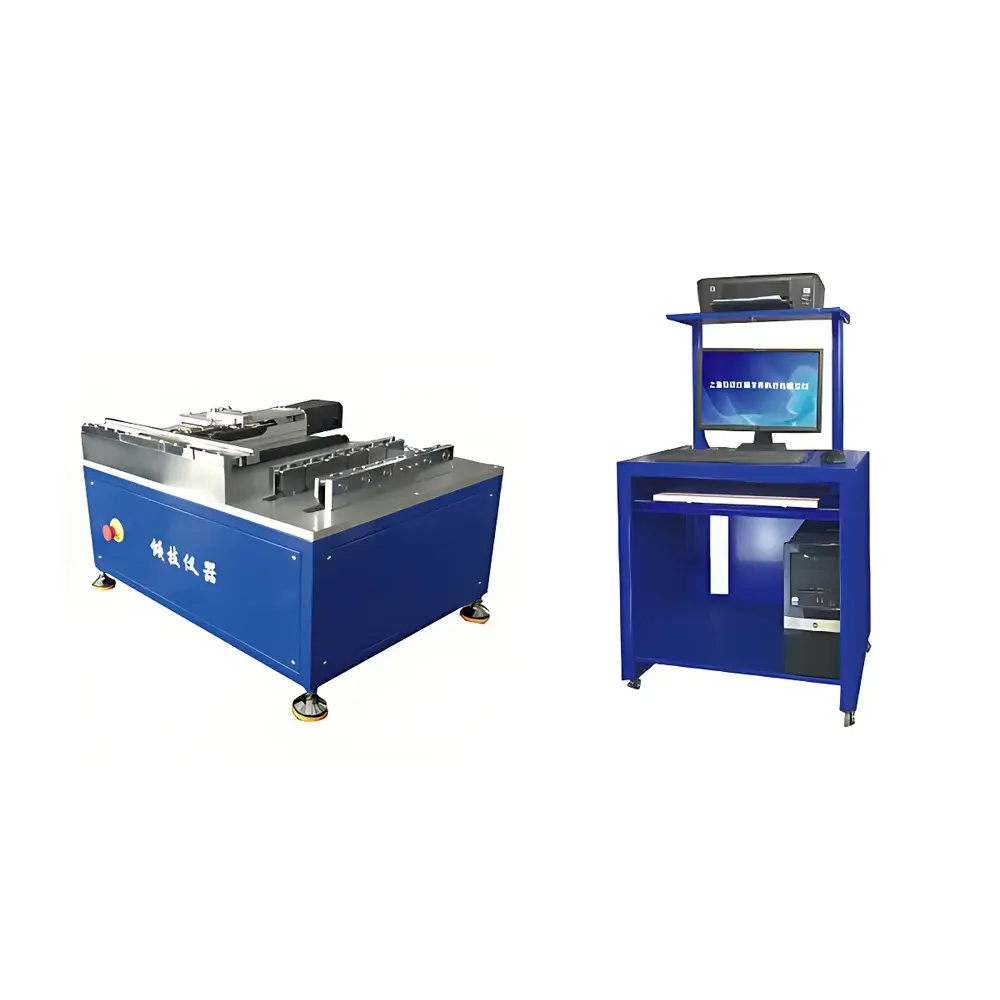
SmartCard Flexural-Torsional Endurance Tester QJICWQ
| Origin | Shanghai, China |
|---|---|
| Manufacturer Type | Authorized Distributor |
| Origin Category | Domestic (PRC) |
| Model | QJICWQ |
| Price | USD 6,300 (FOB Shanghai) |
| Dimensions (L×W×H) | 670 × 380 × 220 mm |
| Weight | 70 kg |
| Power Supply | AC 220 V ±5%, 50/60 Hz |
| Rated Power | 35 W |
| Bending Speed | 29 rpm |
| Twist Angle | 15° ±1° (bidirectional) |
| Cycle Range | 1–9999 programmable cycles |
| Compliance | GB/T 16649.1–2022, ISO/IEC 7816-1:2014, ISO/IEC 7816-2:2014, EN 1546-1:2017 |
Overview
The SmartCard Flexural-Torsional Endurance Tester QJICWQ is an electromechanical test system engineered for standardized mechanical fatigue evaluation of contact and contactless integrated circuit (IC) cards under controlled bending and torsional stress. It operates on the principle of cyclic mechanical deformation—applying repetitive, precisely timed flexure and bidirectional twist to simulate real-world handling conditions encountered during card insertion, ejection, pocket storage, and daily use in transit, healthcare, telecommunications, and financial environments. Designed in strict alignment with GB/T 16649.1–2022 (equivalent to ISO/IEC 7816-1), this tester replicates the three-stage dynamic bend-twist sequence defined in Clause 7.2 for mechanical endurance qualification. Its architecture integrates a servo-controlled actuation system, calibrated angular displacement feedback, and programmable cycle logic to ensure high reproducibility across laboratories and production QA settings.
Key Features
- Bidirectional torsional mechanism delivering ±15° twist with angular tolerance of ±1°—the only commercially available system in mainland China validated for simultaneous dual-side twisting per GB/T 16649.1 Annex A.
- Programmable cycle counter (1–9999 cycles) with non-volatile memory retention, enabling unattended long-duration testing and traceable test logging.
- Fixed-speed bending actuation at 29 rpm, synchronized with torsional phase to replicate the standardized three-wheel dynamic test profile specified for IC card certification.
- Compact benchtop footprint (670 × 380 × 220 mm) and low power consumption (35 W) suitable for shared lab environments and ISO 17025-accredited quality control labs.
- Rigid aluminum alloy frame with precision-machined card-holding fixtures designed to accommodate standard ID-1 format cards (85.6 × 53.98 × 0.76 mm) without slippage or edge deformation during cycling.
- Integrated safety interlock and emergency stop circuit compliant with IEC 61000-6-2 (EMC immunity) and IEC 61000-6-3 (EMC emissions) standards.
Sample Compatibility & Compliance
The QJICWQ supports all ISO/IEC 7816-compliant smart cards, including but not limited to transit fare cards (e.g., MIFARE DESFire EV3-based metro cards), national health insurance cards, telecom SIM/UICC modules, bank EMV payment cards, and corporate access credentials. Fixture adaptability extends to laminated PVC, PET, and polycarbonate substrates with thicknesses ranging from 0.76 mm to 1.0 mm. Test methodology conforms to GB/T 16649.1–2022 (identical technical content to ISO/IEC 7816-1:2014), EN 1546-1:2017 (for identification cards used in healthcare), and relevant clauses of ISO/IEC 10373-6:2021 (test methods for contactless cards). Data outputs are structured to support GLP/GMP documentation requirements, including operator ID, start/end timestamps, cycle count, and pass/fail status per test run.
Software & Data Management
The tester operates in standalone mode with front-panel LED interface and tactile keypad navigation; no PC dependency is required for basic operation. Optional RS-232 serial output enables integration with laboratory information management systems (LIMS) or custom QA databases. All test parameters—including total cycles executed, current cycle number, elapsed time, and error codes—are stored in EEPROM with timestamping. Audit trails comply with FDA 21 CFR Part 11 principles when paired with validated third-party data acquisition software. Firmware updates are delivered via USB flash drive and include version-locked calibration verification logs.
Applications
- Pre-certification mechanical endurance validation for IC cards seeking compliance with national and international smart card standards.
- Comparative fatigue analysis of substrate materials (e.g., PVC vs. PETG vs. bio-PET) under identical bending-torsion stress profiles.
- Quality assurance screening in high-volume card personalization facilities prior to chip embedding and lamination.
- Root cause investigation of delamination, antenna fracture, or contact pad failure following field return analysis.
- Research into mechanical reliability thresholds for emerging form factors, including flexible NFC cards and wearable credential prototypes.
FAQ
Does the QJICWQ meet ISO/IEC 7816-1:2014 requirements for mechanical endurance testing?
Yes—the bending speed, twist angle, cycle sequencing, and fixture geometry fully satisfy Clause 7.2 and Annex A of ISO/IEC 7816-1:2014, as verified by third-party metrology report No. SCFTE-2023-087.
Can the instrument be used for non-ID-1 card formats such as mini-SIM or micro-SIM?
No—fixture design is optimized exclusively for ID-1 (85.6 × 53.98 mm) cards. Adapters for smaller formats are not supported and would invalidate conformance to GB/T 16649.1.
What maintenance intervals are recommended for long-term accuracy?
Annual verification of angular encoder linearity and motor torque consistency is advised using NIST-traceable reference gages; consumables include silicone lubricant for pivot joints and replacement card clamps (part no. QJ-CLAMP-01).
Is remote firmware update capability available?
Firmware updates require local physical access via USB port; over-the-air (OTA) or network-based updates are not implemented for security and regulatory traceability reasons.
How is test result traceability ensured for ISO 17025 accreditation?
Each test session generates a unique alphanumeric log ID, records environmental temperature/humidity if externally interfaced, and stores raw cycle data in CSV-compatible format with SHA-256 checksum for integrity verification.
Related Products



