UXS ADS Series Automated Agar Melting System
| Brand | UXS |
|---|---|
| Origin | Beijing, China |
| Manufacturer Type | Manufacturer |
| Product Category | Domestic |
| Model | ADS Series |
| Pricing | Available Upon Request |
| Instrument Classification | Biopharmaceutical |
Overview
The UXS ADS Series Automated Agar Melting System is an engineered solution for precise, reproducible, and hands-free preparation of agar-based culture media in regulated life science and biopharmaceutical laboratories. Designed around controlled thermal dissolution kinetics, the system employs programmable conductive heating combined with synchronized mechanical stirring to ensure complete, bubble-free solubilization of agar powder in aqueous solutions. Unlike conventional water baths or hot plates, the ADS platform eliminates operator variability by automating the entire sequence—from initial mixing and ramped heating to final temperature stabilization—while maintaining strict thermal uniformity across all active positions. Its architecture supports Good Laboratory Practice (GLP) and Good Manufacturing Practice (GMP) workflows through deterministic process parameters, audit-ready operation logs, and hardware-level temperature redundancy.
Key Features
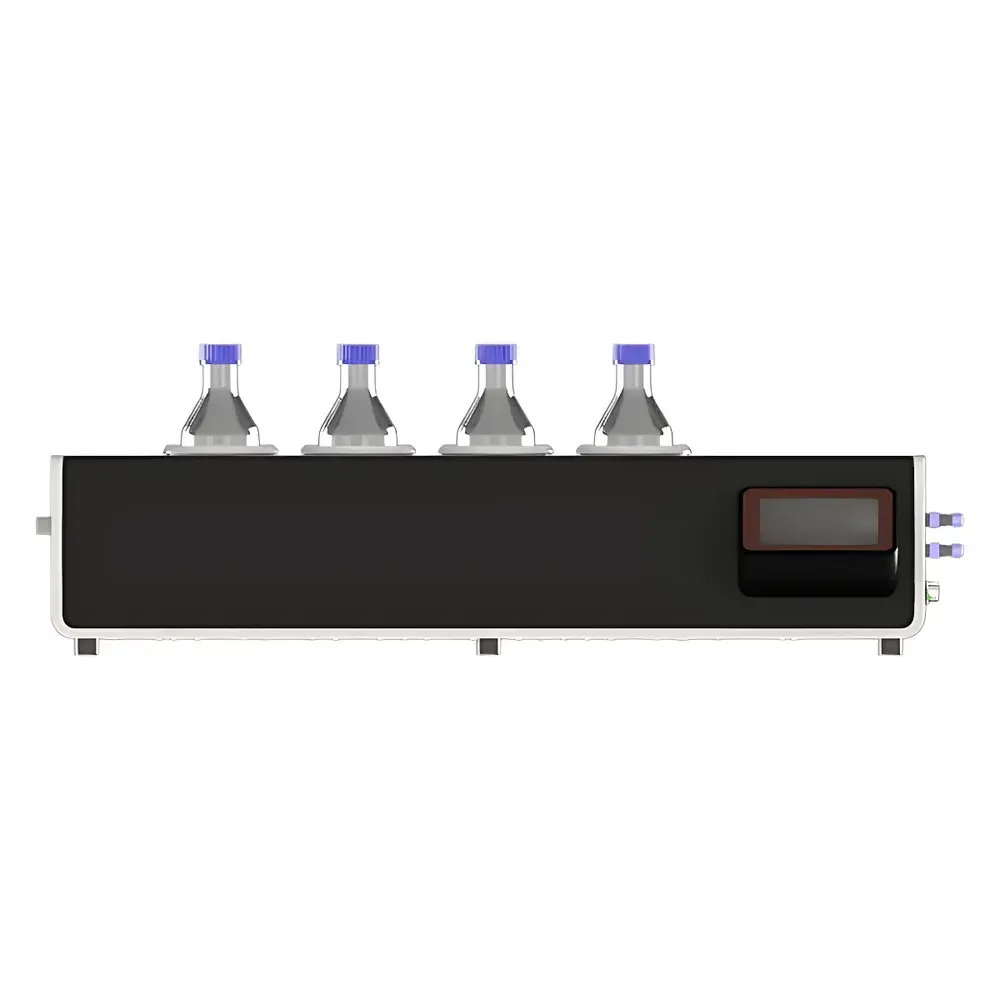
- Modular dual- or octo-position configuration: Two (ADS-2) or eight (ADS-8) independent melting stations operate simultaneously or individually, enabling parallel processing of heterogeneous media formulations without cross-contamination.
- Patented agar dissolution vessel: A proprietary bottle-and-cap assembly features optimized geometry and venting dynamics to suppress foam formation and prevent aerosolized overflow during vigorous hydration phases.
- Uniform thermal management: A bottom-zone heater-free design allows full contact between the heating sleeve and the vessel’s cylindrical wall, ensuring radial heat transfer homogeneity—critical for consistent gelation behavior and subsequent microbiological performance.
- Dual-mode thermal control: Integrated Peltier-based cooling channels enable rapid transition from dissolution (typically 95–100 °C) to holding (e.g., 45–50 °C), with ±0.3 °C stability across all positions after equilibration.
- Intelligent agitation profiling: Stirring speed and torque are dynamically adjusted per stage—low-speed pre-wetting, high-shear dispersion, and gentle post-melt homogenization—to maximize dissolution efficiency while minimizing shear-induced polymer degradation.
Sample Compatibility & Compliance
The ADS Series accommodates standard borosilicate glass or autoclavable polypropylene melting vessels (250–1000 mL capacity), with custom-fit adapters available for non-standard geometries. All wetted components comply with USP Class VI biocompatibility standards. The system meets IEC 61010-1 safety requirements for laboratory equipment and supports traceability under FDA 21 CFR Part 11 via optional electronic signature-enabled software modules. Process parameters—including time-stamped temperature profiles, stir speed logs, and start/stop events—are stored locally with configurable export (CSV, PDF) for internal quality review or regulatory submission.
Software & Data Management
The embedded touchscreen interface provides intuitive access to preloaded protocols (e.g., TSB, LB, Mueller-Hinton) and user-defined methods. Each method stores up to 10 sequential thermal and agitation steps with setpoint tolerances, dwell times, and fail-safe interlocks (e.g., overtemperature cutoff, lid-open detection). Data integrity is preserved through write-once logging with SHA-256 hash verification. Optional Ethernet/Wi-Fi connectivity enables remote monitoring, centralized fleet management, and integration with LIMS platforms via RESTful API. Audit trails record operator ID, timestamp, parameter changes, and system alerts—fully aligned with ALCOA+ data governance principles.
Applications
- Routine preparation of solid and semi-solid microbiological media for clinical diagnostics, environmental testing, and food safety labs.
- High-throughput agarose gel matrix preparation for electrophoresis in molecular biology workflows.
- Media formulation development and validation studies in biopharmaceutical process R&D, including media fill simulations and sterility test support.
- Quality control laboratories requiring ISO/IEC 17025-compliant documentation for media performance qualification (e.g., growth promotion, clarity, pH stability).
- Teaching laboratories seeking standardized, repeatable media preparation to reduce student technique variability and improve pedagogical consistency.
FAQ
Can the ADS system handle low-melting-point agarose formulations?
Yes—the temperature setpoint range spans 30 °C to 105 °C in 0.1 °C increments, allowing precise control for thermally sensitive agarose types without denaturation.
Is calibration traceable to national standards?
Each unit ships with a factory calibration certificate referencing NIST-traceable RTDs; on-site verification kits and accredited third-party calibration services are available.
What maintenance is required for long-term reliability?
No routine consumables are needed; annual verification of thermal uniformity and stir motor torque is recommended using UXS-provided validation tools.
Does the system support integration with existing lab automation infrastructure?
Yes—RS-232, USB device, and Modbus TCP interfaces are standard; custom PLC communication protocols can be implemented upon request.
How does the system prevent condensation-related contamination during prolonged hold cycles?
The patented cap design incorporates a hydrophobic membrane vent that permits pressure equalization while blocking ambient particulates and moisture ingress.
Related Products