
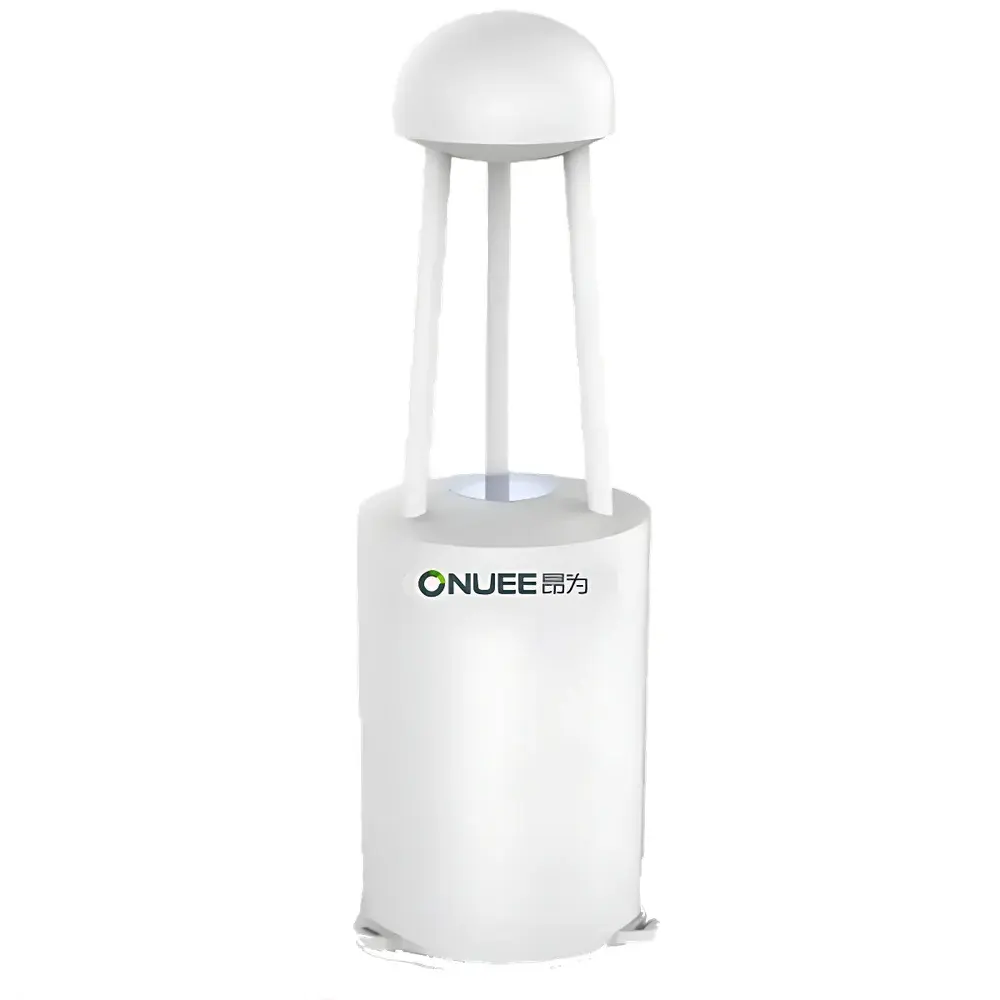
ONUEE UKL100 Open-Path Carbon Flux Monitor
| Brand | ONUEE |
|---|---|
| Origin | Guangdong, China |
| Manufacturer Type | Authorized Distributor |
| Country of Origin | China |
| Model | UKL100 |
| Pricing | Available Upon Request |
| Measurement Principle | Tunable Diode Laser Absorption Spectroscopy (TDLAS) |
| Detection Gases | CO₂, CH₄, H₂O |
| Measurement Range | CO₂: 0–2000 ppm |
| CH₄ | 0–50 ppm |
| H₂O | 0–5% |
| Measurement Frequency | 1–100 Hz |
| Accuracy | CO₂: 0.40 ppm @ 100 Hz, 0.13 ppm @ 10 Hz |
| CH₄ | 7 ppb @ 100 Hz, 5 ppb @ 10 Hz |
| H₂O | 8.17 ppm @ 100 Hz, 3.25 ppm @ 10 Hz |
| Output Interface | Ethernet (JSON protocol supported) |
| Calibration | Factory-calibrated with real-time background reference station correction |
| Dimensions (H₂O) | Ø70 × 282 mm |
| (CO₂) | Ø70 × 220 mm |
| (CH₄) | Ø135 × 600 mm |
| Weight (excl. main controller) | H₂O: 1 kg |
| CO₂ | 1 kg |
| CH₄ | 4 kg |
| Power Supply | 12–36 VDC, <2 A |
| Operating Temperature | −20 to +60 °C |
| Relative Humidity | 0–85% RH (non-condensing) |
| Atmospheric Pressure | 70–106 kPa |
| Wind Speed Limit | ≤15 m/s |
Overview
The ONUEE UKL100 Open-Path Carbon Flux Monitor is a high-precision, field-deployable instrument engineered for eddy covariance (EC) and micrometeorological flux measurements of greenhouse gases in terrestrial and aquatic ecosystems. Utilizing Tunable Diode Laser Absorption Spectroscopy (TDLAS), the UKL100 delivers fast-response, path-integrated gas concentration data with sub-second temporal resolution—critical for quantifying net ecosystem exchange (NEE) of CO₂, CH₄, and H₂O vapor. Unlike closed-path systems requiring sample extraction and conditioning, the open-path architecture eliminates inlet delays, adsorption losses, and pressure/temperature artifacts, ensuring high fidelity in turbulent flux calculations under variable environmental conditions. The system is designed for long-term unattended operation in remote ecological observatories, flux towers, agricultural research stations, and permafrost monitoring networks.
Key Features
- Triple-gas synchronized detection: Simultaneous high-frequency measurement of CO₂, CH₄, and H₂O vapor using independent TDLAS optical modules—each optimized for spectral line selection, laser wavelength stability, and photodetector signal-to-noise ratio.
- Real-time in-situ calibration: Integrated reference background station interface enables continuous zero/span correction against ambient air sampled from a shielded intake, mitigating drift due to optical contamination or thermal drift over extended deployments.
- Ruggedized open-path design: Stainless-steel optical housings with hydrophobic anti-fog coatings and passive thermal management ensure operational reliability across −20 °C to +60 °C ambient temperatures and up to 15 m/s wind loading.
- Low-power, distributed architecture: Modular sensor heads (Ø70–135 mm) connect via shielded Ethernet to a centralized controller, supporting flexible tower mounting and minimizing cable-induced electrical noise in high-EMI environments.
- Alarm-triggered output and event logging: Configurable digital alarm outputs activate upon threshold violation (e.g., signal loss, humidity saturation, power anomaly), enabling automated response protocols in无人值守 (unmanned) sites.
Sample Compatibility & Compliance
The UKL100 is validated for atmospheric sampling in natural and semi-natural environments—including forests, grasslands, wetlands, tundra, and managed croplands. Its open-path geometry ensures representative integration over footprint areas defined by wind direction, turbulence intensity, and sensor height—fully compatible with EC flux computation standards (e.g., AmeriFlux, ICOS, FLUXNET). The instrument complies with ISO 14064-3 requirements for GHG inventory verification and supports data traceability aligned with IPCC Tier 2/Tier 3 reporting frameworks. While not certified to IEC 61508 or ATEX, its electrical design adheres to IEC 61000-6-2/6-4 immunity and emission limits for industrial environments. Data integrity meets GLP-aligned metadata recording practices, including timestamp synchronization via NTP or GPS PPS input.
Software & Data Management
The UKL100 interfaces natively with industry-standard data acquisition platforms (e.g., Campbell Scientific CR6, LI-COR EddyPro, or custom Python-based pipelines) via Ethernet using structured JSON payloads—containing raw absorbance spectra, calculated mixing ratios, quality flags, and diagnostic telemetry. The optional ONUEE DataHub platform provides web-accessible visualization, automated QC filtering (spike detection, coordinate rotation, Webb-Pearman-Leuning correction), gap-filling via marginal distribution sampling (MDS), and export to CF-compliant NetCDF files. Audit trails record all calibration events, firmware updates, and parameter changes—supporting FDA 21 CFR Part 11–compliant environments when deployed with appropriate access controls and electronic signatures.
Applications
- Long-term carbon budget assessment in boreal, temperate, and tropical forest ecosystems.
- Methane flux quantification from rice paddies, peatlands, and thawing permafrost soils.
- Validation of satellite-based GHG retrieval algorithms (e.g., OCO-2, GOSAT, Sentinel-5P).
- Urban-rural gradient studies examining anthropogenic CO₂ and CH₄ plumes.
- Soil respiration partitioning experiments using isotopic tracers (¹³CO₂, CH₃D) in conjunction with co-located analyzers.
- Regulatory compliance monitoring for landfill cover gas emissions and biogas facility fugitive release tracking.
FAQ
What gases does the UKL100 measure simultaneously?
The standard configuration measures CO₂, CH₄, and H₂O vapor at up to 100 Hz. Custom configurations can include N₂O or other trace gases upon request, subject to laser availability and spectral interference analysis.
Is the system suitable for marine or coastal deployment?
Yes—the optical path is sealed against salt-laden aerosols, and housing materials are selected for corrosion resistance. However, installation must avoid direct wave splash and ensure stable mechanical alignment despite structural vibration.
How often is recalibration required in field operation?
Factory calibration remains stable for ≥12 months under typical conditions. Real-time correction using the integrated reference station reduces drift-related uncertainty to <0.5% of full scale between annual maintenance cycles.
Can the UKL100 integrate with existing eddy covariance software?
Yes—its JSON-over-Ethernet interface is documented and interoperable with EddyPro, TK3, and MATLAB-based flux processing toolboxes. Raw spectral data is also accessible for advanced spectral fitting or machine learning applications.
Does the system meet international standards for scientific flux measurement?
It satisfies the technical specifications outlined in the FLUXNET Best Practices Handbook (2022) for open-path GHG analyzers, including spectral resolution ( 0.9999), and temperature sensitivity (<0.02% K⁻¹) across its operating range.
Related Products







