
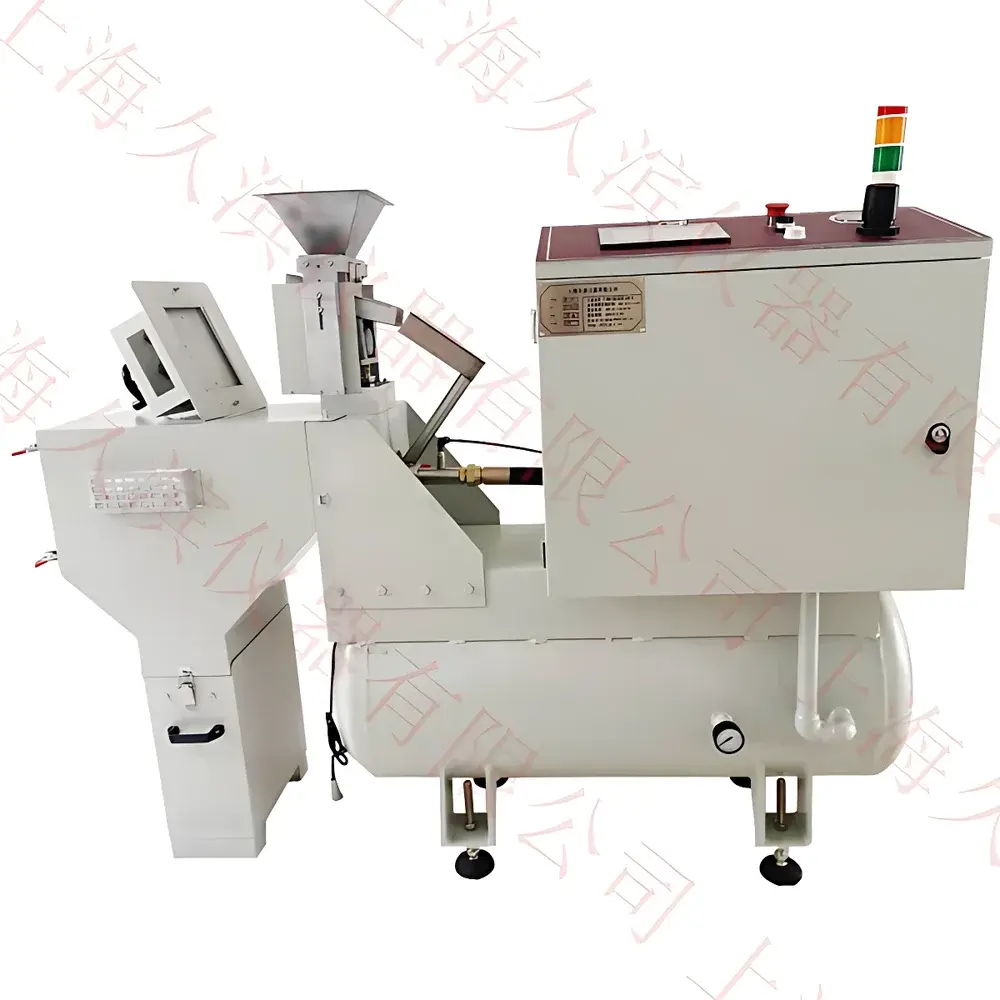
Jiubin JB-JM5 Stone Chipping Impact Tester
| Brand | Jiubin |
|---|---|
| Model | JB-JM5 |
| Type | Stone Chipping Impact Tester |
| Pressure Range | 0–0.8 MPa (adjustable) |
| Test Media | Gravel, Crushed Stone |
| Air Hose Inner Diameter | 15 mm / 20 mm |
| Air Reservoir Volume | 136 L |
| Nozzle Inner Diameter | 30 mm / 53 mm |
| Sample Orientation Angles | 45°, 54°, 90° (flat specimens) |
| Noise Level | ≤120 dB(A) |
| Operation Mode | Continuous duty |
| Feed Control | Electromagnetic vibratory feeder |
| Air Pressure Control | Manual regulator valve |
| Required External Compressor | ≥2 m³/min at 0–0.8 MPa |
| Compliance | Designed for ASTM D3170/D3170M (Chipping Resistance of Coatings), ISO 20567-1, GB/T 5237.4, and automotive OEM specifications (e.g., GMW 14872, Ford CETP 00.00-L-467) |
Overview
The Jiubin JB-JM5 Stone Chipping Impact Tester is an engineered system designed to simulate real-world mechanical degradation caused by high-velocity gravel and stone impact—primarily encountered during vehicle operation on unpaved or poorly maintained roads. It operates on the principle of pneumatic propulsion: compressed air accelerates calibrated abrasive media (gravel or crushed stone) through a precision-bore nozzle onto a stationary or angled test specimen. This controlled impact event replicates the chipping, flaking, delamination, and substrate exposure mechanisms observed in automotive exterior coatings, plastic body panels, laminated glass, and protective film systems. The tester conforms to internationally recognized test standards including ASTM D3170/D3170M (Standard Test Method for Chipping Resistance of Coatings), ISO 20567-1 (Paints and varnishes — Determination of resistance to chipping — Part 1: Gravelometer method), and major OEM protocols such as General Motors GMW 14872 and Ford CETP 00.00-L-467. Its modular architecture supports both R&D validation and production-line quality assurance under GLP-compliant laboratory conditions.
Key Features
- Adjustable impact pressure (0–0.8 MPa) via calibrated manual regulator, enabling precise energy modulation across material classes—from soft elastomeric coatings to hardened thermoplastics.
- Dual-nozzle configuration (30 mm and 53 mm inner diameters) accommodates varying particle size distributions and impact density requirements per test standard.
- Configurable sample orientation: fixed-angle mounting (45°, 54°, 90°) for flat substrates; optional 3D test chamber for complex geometries (e.g., bumpers, mirrors, curved A-pillars).
- 136 L high-volume air reservoir ensures stable pressure delivery during continuous operation, minimizing pressure decay between successive impact cycles.
- Electromagnetically driven vibratory feeder provides consistent, repeatable media feed rate—critical for statistical reproducibility across replicate tests.
- Integrated acoustic enclosure design limits operational noise to ≤120 dB(A); compliant with OSHA 29 CFR 1910.95 hearing protection requirements (ear protection mandatory).
- Modular air hose interface (15 mm / 20 mm ID) facilitates integration with facility-supplied compressed air networks meeting ISO 8573-1 Class 4 purity requirements.
Sample Compatibility & Compliance
The JB-JM5 accepts specimens up to 300 × 300 mm (standard flat mount) or custom-fitted fixtures for non-planar components. Compatible substrate materials include steel, aluminum, galvanized sheet, polycarbonate, ABS, PP, coated composites, and laminated safety glass. All test procedures align with regulatory and industry frameworks governing coating durability: ASTM D3170 defines chipping resistance quantification via visual rating scales (0–10) and cross-section microscopy; ISO 20567-1 specifies particle size grading (typically 5–15 mm angular gravel), impact velocity (≈50–70 m/s), and post-test evaluation criteria (adhesion loss area, substrate exposure depth). The system supports full audit trails required under FDA 21 CFR Part 11 when paired with validated third-party data acquisition software—enabling traceability for IATF 16949-certified Tier 1 suppliers.
Software & Data Management
While the JB-JM5 operates as a hardware-controlled benchtop instrument, it is fully compatible with external PC-based data logging systems (e.g., LabVIEW, MATLAB, or custom SCADA interfaces) via analog 0–10 V pressure monitoring outputs and digital TTL triggers for impact cycle synchronization. Optional add-ons include high-speed camera integration (≥1,000 fps) for impact kinematics analysis and automated image-based chipping quantification using open-source tools like ImageJ with ASTM D714-compliant annotation templates. All raw test parameters—including actual delivered pressure, ambient temperature, feed duration, and total particle count—are recordable in CSV or SQL formats to support CAPA documentation and long-term trend analysis per ISO/IEC 17025 Clause 7.7.
Applications
- Automotive OEM and Tier-1 supplier qualification of basecoat/clearcoat systems against stone chip propagation.
- Evaluation of interlayer adhesion strength in multi-layer polymer films used in headlamp lenses and sensor covers.
- Quantitative comparison of anti-chip tape performance versus spray-on urethane coatings under identical impact energy profiles.
- Development testing of scratch-resistant AR coatings on tempered automotive glass under combined thermal cycling and impact stress.
- Validation of recyclability-driven material substitutions (e.g., bio-based polyolefins) where impact-induced microcracking affects long-term UV stability.
- Correlation studies between lab-scale chipping resistance and field-deployed vehicle fleet data from gravel-prone regions (e.g., Nordic countries, mountainous US corridors).
FAQ
What compressed air specifications are mandatory for reliable JB-JM5 operation?
A minimum supply of 2 m³/min at 0.8 MPa is required; air must be dried to ISO 8573-1 Class 4 (≤3 mg/m³ oil, ≤5 µm particulate) and filtered to prevent nozzle clogging.
Can the JB-JM5 perform low-temperature impact testing?
Yes—when integrated with an externally controlled environmental chamber (−40 °C to +80 °C), the system meets GMW 14872 cold-impact requirements; chamber interface brackets and insulated air lines are available as accessories.
Is operator training included with purchase?
Jiubin provides on-site installation verification and a two-day technical workshop covering calibration procedures, ASTM/ISO protocol execution, failure mode interpretation, and preventive maintenance schedules.
How is chipping damage quantified post-test?
Per ASTM D3170, evaluation uses standardized visual rating charts (0 = no damage, 10 = complete substrate exposure); optional digital imaging with pixel-area analysis enables objective % surface loss calculation.
Does the system support GLP-compliant electronic records?
When interfaced with validated third-party software (e.g., Thermo Fisher SampleManager LIMS), full electronic signatures, audit trails, and 21 CFR Part 11 compliance are achievable—subject to site-specific IQ/OQ validation.



