
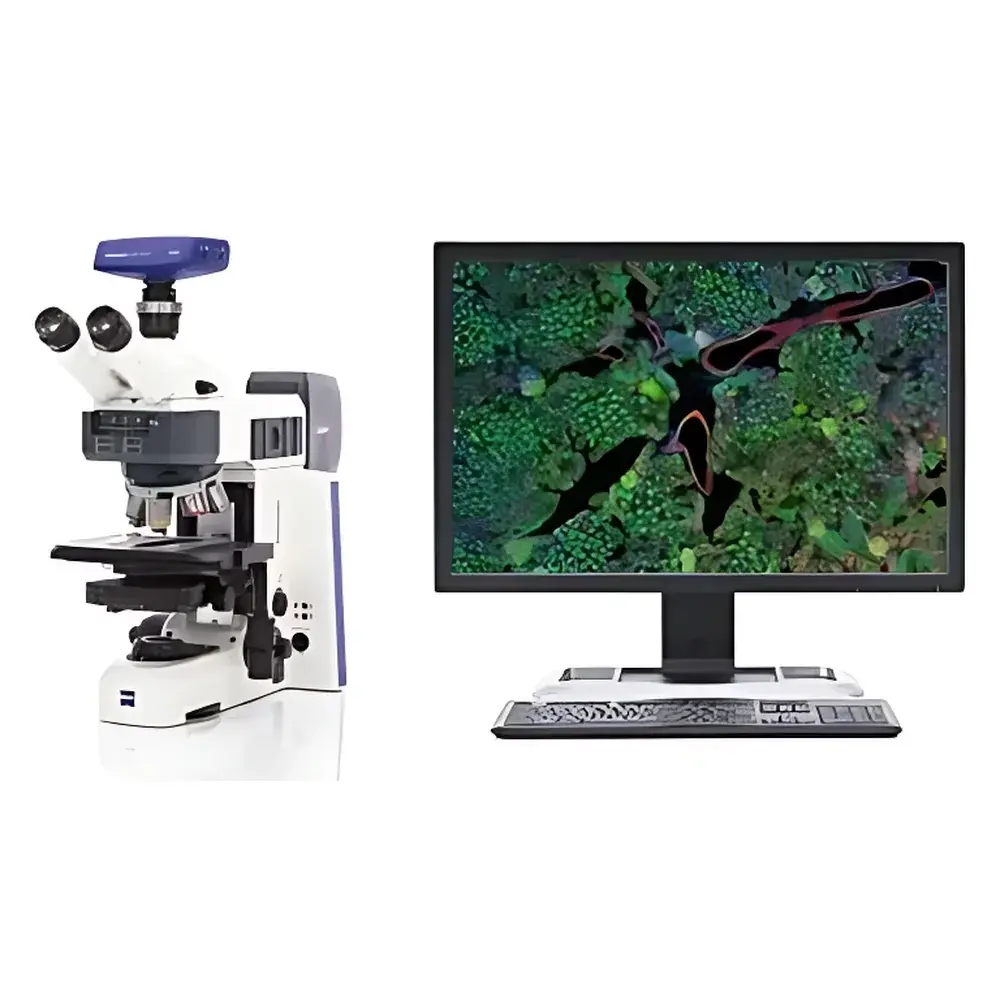
ZEISS Axioscope 5 and Axiolab 5 Upright Microscopes
| Brand | ZEISS |
|---|---|
| Origin | Germany |
| Model | Axioscope 5, Axiolab 5 |
| Microscope Type | Upright Biological & Materials Microscope |
| Optical Design | Infinity-corrected, Modular, Encoded |
| Compliance | ISO 9001-certified manufacturing |
Overview
The ZEISS Axioscope 5 and Axiolab 5 are modular upright microscopes engineered for high-precision optical imaging across life science research, clinical diagnostics, and industrial materials analysis. Both systems employ ZEISS’ proprietary infinity-corrected optical architecture with apochromatic and plan-apochromat objective correction, ensuring diffraction-limited resolution, chromatic fidelity, and flat-field performance across the entire field of view. The Axioscope 5 is purpose-built for demanding multimodal applications—supporting simultaneous fluorescence, DIC, polarization, phase contrast, darkfield, and brightfield illumination within a single platform—while integrating hardware-level encoding for objective, condenser, and filter turret positions to guarantee metadata integrity and experimental reproducibility. The Axiolab 5 serves as a streamlined, ergonomic solution for routine microscopy tasks in pathology labs, cytology units, and quality control environments, featuring intuitive one-button image acquisition, real-time color fidelity matching between eyepiece and digital output, and intelligent light management to minimize photobleaching and thermal drift.
Key Features
- Encoded modular architecture: Both models incorporate motorized or mechanically encoded turrets—5-position encoded nosepiece (Axioscope 5 & Axiolab 5) and 4-position encoded filter/condenser turret (Axioscope 5)—enabling automatic parameter logging, repeatable configuration recall, and seamless integration with ZEN software for SOP-driven workflows.
- Multimodal imaging capability: Axioscope 5 supports concurrent implementation of DIC, fluorescence (up to 4-channel sequential acquisition via Colibri LED illumination), polarization, and transmitted-light techniques without optical realignment—ideal for correlative structural and functional analysis of biological tissues and advanced materials.
- Vario stand compatibility (Axioscope 5 only): Optional Vario base extends maximum specimen height clearance to 380 mm, accommodating large-section histology slides, metallurgical cross-sections, geological thin sections, and custom-engineered samples without stage modification.
- Ergonomic and space-efficient design (Axiolab 5): Compact footprint, low-profile stage, and centralized control layout enable single-handed operation—including focus, illumination intensity, and image capture—reducing operator fatigue during high-throughput screening.
- Intelligent illumination management: Adaptive LED brightness control synchronizes with objective magnification and exposure settings to maintain consistent photon flux, extend LED lifetime (>25,000 h), and reduce thermal load on live specimens and temperature-sensitive materials.
Sample Compatibility & Compliance
The Axioscope 5 and Axiolab 5 accommodate standard 26 mm × 76 mm glass slides, 100 mm petri dishes, metallurgical mounts up to 75 mm diameter, and geological thin sections (30 µm thickness). Both systems comply with ISO 10934-1 (microscope nomenclature), ISO 8578 (objective lens labeling), and DIN EN 61000-6-3 (EMC emission standards). When operated with ZEN Blue or ZEN Connect software, they support audit-trail-enabled image acquisition meeting FDA 21 CFR Part 11 requirements for electronic records and signatures—critical for regulated environments including clinical pathology laboratories (CAP/CLIA), pharmaceutical QC, and aerospace material certification per ASTM E3022 and ISO 17025.
Software & Data Management
ZEN software (Blue edition for routine use; Connect edition for networked labs) provides full instrument control, multi-channel fluorescence registration, extended depth-of-field (EDF) reconstruction, and automated morphometric analysis. Metadata—including objective ID, magnification, exposure time, illumination source, and filter set—is embedded directly into TIFF and OME-TIFF files. Batch processing pipelines support standardized reporting for ISO/IEC 17025-compliant calibration logs, while ZEN Connect enables secure cloud-based image sharing with role-based access control and DICOM-SR export for PACS integration in translational research settings.
Applications
- Biomedical research: High-fidelity imaging of fluorescently labeled subcellular structures (e.g., actin/vimentin co-staining in endometrial epithelium), retinal histology, and muscle fiber ultrastructure using DIC at 63× water immersion.
- Clinical pathology: Routine H&E, trichrome, and immunohistochemical staining evaluation in tissue sections; blood smear morphology assessment with precise color rendering at 40× and 50× dry objectives.
- Materials science: Quantitative metallography of ferrite-pearlite steel microstructures, graphite morphology classification in cast iron (ASTM A247), and mineral identification in cementitious thin sections under polarized light.
- Geoscience & forensics: Birefringence mapping of potassium chromate crystals, sediment grain analysis, and trace evidence examination (e.g., hair, fibers, paint chips) requiring high-resolution transmitted-light contrast.
- Industrial QA/QC: Semiconductor wafer defect inspection, coating uniformity verification, and additive manufacturing powder morphology characterization using brightfield and darkfield modes.
FAQ
What distinguishes the Axioscope 5 from the Axiolab 5 in terms of optical performance?
Both share identical ZEISS Plan-Apochromat and EC Epiplan objectives, but the Axioscope 5 includes enhanced Köhler illumination optics, motorized filter wheels, and DIC prism compatibility across all magnifications—features not present in the entry-tier Axiolab 5.
Can the Axiolab 5 be upgraded to support fluorescence imaging?
Yes—via retrofit with ZEISS Colibri 3 LED illumination system and appropriate filter cubes; however, full multichannel sequential acquisition requires ZEN Connect licensing and hardware synchronization modules.
Is the Vario stand available for the Axiolab 5?
No—the Vario mechanical extension is exclusive to the Axioscope 5 platform due to structural reinforcement and motorized Z-drive integration requirements.
Do these microscopes meet regulatory requirements for clinical diagnostic use?
As Class I non-invasive devices under EU MDR, they are CE-marked for diagnostic support; full compliance with CLIA/CAP requires validation of the complete imaging workflow—including camera calibration, color profiling, and software audit trails—per laboratory-specific SOPs.
How is sample focus stability maintained during long-term time-lapse imaging?
Axioscope 5 supports optional ZEISS Definite Focus 2 hardware—a physical focus stabilization system that compensates for thermal drift and mechanical relaxation in real time, achieving sub-100 nm axial repeatability over 24-hour acquisitions.
Related Products



