
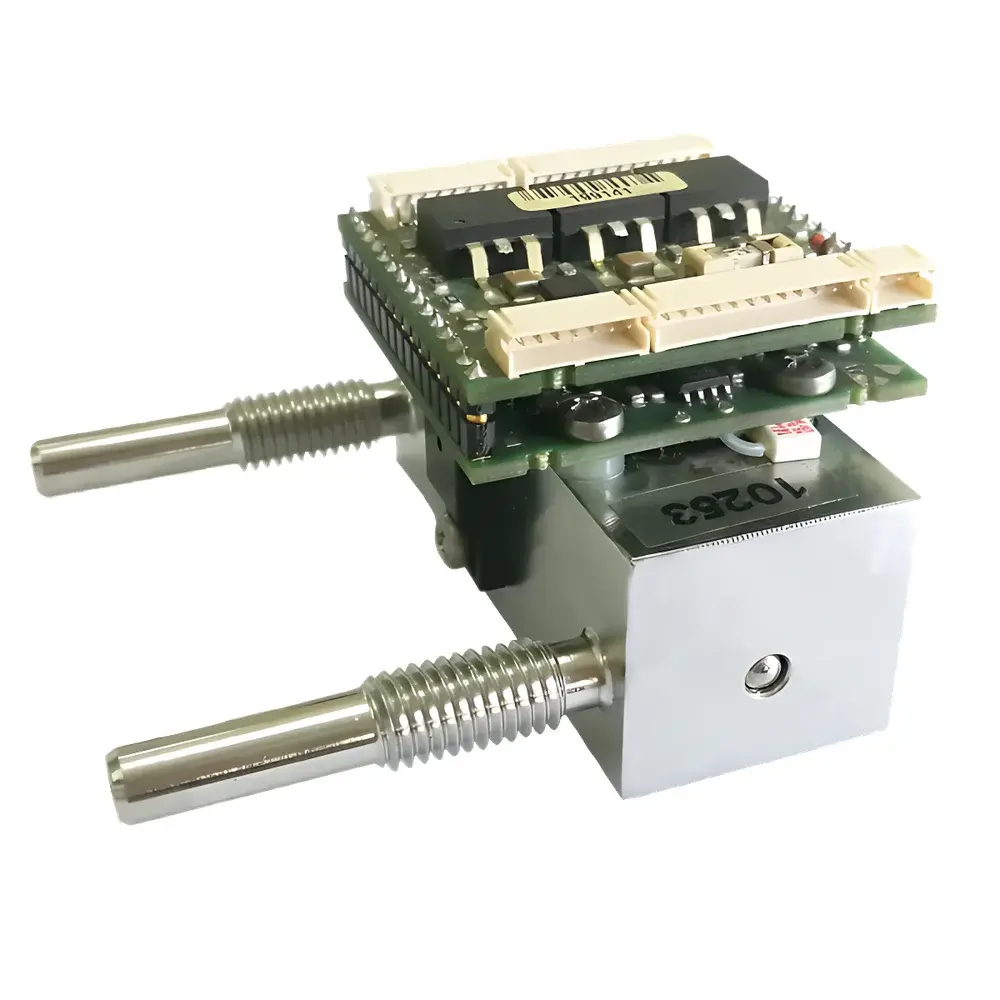
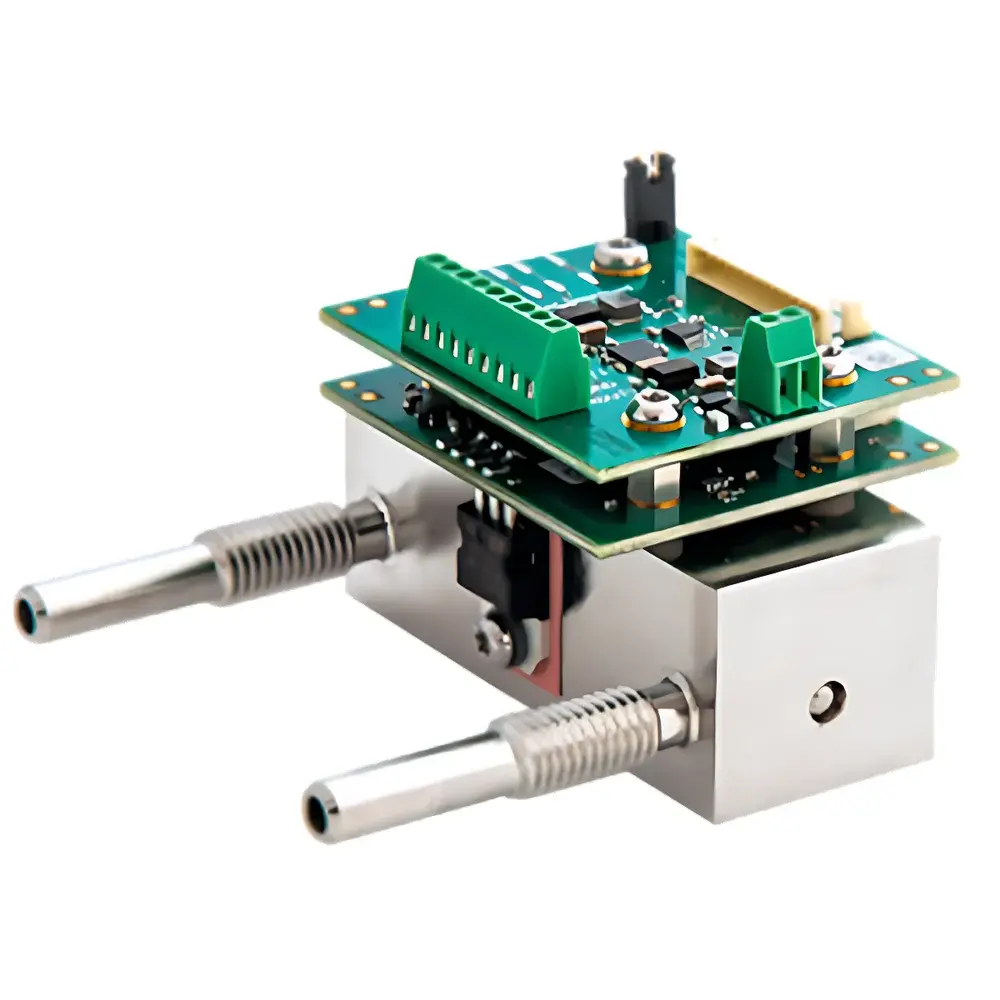
ONUEE FTC320 Thermal Conductivity Gas Sensor Module
| Brand | ONUEE |
|---|---|
| Origin | Germany |
| Model | FTC320 |
| Detection Principle | Thermal Conductivity Detection (TCD) |
| Measurement Type | Single-component gas analysis |
| Repeatability | <1% of full-scale range |
| Response Time (T90) | <1 s at 60 L/h |
| Zero Drift | <2% of full-scale range per week |
| Span Drift | <1% of full-scale range |
| Operating Temperature | −20 °C to +50 °C |
| Pressure Rating | 20 bar (absolute) |
| Power Supply | 18–36 V DC / 700 mA |
| Weight | 350 g |
| Dimensions (W×H×D) | 64×40×75 mm |
| Communication Interface | RS232 (TTL-level) |
| Analog Outputs | 2× 0–10 V |
| Enclosure | Unhoused OEM module, IP00, no EMI shielding |
| Compliance | Designed for non-hazardous areas only |
| Software Support | SetApp 2.0 for configuration, calibration and diagnostics |
| Field Calibration | Supported via RS232 |
| Optional Features | Flow measurement, flow monitoring, multi-gas monitoring, corrosion-resistant coating, condensation/dust protection, temperature sensing, external interference compensation |
Overview
The ONUEE FTC320 Thermal Conductivity Gas Sensor Module is an OEM-grade, high-stability thermal conductivity detector engineered for precise single-component gas concentration measurement in industrial process control, environmental monitoring, and laboratory analytical systems. Based on the fundamental principle of thermal conductivity differential detection—where gas composition alters the rate of heat dissipation from a heated filament—the FTC320 delivers rapid, drift-compensated output with exceptional long-term stability. Unlike catalytic or electrochemical sensors, the TCD principle is inherently non-consumptive, enabling maintenance-free operation over extended service intervals. The module operates without internal amplification or signal conditioning circuitry, preserving raw sensor fidelity for integration into custom host systems. Its unhoused design (IP00), absence of intrinsic safety certification, and lack of electromagnetic shielding confirm its intended use exclusively in non-hazardous environments—making it suitable for integration into analyzers, gas chromatographs, fermentation monitors, and inert atmosphere verification systems where ambient conditions are controlled and electrical safety compliance is managed at the system level.
Key Features
- Ultra-fast response: T90 < 1 second at nominal sample flow of 60 L/h, enabling real-time process feedback and dynamic gas switching applications.
- High metrological stability: Zero drift < 2% of full-scale range per week and span drift < 1% of full-scale range support extended calibration intervals in stable operating environments.
- OEM-optimized interface: 6 mm push-fit sampling port, TTL-level RS232 communication (with optional RS232-to-TTL converter supplied), and dual 0–10 V analog outputs facilitate seamless integration into embedded controllers and DAQ systems.
- Broad gas compatibility: Pre-characterized calibration matrices for 22 binary gas pairs—including H2/N2, CO2/Ar, CH4/air, O2/N2, SF6/N2, and NH3/H2—enable flexible deployment across diverse applications without hardware modification.
- Robust operational envelope: Rated for 20 bar absolute pressure, −20 °C to +50 °C ambient temperature, and continuous operation under variable flow (60–90 L/h) and pressure (±10 Pa deviation above 800 hPa).
- Factory-traceable performance: Each unit undergoes individual characterization and is supplied with a digital calibration certificate referencing NIST-traceable reference gases where applicable.
Sample Compatibility & Compliance
The FTC320 is designed for clean, dry, non-corrosive gas streams. While optional coatings (e.g., PTFE-lined flow paths, gold-plated filaments) mitigate mild condensation and particulate exposure, the base module is not rated for aggressive chemistries (e.g., Cl2, NOx, H2S) or saturated vapor environments without external conditioning. It complies with CE marking requirements for EMC Directive 2014/30/EU and RoHS 2011/65/EU. As an OEM component—not a finished instrument—it does not carry ATEX, IECEx, or UL hazardous location certifications. Integration into final equipment must comply with relevant regional directives (e.g., EU Machinery Directive 2006/42/EC, FDA 21 CFR Part 11 for regulated data capture when used in pharmaceutical manufacturing). The module supports GLP/GMP-aligned workflows through SetApp 2.0’s audit-trail-enabled calibration logging and user-access-controlled parameter changes.
Software & Data Management
SetApp 2.0, ONUEE’s dedicated configuration and diagnostic software, provides full bidirectional communication with the FTC320 via USB-RS232 adapter. Users perform zero/gain calibration, adjust linearization coefficients, configure analog output scaling, set flow-compensation parameters, and export raw sensor voltage traces. All calibration events—including date, operator ID, reference gas values, and deviation metrics—are timestamped and stored in encrypted local logs, satisfying basic ALCOA+ (Attributable, Legible, Contemporaneous, Original, Accurate) data integrity expectations. The software supports batch export of CSV-formatted time-series data for post-processing in MATLAB, Python, or LIMS platforms. No cloud connectivity or remote firmware updates are implemented—ensuring deterministic behavior and cybersecurity isolation in critical infrastructure deployments.
Applications
- Industrial inerting verification: Real-time monitoring of N2 or Ar purge purity in reactor vessels and storage tanks.
- Fermentation off-gas analysis: Quantification of CO2 evolution rates in bioreactors using air or N2 as carrier.
- Hydrogen purity assurance: Detection of trace H2 in synthesis gas streams or residual H2 in nitrogen blankets.
- Landfill gas monitoring: CH4/CO2 ratio tracking in low-oxygen extraction lines.
- Gas chromatography detectors: As a universal, non-destructive TCD for GC effluent analysis where flame ionization is unsuitable.
- Controlled atmosphere packaging: Verification of modified gas mixtures (e.g., CO2/N2/O2) prior to sealing.
FAQ
Is the FTC320 certified for use in explosive atmospheres?
No. The module has no intrinsic safety, explosion-proof, or increased safety certification. It must be installed only in non-hazardous (Zone 2/22 or Class I Division 2) locations.
Can I calibrate the sensor in the field without specialized equipment?
Yes. Using SetApp 2.0 and a certified reference gas, users can execute zero and span calibration via the RS232 interface. No external hardware beyond a PC and gas delivery system is required.
What is the recommended sample conditioning for humid or particulate-laden streams?
A heated sample line (to prevent condensation), sintered metal filter (≤5 µm), and Nafion™ dryer are strongly advised. Optional corrosion-resistant variants include gold-coated filaments and PTFE-wetted surfaces.
Does the module support Modbus or CAN bus communication?
No. Communication is exclusively via TTL-level RS232. Protocol translation requires external gateway hardware.
How does ambient temperature variation affect measurement accuracy?
The FTC320 incorporates internal temperature compensation. Measurement error remains <1% of full-scale range per 10 K ambient change, provided the module reaches thermal equilibrium before operation.
Related Products







