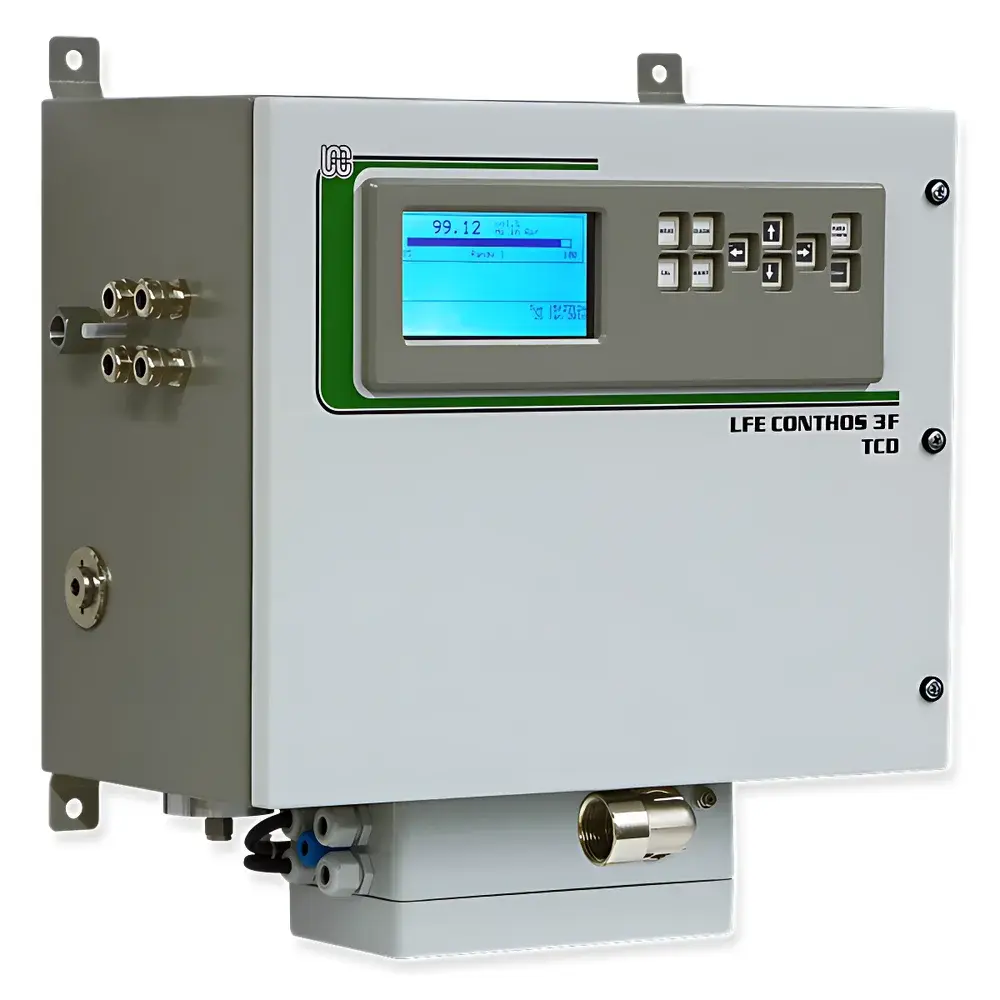
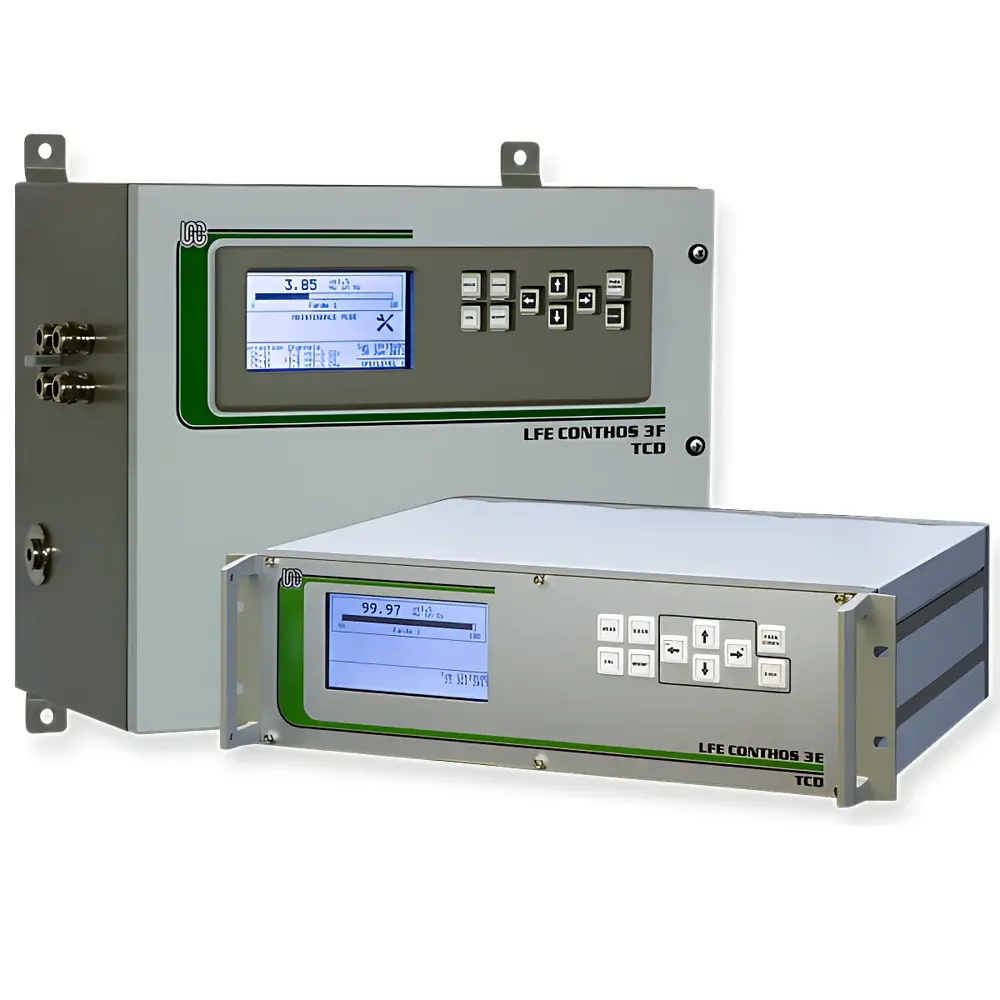
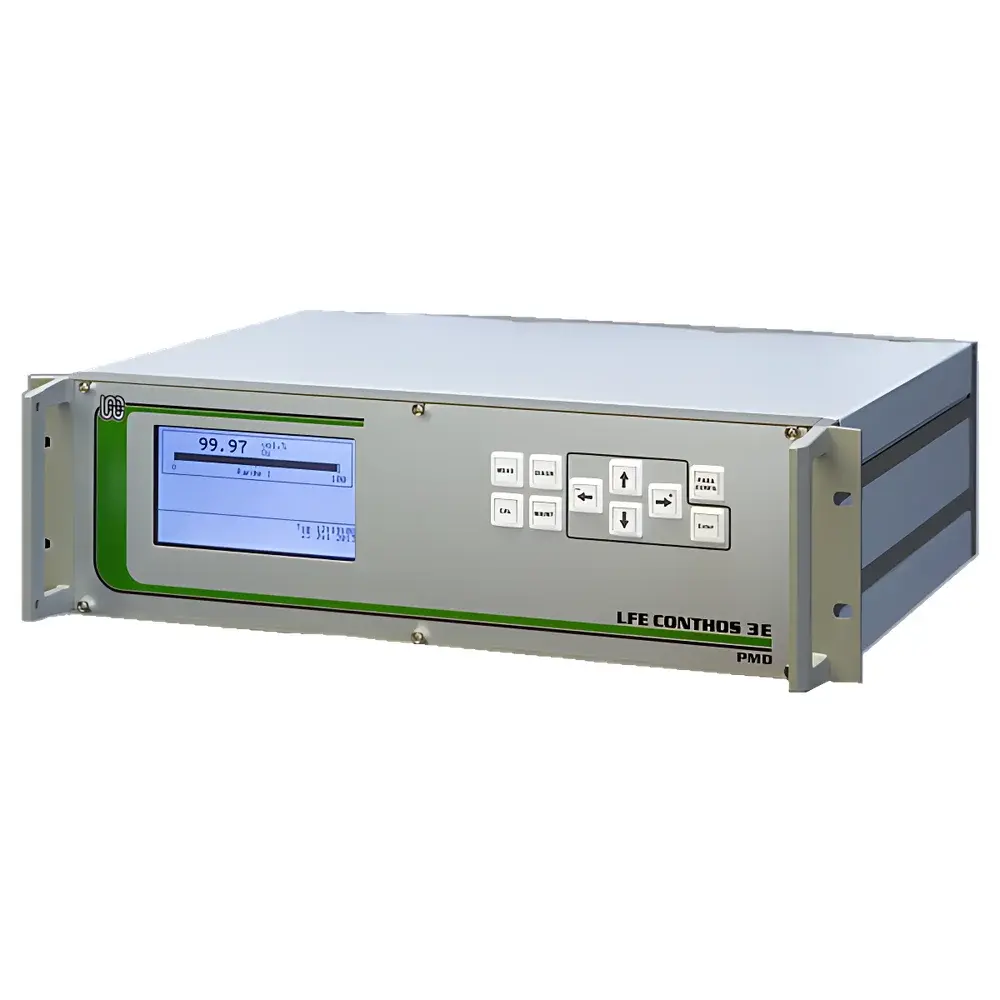
ONUEE CONTHOS TCD Series Online Hydrogen Analyzer
| Brand | ONUEE |
|---|---|
| Origin | Germany |
| Model | CONTHOS TCD Series |
| Measurement Principle | Thermal Conductivity Detection (TCD) |
| Operating Temperature Range | Up to 180 °C (HT variant) |
| Response Time (T90) | ≤3 s |
| Detection Limit | ≤0.5% of span |
| Accuracy & Linearity | ≤0.5% of span |
| Repeatability | ≤0.5% of span |
| Zero Drift | ≤1% of span/week |
| Span Drift | ≤1% of span/week |
| Environmental Temp. Range | +5 °C to +45 °C |
| Protection Rating | IP40 (3E), IP65 (3F/EX/HT) |
| Explosion Protection | II 2 G, Ex p II T4 (3F-EX) |
| Analog Outputs | 2 × configurable (0–20 mA / 4–20 mA) |
| Digital Interface | RS-485 Modbus RTU (optional) |
| Gas Compatibility | H₂, He, Ar, Cl₂, HCl, SO₂, H₂O (high dew point tolerant) |
| Flow Rate Range | 3–120 L/h |
| Power Supply | 100–240 VAC, 48–62 Hz |
Overview
The ONUEE CONTHOS TCD Series Online Hydrogen Analyzer is an industrial-grade thermal conductivity detector engineered for continuous, high-stability gas concentration measurement in demanding process environments. Based on the fundamental physical property of differential thermal conductivity (Δλ), the analyzer quantifies hydrogen concentration by detecting changes in heat dissipation across a precision-balanced Wheatstone bridge circuit containing dual thermistor elements—one exposed to sample gas and one to reference gas. This principle enables robust, drift-resistant measurement without consumables or catalytic surfaces, making it especially suitable for corrosive, high-moisture, or high-dew-point process streams where electrochemical or optical sensors degrade rapidly. Unlike conventional TCD analyzers, the CONTHOS series integrates active temperature control of both internal sensor chambers and external gas pathways—ensuring the TCD operating temperature remains consistently above the sample gas dew point. This eliminates condensation-induced signal instability and significantly reduces or removes the need for external chiller-based sample conditioning systems. Designed and manufactured in Germany, the instrument complies with IEC 61000 electromagnetic compatibility standards and meets mechanical safety requirements per EN 61010-1 for industrial measurement equipment.
Key Features
- Thermally stabilized TCD sensor with corrosion-resistant materials (SS321 stainless steel wetted parts; optional PTFE internal flow path) for long-term operation in aggressive gas matrices including Cl₂, HCl, SO₂, and saturated steam.
- Three independently configurable, switchable measurement ranges per channel—including ultra-low (0–5000 ppm H₂ in N₂) and ultra-high purity modes (99.5–100% H₂)—each factory-linearized using 4th-order polynomial calibration.
- Dynamic multi-component interference compensation via up to three analog input channels or RS-485 Modbus interface, enabling real-time correction for co-varying background gases (e.g., CO₂, CH₄, or moisture).
- Integrated heated gas conduit system (up to 180 °C in HT variant) and field-mountable heated sample lines (optional) to maintain gas-phase integrity across high-dew-point applications such as electrolyzer off-gas monitoring or syngas analysis.
- Explosion-proof configuration (II 2 G, Ex p II T4) certified per ATEX Directive 2014/34/EU for Zone 1 & 2 hazardous areas, with IP65-rated enclosure and intrinsically safe digital I/O options.
- Low gas consumption design (<1 L/min typical), minimizing process disturbance and reducing purge gas costs in closed-loop or low-flow sampling systems.
Sample Compatibility & Compliance
The CONTHOS TCD Series is validated for binary and pseudo-binary gas mixtures where hydrogen is the primary analyte of interest—particularly H₂/N₂, H₂/Ar, H₂/He, and H₂/CO₂ systems. Its thermal conductivity-based detection mechanism inherently rejects inert background shifts caused by pressure fluctuations (effect <0.02% H₂-equivalent per 100 mbar), and exhibits negligible tilt or orientation sensitivity. The analyzer supports compliance with multiple international process analytical standards, including ASTM D1946 (analysis of hydrogen in fuel gases), ISO 8573-1 (compressed air purity classes, when used for H₂-in-air verification), and IEC 61511 (functional safety for SIS integration). For regulated pharmaceutical or fine chemical manufacturing, optional audit-trail-enabled firmware and NAMUR NE107-compliant diagnostics support alignment with FDA 21 CFR Part 11 and EU Annex 11 data integrity expectations. All variants undergo factory verification per ISO/IEC 17025-accredited procedures, with traceable calibration certificates available upon request.
Software & Data Management
Configuration, diagnostics, and firmware updates are performed via a dedicated Windows-based PC utility connected through a non-isolated serial port (RS-232 or USB-to-serial adapter). The software provides full access to all instrument parameters—including range selection logic, analog output scaling, alarm thresholds, digital I/O mapping, and dynamic interference correction coefficients. For integration into distributed control systems (DCS) or SCADA platforms, the optional RS-485 interface implements Modbus RTU protocol (slave mode), supporting register-level read/write access to real-time measurements, status flags, and diagnostic codes. Analog outputs conform to NAMUR NE43 fault signaling conventions, while digital status outputs follow NAMUR NE107 guidelines for standardized event classification (e.g., “Maintenance Required”, “Sensor Fault”, “Calibration Due”). No cloud connectivity or proprietary cloud services are embedded—ensuring full data sovereignty and compatibility with air-gapped industrial networks.
Applications
- Metallurgical processes: Real-time monitoring of H₂ concentration in blast furnace top gas, direct reduction iron (DRI) off-gas, and reformed syngas streams.
- Petrochemical refining: In-situ verification of hydrogen partial pressure during hydrotreating, hydrocracking, and amine regeneration unit vent streams.
- Hydrogen production & purification: Continuous analysis of PEM and alkaline electrolyzer anode/cathode gas outputs, PSA tail gas, and purity verification prior to compression or storage.
- Safety-critical monitoring: Lower/upper explosive limit (LEL/UEL) surveillance in hydrogen handling facilities, battery room ventilation systems, and fuel cell test benches.
- High-dew-point process streams: Measurement of H₂ in wet reformate, biomass-derived syngas, and steam methane reformer (SMR) effluent where conventional analyzers require complex conditioning.
FAQ
Does the CONTHOS TCD require zero gas or span gas for routine operation?
No—zero and span calibration are manual two-point procedures (recommended quarterly or after maintenance), but the analyzer operates stably without continuous reference gas supply due to its differential thermal conductivity architecture and active temperature stabilization.
Can the instrument measure hydrogen in chlorine-rich environments?
Yes—the TCD sensor housing and internal flow path are constructed from SS321 stainless steel and optionally PTFE, providing proven resistance to dry Cl₂ and HCl at elevated temperatures up to 180 °C.
Is Modbus TCP supported?
No—only RS-485 Modbus RTU is available as a hardware option. Ethernet-based protocols require external protocol gateways compliant with Modbus TCP to RTU conversion.
What is the minimum detectable hydrogen concentration?
The lower detection limit is application-dependent but typically ≤5000 ppm H₂ in binary N₂ mixtures under standard conditions (1 atm, 25 °C), with signal stability maintained down to 0.5% of full-scale span.
How is cross-sensitivity to water vapor mitigated?
By maintaining the entire gas pathway—including sample inlet, sensor chamber, and exhaust—at a temperature exceeding the process dew point (via integrated heating), condensation is prevented, eliminating water-related signal artifacts and baseline drift.