
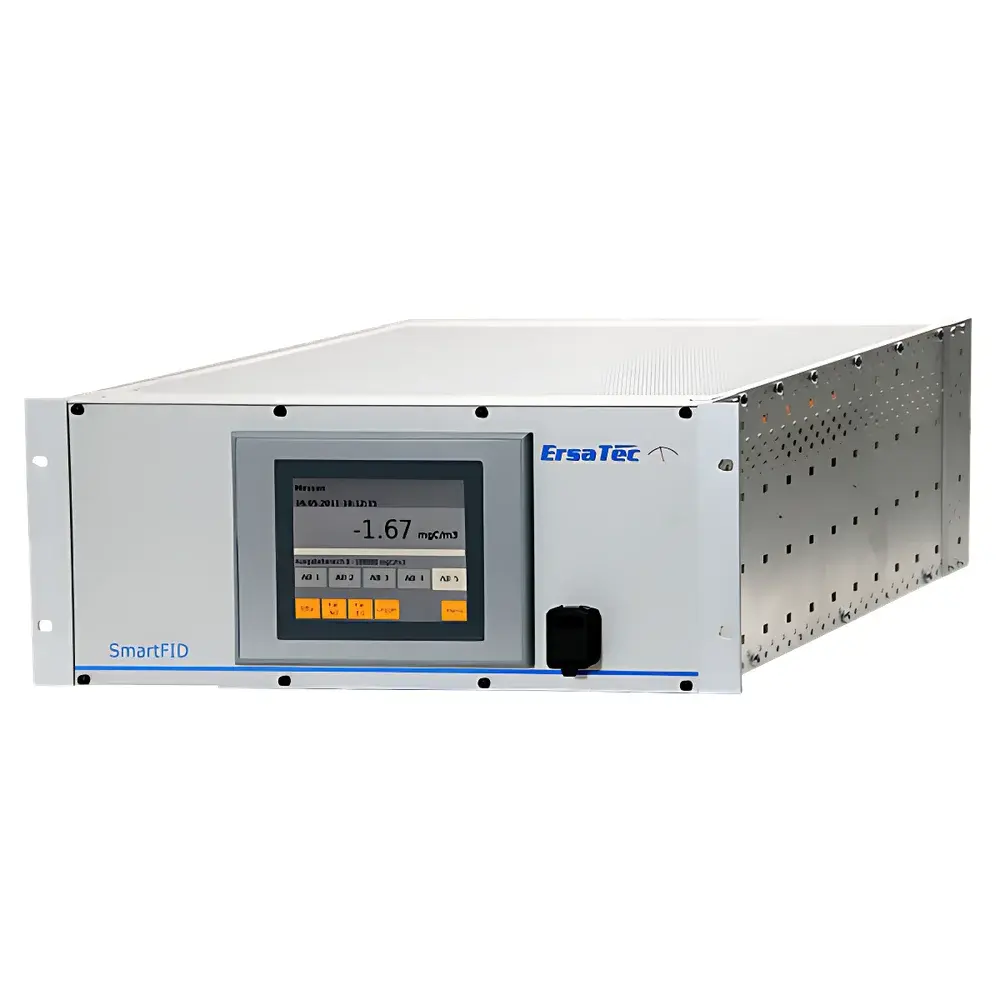
Ersatech SmartFID ST Online Total Hydrocarbon Analyzer
| Brand | Ersatech |
|---|---|
| Model | SmartFID ST |
| Origin | Germany |
| Detection Principle | Flame Ionization Detection (FID) |
| Instrument Type | Online Analyzer |
| Configuration | Composite VOC Analyzer |
| Measurement Range | 0–100,000 ppm (as C₃H₈) |
| Resolution | 0.01 ppm |
| Accuracy | ±1.0% of reading |
| Response Time (T₉₀) | <1.5 s |
| Operating Temperature of Wetted Parts | 200 °C |
| Power Supply | 115–230 VAC, 48–63 Hz, max. 350 W |
| Dimensions | 177 × 445 × 365 mm (4U, 19″ rack-mountable) |
| Weight | 9 kg |
| Analog Outputs | Two user-configurable 0/4–20 mA |
| Digital Outputs | Three programmable relay contacts (250 V AC, 1 A) |
| Sample Flow Rate | ~1.2 L/min |
| Zero Drift | ≤0.5% of full scale per month |
| Span Drift | ≤2.8% of full scale per week |
| Linearity | ±1.0% of selected range |
| Oxygen Interference | <4% at 80 ppm C₃H₈ |
| Warm-up Time | 25 min |
Overview
The Ersatech SmartFID ST is a rack-mounted (19″, 4U), continuous online total hydrocarbon analyzer engineered for high-reliability measurement of volatile organic compounds (VOCs) and total hydrocarbons (THC) in industrial process and emission streams. It employs flame ionization detection (FID), a well-established, universally accepted technique standardized under ASTM D6348, ISO 12013, and EN 12619 for quantitative carbon-based compound analysis. The instrument operates on the principle that organic molecules—when combusted in a hydrogen-air flame—generate ions proportional to their carbon content; these ions are collected at an electrode to produce a current signal linearly correlated with hydrocarbon concentration. Unlike catalytic or PID-based alternatives, FID offers inherent insensitivity to water vapor, CO₂, and most inorganic gases, delivering robust performance in demanding environments such as RTO exhaust, syngas purification, and chemical plant off-gas monitoring.
Key Features
- Rack-integrated 4U design with front-panel 7″ color LCD display supporting multilingual UI (English, German, French, Spanish, Chinese)
- Fully heated gas path: all wetted components—including sample line, detector chamber, and valves—maintained at 200 °C to prevent condensation and adsorption losses, enabling stable operation in high-humidity or low-volatility VOC applications
- Five programmable measurement ranges (e.g., 0–10 ppm to 0–10 vol.% as propane), with automatic range switching and user-defined span points
- Integrated pressure regulation system ensuring consistent sample delivery across variable upstream conditions
- Onboard microprocessor control with embedded real-time operating system (RTOS), supporting autonomous calibration, zero/span validation, and fault diagnostics
- Low-consumption fuel gas architecture: compatible with ultra-pure H₂ (Class 5, <0.5 ppm THC) at 1.2 L/h or H₂/He blends at ~2.4 L/h—optimized for extended unattended operation
- Internal data logger storing up to 30 days of timestamped measurements in XML format; exportable via USB to Excel-compatible CSV or direct integration with SCADA systems
Sample Compatibility & Compliance
The SmartFID ST is validated for measurement of saturated and unsaturated aliphatic/aromatic hydrocarbons, chlorinated VOCs (e.g., chloroform, TCE), and oxygenated organics (e.g., acetone, ethanol)—all reported as total carbon equivalents (mg C/m³ or ppm C). Its heated sampling train accommodates complex matrices including humid flue gas, refinery off-gas, biogas, and solvent-laden air without conditioning-induced bias. Regulatory compliance includes adherence to EPA Method 25A for stationary source THC monitoring, EN 15267-3 for QAL1 certification, and suitability for use in environments governed by EU Industrial Emissions Directive (IED) and U.S. Clean Air Act Subpart TT. All firmware and data handling routines support audit-ready operation per FDA 21 CFR Part 11 requirements when configured with optional electronic signature and audit trail modules.
Software & Data Management
The instrument runs Ersatech’s proprietary SmartControl firmware, accessible locally via touchscreen or remotely via Ethernet (TCP/IP) using standard Modbus TCP or OPC UA protocols. Configuration, calibration logs, alarm history, and trend visualization are managed through a browser-based interface compatible with Windows, macOS, and Linux. Raw measurement data include timestamp, range ID, temperature/pressure compensation flags, and diagnostic status codes. Internal memory retains ≥10,000 records with cyclic overwrite; external storage supports scheduled auto-export via USB mass storage mode. Optional cloud connectivity enables secure MQTT-based telemetry to centralized EMS platforms, with TLS 1.2 encryption and configurable retention policies aligned with ISO/IEC 27001 data governance frameworks.
Applications
- Continuous emissions monitoring (CEMS) of total hydrocarbons from thermal oxidizers (RTO/RCO), incinerators, and catalytic converters
- Process safety interlocks in chemical synthesis units detecting hydrocarbon breakthrough in purge or vent streams
- Real-time tracking of VOC slip across activated carbon or zeolite adsorbers in solvent recovery systems
- Monitoring of methane and non-methane hydrocarbons (NMHC) in landfill and anaerobic digester biogas upgrading lines
- Quality assurance in pharmaceutical cleanroom ambient air and HVAC ductwork verification per ISO 14644-8
- Regulatory reporting for REACH, SCIP, and VOC abatement permit compliance in coating, printing, and composite manufacturing facilities
FAQ
What calibration gases are required for routine operation?
Propane in air (80% of full scale) is recommended for span calibration; certified zero air (hydrocarbon-free, carbon-filtered or catalytically scrubbed) is used for zero adjustment. Both must be supplied at 3 bar pressure and meet ISO 6141 purity specifications.
Can the SmartFID ST distinguish between methane and non-methane hydrocarbons?
No—by default, it reports total hydrocarbons as carbon-equivalent concentration. For NMHC determination, integration with an optional non-methane cutter module (e.g., catalytic methanizer bypass) is required, followed by differential measurement using a second FID channel.
Is field maintenance of the FID jet or collector electrode possible?
Yes—electrode cleaning and jet inspection are supported via front-access service ports. Maintenance intervals are typically 6–12 months depending on sample cleanliness; detailed procedures and torque specifications are provided in the IEC 61511-compliant maintenance manual.
Does the analyzer support remote firmware updates?
Yes—signed firmware packages can be uploaded over Ethernet or USB. Updates preserve all configuration parameters and historical logs; rollback capability is included for validation-critical installations.
What safety certifications does the SmartFID ST hold?
It carries ATEX II 2G Ex d IIB T4 Gb, IECEx Ex d IIB T4 Gb, and UL/cULus Class I, Division 1, Groups B, C, D certifications for hazardous area installation, along with CE marking per EMC Directive 2014/30/EU and RoHS 2011/65/EU.







