
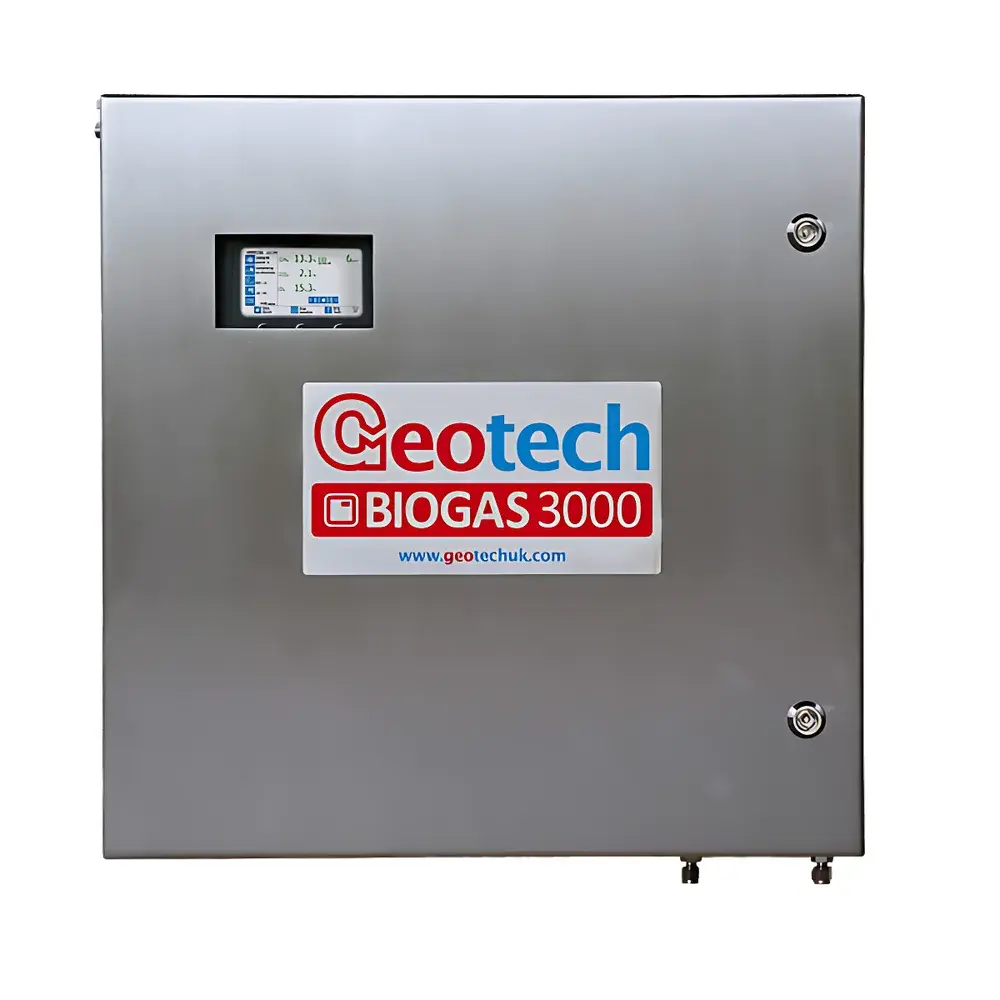
Geotech BIOGAS 3000 Online Biogas Analyzer
| Brand | Geotech (UK) |
|---|---|
| Origin | USA |
| Model | BIOGAS 3000 |
| Configuration | Online Multicomponent Gas Analyzer |
| Measurement Principle | Dual-Channel NDIR (CH₄, CO₂), Electrochemical (O₂, H₂S, CO, H₂) |
| Response Time (T90) | ≤10 s (CH₄, CO₂), ≤20 s (O₂), ≤30–40 s (H₂S, CO, H₂) |
| Repeatability | ±0.5% vol (CH₄/CO₂, 0–70%), ±1% vol (O₂), ±1.5–5% FS (H₂S/CO/H₂) |
| Operating Temperature | 0–50 °C (standard), –20–50 °C (with optional heater) |
| Sampling Points | 1–4 independent channels |
| IP Rating | IP65 |
| Power Supply | 110–230 VAC, 50/60 Hz, max. 155 W |
| Output | 4–20 mA (6 configurable channels), Modbus RTU (RS-485), optional PROFIBUS/PROFINET/Ethernet |
| Certifications | ATEX / IECEx II 3 G Ex nA nC IIA T1 Gc, UKAS ISO/IEC 17025 calibration certificate (No. 4533), BS EN 61010-1:2010, BS EN 50270:2006 |
Overview
The Geotech BIOGAS 3000 is a purpose-engineered online multicomponent gas analyzer designed for continuous, real-time monitoring of biogas composition in anaerobic digestion plants, landfill gas recovery systems, and municipal wastewater treatment facilities. It employs dual-channel non-dispersive infrared (NDIR) spectroscopy for high-stability CH₄ and CO₂ quantification, coupled with electrochemical sensing for O₂, H₂S, CO, and H₂—enabling simultaneous measurement of up to six gas components across one to four independent sampling points. Its architecture follows the fundamental principles of traceable gas metrology: each sensor path is thermally stabilized, flow-controlled, and pressure-compensated to ensure consistent performance under variable ambient conditions. The instrument operates within a defined measurement uncertainty framework aligned with ISO/IEC 17025 requirements, with all factory calibrations traceable to UKAS-accredited reference standards. Unlike portable or spot-check analyzers, the BIOGAS 3000 is engineered for unattended, long-term deployment—supporting process optimization, emissions reporting (e.g., GHG inventories per IPCC Tier 2), and regulatory compliance (e.g., EU Landfill Directive 1999/31/EC, US EPA 40 CFR Part 60 Subpart WWW).
Key Features
- Dual NDIR optical modules for CH₄ and CO₂ with built-in temperature and pressure compensation—ensuring <0.5% vol accuracy across 0–70% range without frequent recalibration.
- Modular electrochemical sensor array: user-swappable O₂, H₂S (50–10,000 ppm), CO (0–1000 ppm), and H₂ (0–1000 ppm) cells—each rated for ≥2 years service life (O₂ sensor: ≥3 years).
- Configurable multi-point sampling: supports sequential or parallel analysis across 1–4 gas streams via pneumatically actuated solenoid valves and integrated mass flow control (300 mL/min nominal, alarm threshold at <75 mL/min).
- ATEX/IECEx-certified enclosure (II 3 G Ex nA nC IIA T1 Gc) with IP65-rated stainless-steel chassis (650 × 600 × 210 mm), suitable for Zone 2 hazardous areas and outdoor installation.
- Integrated condensate management: auto-monitoring liquid level in internal trap with dedicated drain-full alarm and fail-safe relay output.
- Field-serviceable design: front-accessible 2 µm PTFE particulate filter, tool-free sensor cartridge replacement, and hot-swap capable electronics bay.
- Extended environmental operation: optional 100 W heater enables stable measurement down to –20 °C ambient, critical for cold-climate biogas upgrading facilities.
Sample Compatibility & Compliance
The BIOGAS 3000 is validated for direct analysis of raw, conditioned, and upgraded biogas streams containing moisture, siloxanes (within typical concentration limits), and particulates ≤2 µm. It meets stringent international safety and metrological requirements: certified to BS EN 61010-1:2010 for electrical safety in laboratory and industrial environments; compliant with BS EN 50270:2006 for electromagnetic compatibility in gas detection applications; and fully aligned with ISO/IEC 17025:2017 for calibration traceability—verified by UKAS Certificate No. 4533. All delivered units include full calibration documentation referencing NIST-traceable standard gases. For regulated operations, the analyzer supports audit-ready data integrity through time-stamped event logging (power loss, sensor fault, flow deviation), configurable alarm thresholds with latching relays, and hardware-enforced 4–20 mA signal validation. While not FDA 21 CFR Part 11–compliant out-of-the-box, its Modbus RTU interface enables integration into validated SCADA or DCS platforms meeting GxP data governance criteria.
Software & Data Management
The onboard embedded system features a 4.3-inch TFT color display with intuitive icon-driven navigation, supporting multilingual UI (English, German, French, Spanish). Real-time gas concentrations, flow rate, temperature, pressure, and diagnostic status are presented with color-coded thresholds (green/yellow/red) per component. All operational data—including calibration logs, alarm history, and sensor health metrics—are stored in non-volatile memory backed by a lithium-manganese battery (72-hour retention during power outage). Data export is supported via USB host port (CSV format) or RS-485 Modbus RTU (function codes 03/04/16) for integration with PLCs, historians (e.g., OSIsoft PI), or cloud-based environmental monitoring platforms. Optional fieldbus modules enable native PROFIBUS DP-V1 or PROFINET IO communication with cycle times <100 ms. No proprietary software license is required for basic configuration; advanced diagnostics and remote firmware updates are accessible via secure HTTPS web interface (password-protected, TLS 1.2 encrypted).
Applications
- Real-time feedstock digestion efficiency monitoring in agricultural AD plants—correlating CH₄:CO₂ ratio with volatile fatty acid (VFA) trends to preempt acidification.
- Landfill gas collection optimization—identifying spatial variations in H₂S and O₂ to locate active methanogenic zones and assess cover integrity.
- Biogas upgrading control—verifying pre- and post-desulfurization H₂S removal efficiency (<10 ppm target) and detecting breakthrough events.
- Combined heat and power (CHP) engine protection—continuous CO and H₂ monitoring to detect incomplete combustion or thermal cracking in syngas blends.
- Regulatory reporting for carbon credit verification (e.g., Verra VM0038) requiring continuous CH₄ flux data with documented uncertainty budgets.
- Process safety interlocks—triggering emergency shutdown or ventilation activation upon O₂ >10% (air ingress) or H₂S >50 ppm (toxicity threshold).
FAQ
What gas components can the BIOGAS 3000 measure simultaneously?
It measures CH₄ and CO₂ continuously using NDIR, plus O₂ as standard. H₂S, CO, and H₂ are available as optional electrochemical sensors—up to six components total across one to four sampling points.
Is calibration required on-site after installation?
Yes—initial field calibration using certified span gases is mandatory to account for transport-induced drift and site-specific pressure/temperature profiles. The unit includes user-accessible zero/span functions with password-protected calibration mode.
Can it operate reliably in high-humidity biogas streams?
Yes—the integrated PTFE membrane filter (2 µm), heated sample line option, and condensate trap with level monitoring prevent water ingress and sensor poisoning. Relative humidity tolerance is 0–90% non-condensing.
How is sensor drift managed over time?
Each electrochemical sensor includes automatic baseline correction algorithms and periodic zero-air purging (3 min/day per channel). The UKAS-certified calibration certificate provides documented uncertainty values per component, enabling predictive maintenance scheduling.
Does it support integration with existing plant SCADA systems?
Yes—via Modbus RTU (RS-485) as standard; optional PROFIBUS, PROFINET, or Ethernet/IP modules provide native industrial protocol support with configurable polling intervals and alarm mapping.







