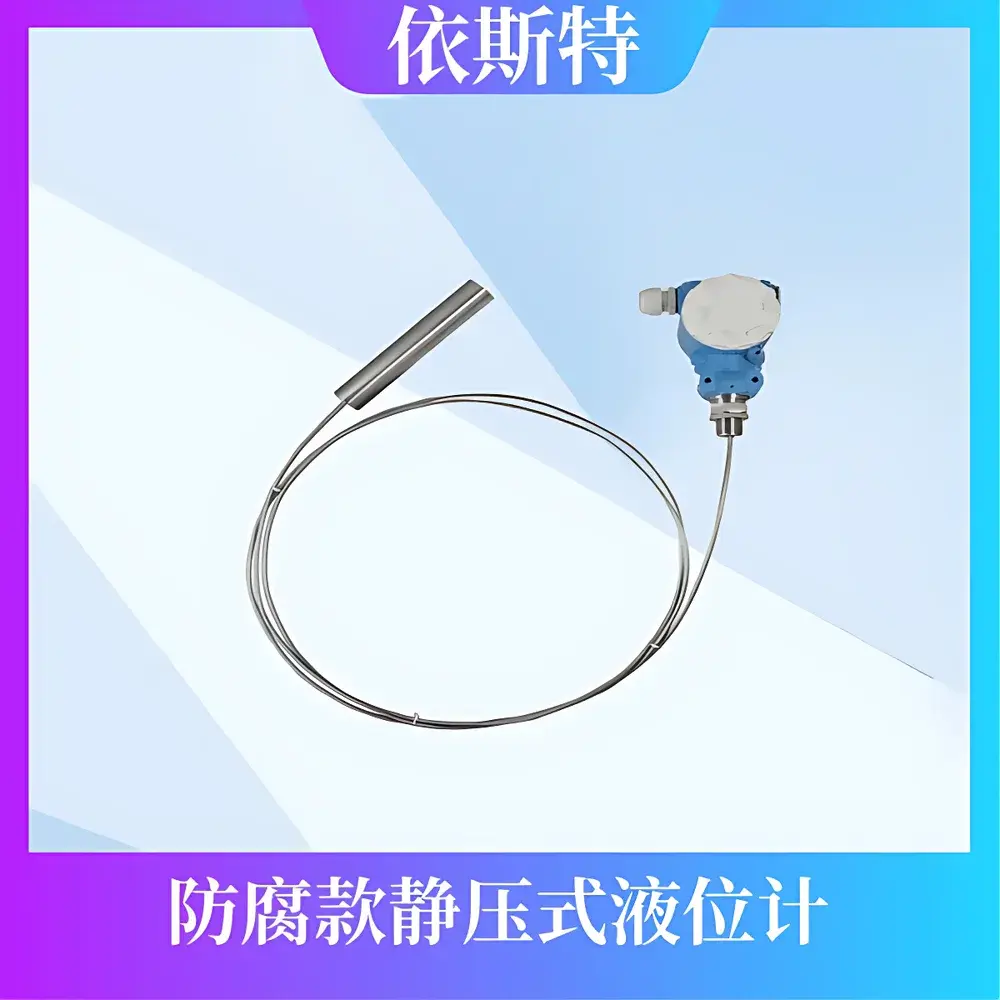
YST918S Submersible Hydrostatic Level Transmitter
| Brand | YST (Dalian Yist) |
|---|---|
| Origin | Liaoning, China |
| Model | YST918S |
| Measurement Range | 0–100 m H₂O |
| Sensor Type | Diffused Silicon Pressure Sensor |
| Output Signal | 4–20 mA (2-wire, loop-powered) |
| Accuracy | ±0.5% FS (typ.) |
| Temperature Compensation | Built-in Automatic Compensation |
| Enclosure Rating | IP68 |
| Housing Material | 316L Stainless Steel |
| Operating Temperature | −40 °C to +80 °C |
| Supply Voltage | 24 VDC (±10%) |
| Power Consumption | <1 W |
| Immersion Depth | Continuous submersion up to rated range |
| EMI/RFI Protection | Integrated shielding and filtering |
Overview
The YST918S Submersible Hydrostatic Level Transmitter is an industrial-grade hydrostatic level measurement instrument engineered for long-term, high-reliability deployment in liquid storage tanks, reservoirs, wells, and process vessels. Based on the fundamental principle of hydrostatic pressure—where liquid height (h) is derived from the measured pressure (P) via the relationship P = ρ·g·h—the YST918S delivers stable, drift-resistant level data under variable fluid density and ambient temperature conditions. Designed for continuous immersion, it operates without moving parts or mechanical linkages, eliminating wear-related calibration drift and ensuring consistent performance across decades of service in demanding water, wastewater, petrochemical, and civil infrastructure applications.
Key Features
- Diffused silicon pressure sensing element: High-stability, low-hysteresis sensor with integrated temperature compensation circuitry, minimizing thermal zero shift and span error over the full operating range.
- IP68-rated stainless-steel housing: Hermetically sealed 316L stainless steel body enables permanent submersion in aggressive media—including chlorinated water, brackish solutions, and hydrocarbon liquids—without degradation of structural integrity or signal fidelity.
- Standard 4–20 mA two-wire output: Compatible with industry-standard PLCs, DCS systems, SCADA RTUs, and analog input modules; supports loop-powered operation with minimal wiring requirements and intrinsic safety compatibility when used with appropriate barriers.
- Robust environmental tolerance: Rated for continuous operation between −40 °C and +80 °C ambient, with internal thermal management ensuring stable sensor response even during rapid ambient transients.
- EMI/RFI-hardened signal conditioning: Onboard filtering, galvanic isolation (optional), and shielded cable interface mitigate electromagnetic interference common in industrial plants, substations, and pump stations—ensuring signal integrity over distances exceeding 1,000 meters.
- Modular mounting flexibility: Supports multiple installation configurations—including direct submersion (cable-weighted probe), flanged mounting, and threaded adapter options—enabling adaptation to existing tank nozzles, manholes, or custom well casings without structural modification.
Sample Compatibility & Compliance
The YST918S is validated for use with non-corrosive and mildly corrosive liquids, including potable water, raw sewage, clarified effluent, diesel fuel, crude oil (non-explosive grades), glycol solutions, and hydraulic fluids. Its 316L wetted materials meet ASTM A240 and ISO 15156-3 requirements for chloride resistance up to 200 ppm at pH 6–9. While not intrinsically safe certified, the device complies with IEC 61000-6-2 (immunity) and IEC 61000-6-4 (emissions) for industrial environments. It supports traceable calibration per ISO/IEC 17025 practices and is suitable for installations governed by ANSI/ISA-5.1, EN 61326-1, and GB/T 13983–2014 (Chinese national standard for submersible level transmitters). For regulated industries (e.g., municipal water utilities), its linear 4–20 mA output facilitates integration into audit-ready data acquisition systems compliant with EPA 40 CFR Part 136 and EU WFD monitoring protocols.
Software & Data Management
The YST918S operates as a standalone analog transmitter and requires no embedded firmware, configuration software, or network connectivity. Its output is inherently compatible with legacy and modern control architectures alike. When integrated into supervisory systems, the 4–20 mA signal maps linearly to the full 0–100 m range, enabling straightforward scaling in HMIs, historian databases (e.g., OSIsoft PI, Wonderware Historian), and cloud-based platforms (e.g., AWS IoT Core, Azure IoT Hub) via analog-to-digital gateways. For field verification and periodic calibration, users may employ handheld HART communicators (with optional HART protocol version) or standard multimeters and pressure calibrators traceable to NIST or CNAS-certified standards. All calibration records—including date, reference standard ID, zero/span adjustments, and deviation logs—can be retained within facility CMMS or QA documentation systems to support GLP/GMP-aligned maintenance workflows.
Applications
- Municipal water supply: Real-time monitoring of clearwell, reservoir, and elevated tank levels for automated pump staging and demand-based distribution control.
- Wastewater treatment: Level feedback in influent channels, aeration basins, and final clarifiers—resistant to biofilm buildup and suspended solids abrasion.
- Oil & gas storage: Crude oil, condensate, and refined product level measurement in aboveground and underground tanks; compatible with vapor space considerations via vented cable design.
- Irrigation & flood control: Remote river stage and dam reservoir monitoring using solar-powered telemetry nodes interfaced with the analog output.
- Industrial process sumps: Chemical dosing tank level control, coolant reservoir supervision, and boiler feedwater monitoring in manufacturing facilities.
FAQ
What is the maximum submersion depth supported by the YST918S?
The YST918S is rated for continuous submersion up to 100 meters of water column (H₂O), corresponding to ~980 kPa gauge pressure. Exceeding this limit may compromise diaphragm integrity and void warranty.
Does the YST918S require zero calibration after installation?
Yes—mechanical zero offset must be verified and adjusted post-installation to account for local atmospheric pressure, cable head height, and mounting orientation. A one-point dry calibration at known zero level is sufficient for most applications.
Can the YST918S be used in seawater?
It is suitable for short-term exposure and low-chloride brackish water. For prolonged seawater immersion (>30 days), supplemental cathodic protection or titanium-sheathed variants are recommended due to crevice corrosion risk in 316L at elevated temperatures.
Is explosion-proof certification available for hazardous area use?
The base YST918S model is not ATEX, IECEx, or UL Class I Div 1 certified. However, it may be deployed in Zone 2/Class I Division 2 areas when paired with approved safety barriers and installed per NEC Article 504 guidelines.
How often should routine verification be performed?
Annual functional verification against a traceable pressure standard is recommended for critical applications; semi-annual checks are advised where fluid composition, temperature cycling, or mechanical shock is frequent.
Related Products