
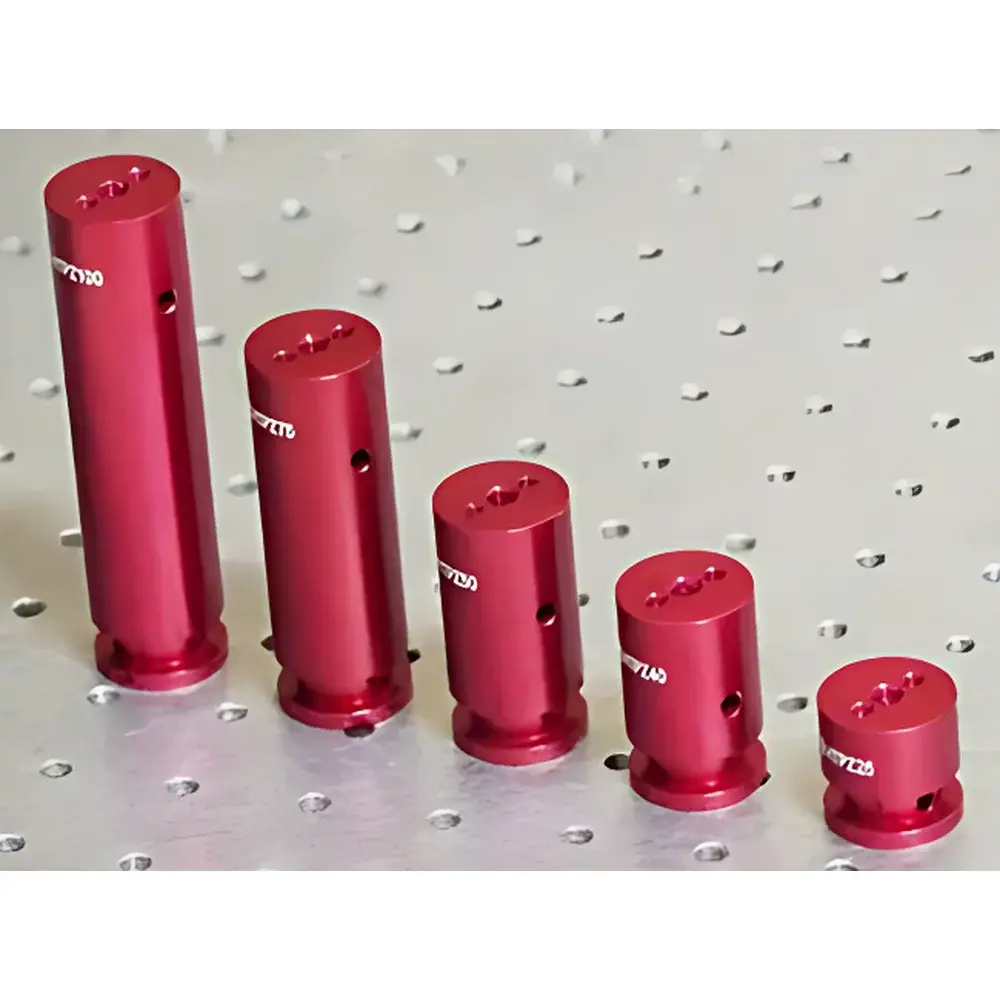
Hanting HTPZ Series Aluminum Optical Support Posts
| Brand | Hanting (HT) |
|---|---|
| Origin | Jiangsu, China |
| Manufacturer Type | Authorized Distributor |
| Product Origin | Domestic (China) |
| Models | HTPZ75, HTPZ25, HTPZ40, HTPZ50, HTPZ100, HTPZ150 |
| Pricing | Available Upon Request |
Overview
The Hanting HTPZ Series Aluminum Optical Support Posts are precision-engineered structural components designed for stable, modular alignment and positioning of optical elements in laboratory-scale optical benches, interferometric setups, laser cavity configurations, and teaching laboratories. Constructed from high-grade 6061-T6 aluminum alloy, these posts offer an optimal balance of mechanical rigidity, dimensional stability, low thermal expansion, and non-magnetic performance—critical attributes for vibration-sensitive photonic experiments. Each post functions as a passive height-adjustable pillar that interfaces seamlessly with standard optical rails, breadboards (e.g., metric or imperial grid), and kinematic mounts via standardized threading. Their role is foundational: to maintain precise axial registration and lateral repeatability of mirrors, lenses, waveplates, detectors, and fiber couplers without introducing parasitic tilt or drift during thermal cycling or mechanical loading.
Key Features
- Modular height options: Six standard lengths (25 mm, 40 mm, 50 mm, 75 mm, 100 mm, and 150 mm) enable rapid configuration of multi-level optical paths while preserving collinearity.
- Top surface machined with dual-threaded mounting patterns: M4 and M6 tapped holes arranged on a concentric pitch circle—compatible with common lens holders, mirror mounts, and translation stages from major optical hardware manufacturers.
- Integrated neodymium-based magnetic base (optional variant): Provides rapid, tool-free attachment to ferromagnetic optical tables or steel breadboards; includes clear safety labeling advising separation from magnetically sensitive devices (e.g., mechanical watches, credit cards, MRI-compatible instrumentation).
- Surface finish: Anodized matte black (Type II, 15–20 µm thickness) for enhanced scratch resistance, reduced stray light reflection, and improved corrosion protection in controlled lab environments.
- Thread specification: Standard M6 × 0.75 external thread at the base for secure insertion into tapped holes on optical tables or adapter plates (e.g., Thorlabs BA series, Newport KM series).
Sample Compatibility & Compliance
These support posts are intended for use with standard optomechanical components conforming to ISO 10110-7 (optical element mounting interfaces) and ANSI/OEOSC OP1.002 (optical table interface specifications). While not certified to ISO 9001 or CE for standalone device classification (as passive mechanical hardware), their dimensional tolerances (±0.05 mm length, ±0.02 mm diameter) align with typical Class 100 cleanroom-compatible assembly requirements. The aluminum alloy complies with ASTM B209 for wrought aluminum sheet and plate, ensuring traceable material certification upon request. No RoHS or REACH non-compliance has been reported; all anodization processes utilize chromate-free sealing per MIL-A-8625 Type II standards.
Software & Data Management
As purely mechanical, non-electronic components, the HTPZ posts require no firmware, drivers, or software integration. However, they are fully compatible with optical design and alignment simulation workflows in Zemax OpticStudio, Code V, and FRED—where users may assign accurate CAD models (STEP/IGES files available upon request) to verify clearance, line-of-sight constraints, and gravity-induced deflection under load. For GLP/GMP-aligned labs, batch-specific calibration certificates (dimensional verification reports) can be supplied upon order, supporting audit readiness for method validation documentation.
Applications
- Laser beam steering assemblies requiring vertical offset between input/output ports and intermediate optics.
- Interferometer arm elevation in Michelson, Mach–Zehnder, or Sagnac configurations where path-length matching demands sub-millimeter height control.
- Mounting of spectrometer entrance slits, fiber collimators, or photodetector arrays in compact OEM spectroscopic modules.
- Undergraduate and graduate optics teaching labs—used in experiments covering polarization, interference, diffraction, and Fourier optics due to consistent repeatability across student workstations.
- Integration into custom-built optical coherence tomography (OCT) probe heads or confocal microscopy scan engines where thermal stability and weight minimization are prioritized.
FAQ
Are mounting screws included with the posts?
No—M4 and M6 cap screws (e.g., SHCS DIN 912) must be selected based on component stack height and torque requirements; recommended tightening torque is 0.5–0.8 N·m.
Can these posts be used in vacuum environments?
Not without modification: the anodized layer contains trapped moisture and may outgas above 10⁻⁵ mbar; for UHV applications, electropolished bare aluminum or titanium alternatives are advised.
Is the magnetic base removable or replaceable?
The magnetic base is permanently integrated; however, non-magnetic variants (HTPZ-NM series) are available for EMI-sensitive or ultra-high-stability applications.
Do you provide CAD models for system integration?
Yes—STEP, IGES, and SolidWorks native files for all six models are available for download from the product support portal after registration.
What is the maximum static load rating per post?
At 100 mm height, each post supports up to 8 kg axially with ≤1.2 µrad angular deviation; load capacity scales inversely with unsupported length per Euler–Bernoulli beam theory assumptions.





