
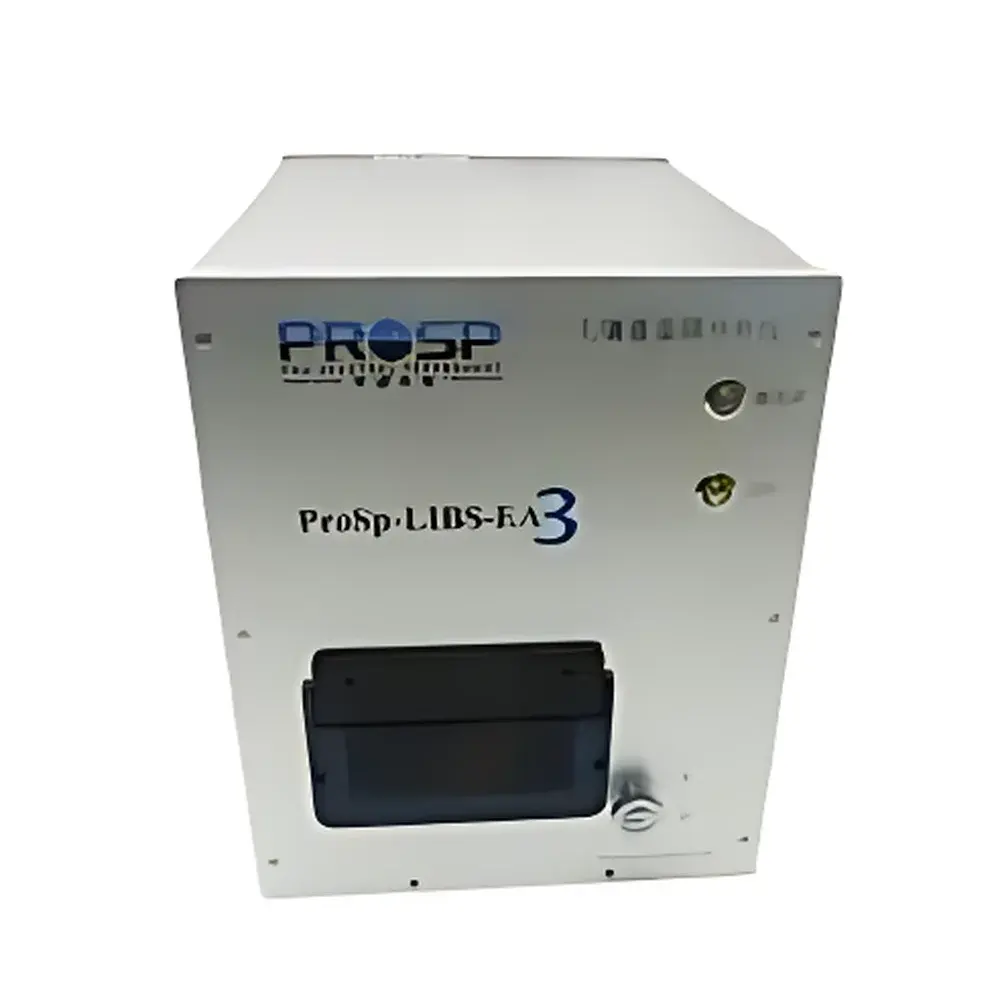
ProSp-LIBS-EA3 Portable Soil Heavy Metal Analyzer by SPL Photonics
| Brand | SPL Photonics |
|---|---|
| Origin | Zhejiang, China |
| Model | ProSp-LIBS-EA3 |
| Instrument Type | Multi-Element LIBS-Based Soil Analyzer |
| Laser Source | Diode-Pumped Nd:YAG (1064 nm) |
| Spectrometer | Triple Ocean Insight HR2000+ Units |
| Detection Limit | ~10 ppm (solid/powder samples) |
| Laser Energy Range | 0–50 mJ (adjustable) |
| Pulse Repetition Rate | 1–20 Hz |
| Spot Size | ~30 µm |
| Measurement Time | 0.1–1 s per spectrum |
| Dimensions | 360 × 310 × 260 mm |
| Weight | 10 kg |
| Power Input | 24 V DC |
Overview
The ProSp-LIBS-EA3 Portable Soil Heavy Metal Analyzer is a field-deployable, benchtop-grade instrument engineered for rapid, in-situ elemental analysis of soils using Laser-Induced Breakdown Spectroscopy (LIBS). Unlike conventional wet-chemistry or XRF-based methods, LIBS enables direct solid-sample interrogation without digestion, acid treatment, or vacuum environments. A high-stability, diode-pumped Nd:YAG laser (1064 nm) generates micro-plasma on the sample surface; emitted atomic/ionic line spectra are collected and resolved by three synchronized Ocean Insight HR2000+ high-resolution spectrometers covering complementary UV–VIS–NIR spectral ranges (200–900 nm). This multi-channel optical architecture ensures broad elemental coverage—including Hg, Cd, Pb, Cr, Cu, Ni, Co, Sn, and As—with robust signal-to-noise ratio and minimized spectral interference. The system operates on fundamental plasma emission physics, delivering quantitative and semi-quantitative results traceable to NIST-certified soil reference materials (e.g., SRM 2710a, 2711a) when calibrated with matrix-matched standards.
Key Features
- True portable LIBS platform: Integrated laser, spectrometers, sample chamber, and control electronics in a single 10 kg enclosure (360 × 310 × 260 mm), compatible with external 24 V lithium battery packs for >4 hours of continuous field operation
- High-reproducibility laser source: Montfort MP-1064-QS diode-pumped Nd:YAG laser delivering ≤30 µm focused spot size, 10⁹ shot lifetime—enabling stable ablation across heterogeneous soil matrices
- Triple-spectrometer detection: Three HR2000+ units configured in parallel for extended spectral coverage (200–400 nm, 400–650 nm, 650–900 nm), minimizing gaps in critical elemental lines (e.g., As I 193.7 nm, Pb II 220.3 nm, Cd I 228.8 nm)
- Minimal sample preparation: Accepts native soil, dried powders, or pressed pellets; no acid digestion, grinding, or pelletizing required—analysis performed directly on <1 g sample volume
- Near-non-destructive measurement: Single-shot ablation crater diameter <50 µm, depth <1 µm—preserving sample integrity for sequential or confirmatory testing
- Real-time acquisition: Full spectrum capture in 0.1–1 s per laser shot, supporting rapid mapping (e.g., 10 × 10 grid in <2 min) and statistical averaging over multiple pulses for improved precision
Sample Compatibility & Compliance
The ProSp-LIBS-EA3 is validated for use with mineral soils, sediments, sludges, and weathered topsoil matrices across pH 4–9 and organic matter content up to 15% (w/w). It complies with ASTM D8112–21 (Standard Guide for Field Screening of Soils Using LIBS) and supports method development aligned with EPA Method 6010E (ICP-OES) and ISO 11466 (extraction of trace elements from soils). While not a certified regulatory instrument per se, its calibration protocols adhere to ISO/IEC 17025:2017 requirements for analytical validation—including limit of detection (LOD ≈ 10 ppm), linearity (R² > 0.995 over 10–1000 ppm range), and repeatability (RSD < 8% at 50 ppm level). Data output formats (CSV, ASCII, .spc) are compatible with LIMS integration and GLP-compliant audit trails when paired with optional timestamped logging firmware.
Software & Data Management
The instrument ships with SPL’s proprietary ProSp-LIBS Control Suite v3.2—a Windows-based application supporting real-time spectral visualization, automated peak identification (NIST Atomic Spectra Database v2023 embedded), multivariate calibration (PLS-R, PCA), and batch report generation. All raw spectra are stored with full metadata: laser energy, pulse count, integration time, GPS coordinates (via optional Bluetooth module), and operator ID. Export options include PDF analytical reports compliant with ISO 14001 environmental monitoring documentation standards. Software supports 21 CFR Part 11–ready configuration (user roles, electronic signatures, immutable audit logs) when deployed in regulated QA/QC labs.
Applications
- Rapid screening of contaminated sites (brownfields, mining tailings, agricultural land) prior to detailed lab analysis
- On-site verification of remediation efficacy—tracking Pb, Cd, and As concentration gradients before/after stabilization treatments
- Soil health monitoring in precision agriculture: mapping micronutrient (Cu, Ni, Co) and toxic element distribution at sub-field scale
- Regulatory field audits: Supporting Tier 1 site assessments under EU Soil Thematic Strategy or China’s GB 15618–2018 standard
- Academic research: Plasma diagnostics, matrix effect correction modeling, and LIBS method transfer studies
FAQ
Does the ProSp-LIBS-EA3 require laboratory infrastructure such as fume hoods or chilled water?
No. It operates on 24 V DC power only, with air-cooled laser and spectrometers—no external cooling, gases, or vacuum systems are needed.
Can it quantify total metal content or only bioavailable fractions?
It measures total elemental concentration in the ablated volume. For bioavailability assessment, users must combine LIBS data with sequential extraction protocols offline.
Is spectral calibration traceable to international standards?
Yes—wavelength calibration uses Hg/Ne and Ar emission lines; intensity calibration employs NIST-traceable ceramic standards (e.g., NIST SRM 2197).
What maintenance is required for long-term field deployment?
Annual optical alignment verification and spectrometer dark-current recalibration are recommended; laser optics cleaning every 6 months in high-dust environments.
How does it handle soil moisture or organic coatings?
Surface moisture reduces plasma stability; drying or gentle air-blowing is advised. Organic layers (e.g., humus) may attenuate signal—surface ablation cleaning (3–5 pre-shots) is implemented automatically in advanced mode.







