
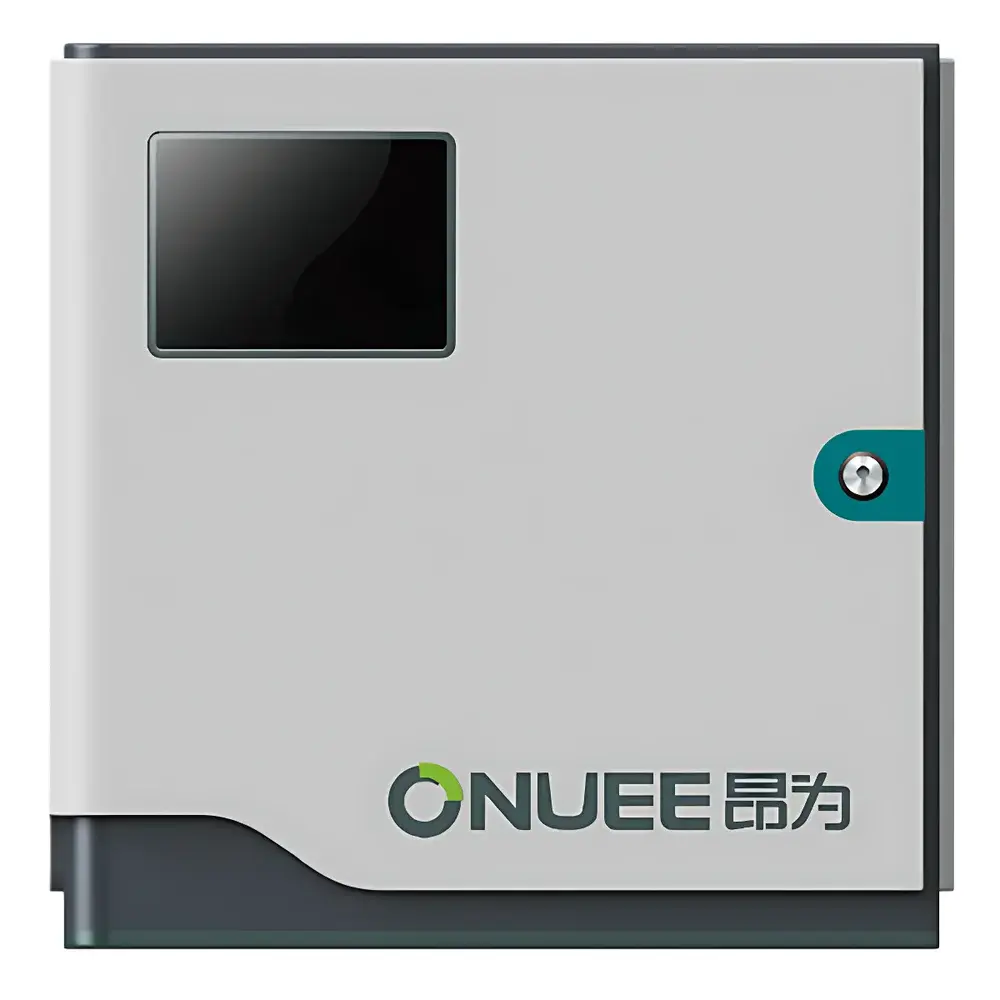
ONUEE UE2030 Multi-Component Greenhouse Gas Analyzer
| Brand | ONUEE |
|---|---|
| Origin | Guangdong, China |
| Manufacturer Type | Authorized Distributor |
| Country of Origin | China |
| Model | UE2030 |
| Pricing | Available Upon Request |
| Measurement Principle | Tunable Diode Laser Absorption Spectroscopy (TDLAS) |
| Application Sector | Environmental Monitoring |
| Detection Gases | CH₄ (0–100 ppm), CO₂ (0–2000 ppm), CO, N₂O, H₂O |
| Accuracy | CH₄ ±0.3 ppm |
| Response Time | <1 s |
| Zero Noise | CH₄ 0.15 ppm |
| Precision at 80% Full Scale | CH₄ 0.3 ppm |
| Measurement Uncertainty | ±3% of reading |
| LOD | CH₄ 10 ppb |
| Output Interface | RS485 |
| Power Supply | DC 12 V |
| Operating Temperature | −30 °C to +60 °C |
| Relative Humidity | <95% RH (at +25 °C) |
| Ambient Pressure Range | 80–116 kPa |
| Dimensions | 25 cm × 53 cm × 54 cm |
| Net Weight | 5 kg |
| Enclosure | 2U Rack-Mountable Chassis |
| Internal Sampling | Integrated diaphragm pump with particulate filter and moisture trap |
Overview
The ONUEE UE2030 Multi-Component Greenhouse Gas Analyzer is a field-deployable, high-stability optical gas analyzer engineered for continuous, real-time quantification of carbon flux-relevant trace gases—including methane (CH₄), carbon dioxide (CO₂), carbon monoxide (CO), nitrous oxide (N₂O), and water vapor (H₂O)—in ambient air, soil flux chambers, eddy covariance systems, and industrial stack emissions. It employs Tunable Diode Laser Absorption Spectroscopy (TDLAS), a physics-based, calibration-transferable technique that leverages narrow-linewidth laser emission tuned across ro-vibrational absorption features of target molecules. Unlike non-dispersive infrared (NDIR) or electrochemical sensors, TDLAS delivers inherent selectivity, minimal cross-sensitivity, and immunity to baseline drift—critical for long-term unattended operation in variable environmental conditions. The instrument integrates an internal vacuum diaphragm pump, heated particulate filtration, and a temperature-stabilized multi-pass absorption cell (effective path length >10 m), enabling sub-ppb detection limits and sub-second temporal resolution without external gas conditioning hardware.
Key Features
- Multi-gas capability via modular laser source architecture—supports simultaneous or sequential detection of CH₄, CO₂, CO, N₂O, and H₂O using wavelength-scanned single-mode lasers
- Integrated sample handling system: self-contained pump, sintered stainless-steel inlet filter (≥0.5 µm), and Nafion™-based water vapor management stage to prevent condensation and spectral interference
- Thermally stabilized Herriott-type multi-pass cell with active temperature control (±0.05 °C), ensuring consistent optical pathlength and minimizing thermal broadening effects on line shape fidelity
- Rack-mountable 2U industrial enclosure (25 × 53 × 54 cm) rated IP54 for outdoor cabinet or mobile lab deployment; operating range extends from −30 °C to +60 °C with full specification compliance
- Low-power DC12V operation optimized for solar-battery hybrid stations; average power draw <12 W during continuous measurement mode
- Factory-calibrated with NIST-traceable gas standards; calibration certificates include uncertainty budgets per ISO/IEC 17025 requirements
Sample Compatibility & Compliance
The UE2030 is validated for direct analysis of ambient air, chamber headspace gas, and diluted stack effluent streams without pre-concentration. Its optical design accommodates particulate loadings up to ISO Class 8 cleanroom levels and dew points down to −20 °C after internal drying. All gas-wetted components are electropolished 316L stainless steel or PFA-lined to prevent adsorption hysteresis—particularly critical for CH₄ monitoring at sub-ppm levels. The analyzer meets EN 15267-3 (QAL1 certification framework for automated measuring systems), supports audit-ready data logging aligned with EPA Method TO-15 and ISO 14064-3 verification protocols, and provides configurable digital outputs compliant with IEC 61131-3 for integration into SCADA and environmental data acquisition platforms.
Software & Data Management
Embedded firmware enables autonomous operation with dual-mode data output: ASCII-formatted serial telemetry over RS485 (Modbus RTU protocol) and buffered local storage (microSD card, up to 32 GB). Timestamped raw absorbance spectra, second-by-second concentration values, diagnostic parameters (laser current/temp, cell pressure, signal SNR), and system health logs are recorded with millisecond precision. Optional PC-based configuration software supports spectral fitting validation, zero/span adjustment history tracking, and GLP-compliant electronic signature workflows. Data export formats include CSV, NetCDF4, and CF-1.6 metadata-compliant files suitable for FLUXNET, ICOS, and NOAA GML archival submission.
Applications
- Atmospheric carbon flux studies using closed/open-path chamber systems and eddy covariance towers
- Landfill and wastewater treatment plant fugitive emission monitoring per EPA GHGRP Subpart FF and EU MRV Regulation
- Soil respiration and agricultural methane inventory campaigns under IPCC Tier 2/3 reporting guidelines
- Industrial process gas analysis in biogas upgrading, natural gas distribution, and chemical synthesis facilities
- Mobile platform deployment on UAVs, ground vehicles, or tethered balloon payloads for spatial mapping of emission plumes
- Calibration transfer reference unit for networked low-cost sensor arrays requiring periodic correction against primary standard instrumentation
FAQ
Does the UE2030 require periodic recalibration in the field?
Field recalibration is not mandatory under stable operating conditions; however, quarterly zero/span verification using certified span gases is recommended per ISO 14644-1 and EPA Method 205 for regulatory-grade data. The instrument stores full calibration history with user-annotated timestamps.
Can the analyzer operate unattended for extended periods?
Yes—designed for >6 months of continuous operation with scheduled maintenance intervals every 6–12 months, primarily involving filter replacement and optical window inspection. Built-in diagnostics monitor pump performance, laser stability, and cell contamination indices.
Is the UE2030 compatible with third-party data loggers and cloud platforms?
All RS485 Modbus registers are publicly documented; custom drivers exist for Campbell Scientific CR series, National Instruments DAQ systems, and AWS IoT Core ingestion pipelines via MQTT bridge.
What safety certifications does the unit hold?
CE marked per EMC Directive 2014/30/EU and Low Voltage Directive 2014/35/EU; RoHS 2011/65/EU compliant; no ATEX or IECEx certification—intended for non-hazardous area deployment only.
How is moisture interference mitigated for CH₄ and CO₂ measurements?
H₂O spectral overlap is corrected in real time using co-measured water vapor concentration and high-fidelity line-by-line radiative transfer modeling (HITRAN2020 database), eliminating need for chilled mirror dryers or permeation dryers in most ambient applications.
Related Products







