
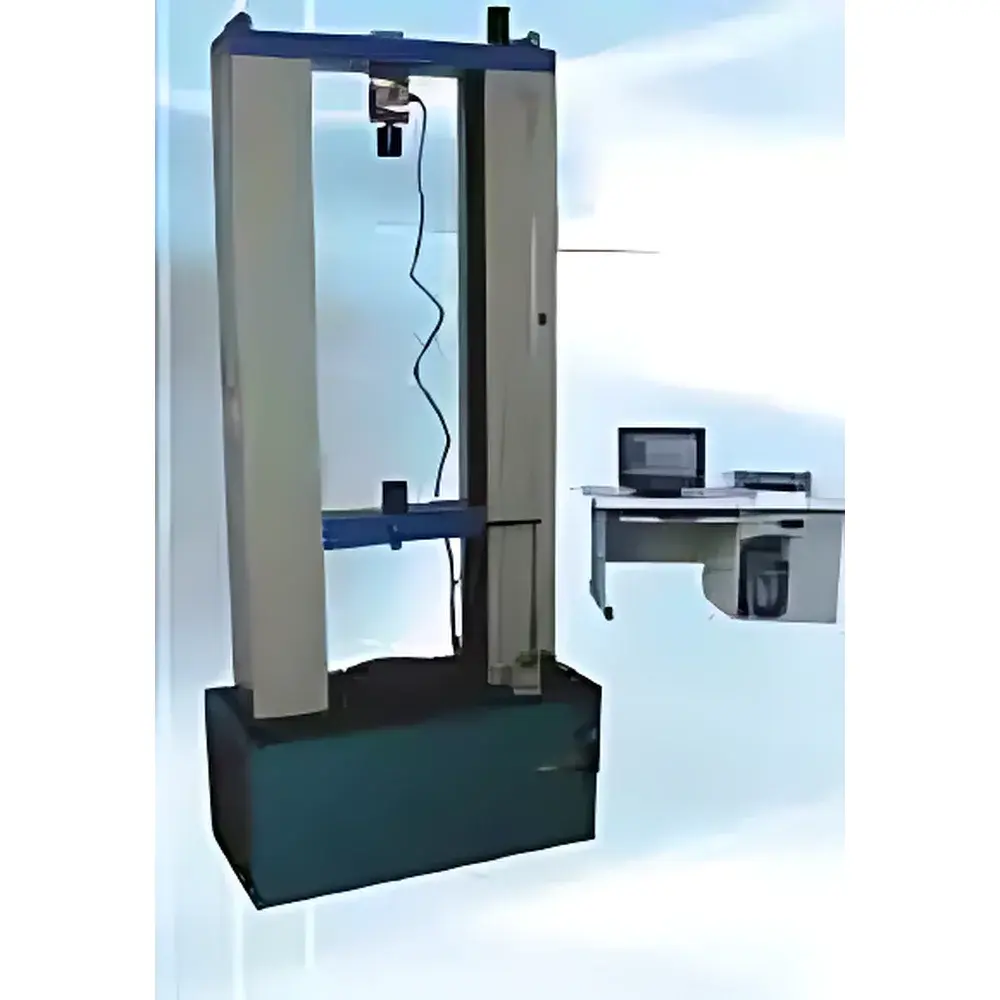
JB-Brookfield JB-119 Advanced Universal Tensile Testing Machine
| Brand | JB Instruments |
|---|---|
| Origin | Taiwan |
| Model | JB-119 |
| Load Capacity | 0–20 kN (user-selectable) |
| Force Accuracy | ±0.5% of full scale |
| Effective Test Width | 380 mm |
| Max. Travel Distance | 1000 mm |
| Test Speed Range | 0.001–500 mm/min (infinitely variable) |
| Displacement Resolution | 1/200,000 |
| Displacement Accuracy | ±0.005% of reading |
| Drive System | Servo motor (Japan-made) + AC motor (Taiwan-made) |
| Load Cell | High-precision strain-gauge transducer (USA-manufactured) |
| Mechanical Transmission | Precision ground ball screw (Taiwan) + high-rigidity zero-backlash lead screw (Korea) |
| Safety Features | Upper/lower mechanical limit switches, emergency stop button |
| Display Interface | Dual-mode — PC-based software + embedded microcomputer display |
| Power Supply | 220 V, 50 Hz |
| Net Weight | 1180 kg |
| Dimensions (W×D×H) | 1280 × 950 × 1800 mm |
| Unit Options | g, kg, N, kN, lbf, ozf |
Overview
The JB-Brookfield JB-119 Advanced Universal Tensile Testing Machine is an electromechanically integrated materials testing system engineered for precision mechanical property evaluation across R&D laboratories, QC departments, and manufacturing facilities. Based on the fundamental principles of uniaxial force-displacement measurement, it applies controlled tensile, compressive, flexural, peel, tear, and shear loads to specimens in accordance with standardized test methods including ASTM D638, ISO 527, ASTM D790, ISO 178, ASTM D903, and ISO 8510. Its modular architecture supports both standalone operation via embedded microcontroller interface and full PC-based control, enabling compliance with GLP and GMP documentation requirements through audit-trail-capable software logging.
Key Features
- High-fidelity load measurement using a certified USA-manufactured strain-gauge load cell, delivering ±0.5% accuracy over the full 0–20 kN range (user-configurable sub-ranges available)
- Dual-drive capability: Japanese servo motor for high-resolution low-speed testing (0.001 mm/min) and Taiwanese AC motor for robust high-speed operation (up to 500 mm/min), ensuring optimal torque delivery across dynamic loading profiles
- Mechanical transmission system combines a precision-ground Taiwanese ball screw with a Korean zero-backlash lead screw assembly, minimizing hysteresis and ensuring long-term repeatability in displacement control
- Integrated dual-display architecture — real-time waveform visualization and parameter monitoring via industrial-grade microcomputer panel, supplemented by comprehensive data acquisition and analysis on Windows-based software platform
- Comprehensive safety suite including hardware-based upper/lower mechanical travel limits, fail-safe emergency stop circuitry compliant with IEC 60204-1, and automatic overload cut-off logic
- True infinite-speed adjustability (0.001–500 mm/min) with programmable ramp-hold-step profiles, supporting quasi-static, creep, stress-relaxation, and cyclic loading protocols
Sample Compatibility & Compliance
The JB-119 accommodates a broad spectrum of specimen geometries and material classes—including metallic alloys, polymer films, elastomeric compounds, textile yarns, composite laminates, adhesive bonds, and electrical insulation components—via interchangeable fixture sets (tensile grips, compression platens, three-point bend fixtures, peel jigs, and shear adapters). All mechanical and electrical subsystems conform to CE marking directives (2006/42/EC Machinery Directive, 2014/30/EU EMC Directive) and meet essential requirements of ISO 7500-1:2018 for static force verification of testing machines. Optional configurations support FDA 21 CFR Part 11-compliant electronic signatures and audit trails when paired with validated software modules.
Software & Data Management
The JB-119 operates with JBTestSuite™ v4.x—a Windows-native application designed for ISO/IEC 17025-aligned data integrity. It provides real-time graphing of stress-strain, load-displacement, and time-dependent curves; automated calculation of modulus, yield strength, elongation at break, Poisson’s ratio, and secant stiffness; batch report generation in PDF/Excel formats with customizable templates; and multi-curve overlay for comparative statistical analysis. Raw data export is supported in CSV and universal .tdms formats. System-level user access controls, electronic signature workflows, and tamper-evident audit logs ensure traceability required under GLP, GMP, and internal quality management systems.
Applications
This universal tester serves as a primary validation tool in diverse industrial sectors: metal stamping and fastener manufacturers rely on its repeatable yield point detection for incoming raw material certification; polymer compounders use its high-resolution displacement tracking to correlate melt index with tensile ductility; medical device OEMs perform peel strength verification on sterile packaging per ASTM F88; aerospace suppliers conduct interlaminar shear testing on carbon fiber prepregs; and footwear labs quantify sole adhesion durability under cyclic delamination protocols. Its adaptability extends to accelerated aging studies where sequential mechanical tests track property degradation after thermal/humidity exposure.
FAQ
What standards does the JB-119 comply with for force calibration?
It meets ISO 7500-1:2018 Class 0.5 accuracy requirements and supports third-party verification using NIST-traceable deadweight or hydraulic calibration systems.
Can the system perform cyclic fatigue testing?
Yes—when equipped with optional closed-loop controller firmware and compatible software license, it supports sinusoidal, triangular, and trapezoidal waveforms up to 5 Hz with programmable mean stress and R-ratio control.
Is test method scripting supported?
JBTestSuite™ includes a built-in macro editor allowing users to define multi-step test sequences—including pre-load conditioning, dwell periods, speed transitions, and conditional branching based on real-time threshold events.
How is data integrity ensured during long-duration tests?
All measurements are timestamped at 100 Hz minimum sampling rate, buffered locally on non-volatile memory, and synchronized with PC storage via redundant USB 2.0 and Ethernet interfaces to prevent loss during power interruption.
What maintenance intervals are recommended for the mechanical drive system?
Ball screw lubrication is specified every 2,000 operational hours; load cell zero-check and system verification are advised quarterly per ISO 17025 internal audit schedules.
Related Products



